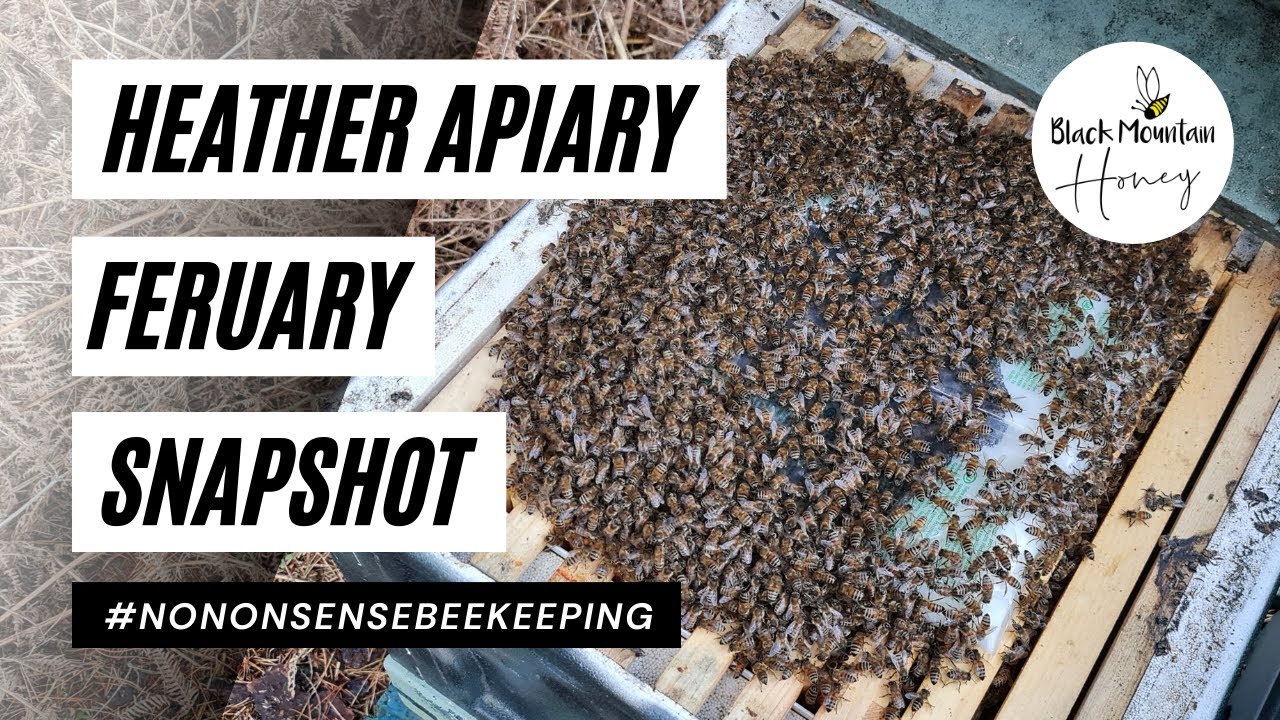
In this No Nonsense Beekeeping episode, Laurence Edwards of Black Mountain Honey conducts a visual winter inspection of the Heather Apiary using a GoPro. He walks through each of the 23 hives, noting colony size (frames covered), cluster shape, weight, and fondant consumption. Edwards assesses which colonies have sufficient food, which need additional fondant slabs, and which appear at risk of loss based on cluster cohesion and activity. He comments on genetic differences observed in darker bees, acknowledges a minor mistake of leaving an Apivar strip in a hive, and explains his decision not to disturb certain colonies. Throughout, he emphasizes the importance of colonies working the fondant (covering 60‑70% of frames) as a health indicator. Edwards concludes with a risk assessment, projecting a potential loss of 1‑2 colonies, plans for spring splits to increase the apiary to about 30 hives, and invites viewers to subscribe.
Chapters
Hi, I'm Lawrence Edwards from Black Mountain Honey. Welcome to another episode of No Nonsense Beekeeping. I've taken to using my GoPro here today because I can't get my truck up here because it is very, very wet. But I'm doing a first inspection of the Heather Apiary bees, just going around checking they've got enough weight, adding fondant if necessary. I promised you I'll give you a snapshot of this apiary, so I'm going to go around again and give you a snapshot of every single hive just to show you inside the colonies and what I'm Not picking out any frames, not doing any inspections, just showing you the shape of the clusters, the size of the colonies.
Really nice looking size colony spread across seven frames, tucking right into that fondant.
Good weight to them. Got at least a couple of weeks before these guys need any more food.
Considerably smaller size colony here over one two three four five six. Still a good size colony though.
What's always nice to see is that they're starting to work into that fondant, so it shows that they're kind of needing that food and they're doing it for a reason. So just place that fondant back over them just so it's in the right place. See these guys in a couple of weeks.
Next hive, probably about average, a lot bigger on one side, so they've pushed that cluster all the way over there. 6 frames on one side, 8 frames on the other side.
Working the fondant really nicely, fondant's in the right place, come back in 2 weeks.
Again, all clustered over one side, clustered up to 7 on that side. They're probably reaching halfway through that fondant, decent amount of weight left in the box, fondant exactly where I want it to be, no action needed here. Now if you remember this colony, this was the big mega monster colony.
So this overwintered on a double brood configuration, it was actually brood and a 14 by 12. As you can see there. Now they are polishing off that fondant. Huge colony here, even in the upturned feeder, lots of bees still up there. They're hefting okay for weight, but what I'm going to do with these ones is I'm going to swap out that fondant and just give them another big slab. Too much of a risk to leave them with that small amount of fondant left. They could polish that off in a couple of days. So give them a nice big slab and that will see these guys through for another couple of weeks. So this is the hive next door, way, way smaller.
If you zoom in, look at the colour of those bees. Very, very different genetics, these bees.
They're a much darker bee, and they probably just don't overwinter in such a big configuration.
If you look at that fondant, you can just about see all the way around there, there's a big hole. So if I was to lift that fondant off, that cluster would come all the way around there.
So I'm not going to do that because I don't want to disrupt them, Doesn't matter if they're looking like this, and if they are, there's nothing you can do. So just make sure they're in contact with the fondant, close them up, come back in a few weeks.
Now these guys look a nice size, not like any of the monster colonies here, but over a good 7 frames. You can see they're just about working that fondant. I'm not going to lift it off again.
Really happy with what I'm seeing so far. The average size is around 6 or 7 frames. They're active, they're on the fondant, They're out flying. Very happy indeed.
So this was the colony that I was a bit worried about, and you can see they have actually taken down a lot of that fondant.
It's considerably smaller than the rest of them though. This is the one that I'm still not 100% sure whether we're going to get them through. I'm not going to remove that fondant because I don't want to do them any unnecessary damage, but yeah, this one's definitely touch and go.
Much smaller colony again, but you can see where they've taken this fondant down around here. The cluster will be all the way out to here. It's small, but it's no by no means a dwindling colony.
You can see there I've made a bit of a schoolboy error, which I'm happy to admit. I've left that apivar in, so naughty naughty should have taken that one out. I'll get it out now while I remember. But yeah, these guys have got enough food.
Hopefully they'll start to rear some brood, get going forward into the season.
Now this is very much a dwindling colony. Remember when I said that the fact that they're not clustering up, they're kind of wandering around with no purpose, they're in a really small area? Don't like the look of this at all. I'm gonna resist the temptation to open up the frames and have a look because there's nothing I can do, but yeah, I'm chalking this one off. I don't think this one's gonna make it through.
Back into a slightly bigger colony here, still much smaller than I'd like to see them up here. But spread over a few more frames. A little bit feisty, these ones. Fondant's in the right place though, so I'm going to close them up. Now that's more like it. Definitely working through that fondant quite quickly though, so these guys here are going to get another slab of fondant put in there.
But this is what we want to see. We want to see them working the fondant. We want to see them covering 60-70% of the frames as a minimum. You can see they've got purpose.
They're clustered up.
They're all doing their job. That's what we want to see. This is a good-looking colony.
Again, nice looking colony here. Not quite as big as the one previously, but you can see they're really powering through that fondant like it's nearly run out.
These definitely need a little top up as well.
Next colony. These guys didn't get any fondant because they were so heavy, and they're still really heavy now.
These were the ones that I was really concerned about with and not happy with them at all.
But they're actually a little bit better than I expected them to be.
I was expecting to open these ones up and them to be dead and nothing there.
They're spread over a few frames. I can see them go down a bit, so we'll just see how these ones go. So I wish they were all like this— really nice gentle bees working through their fondant.
Still got plenty of fondant left, nice big colony, still got some weight to it, active at the front. This is what we want to see.
Now this is really interesting to see, this one. This was by far and away the best performing colony of last year. It was a monster. I'll see if I can dig up the video that goes with it.
This one was full to the brim with bees, and it's a lot smaller now.
And it's obviously just down to the genetics of the bees.
They look healthy, they're in a decent cluster. I'm not going to do anything different. They're touching the fondant, but I was expecting to open this one up and it to be jam-packed still full of bees, and it's only about 50% full.
So nothing wrong with it, just a bit of an observation from me.
Now, I never like it when I crack bees in this weather and they start flying up like this. It always signals to me that Something is wrong. Now it might not be, but I don't like the temperament of these, don't like the fact that they're not clustered with purpose. So we'll see how we go with these. Not going to crack them open, not going to do anything, but don't like the look of these ones.
Back to some more friendly bees now, covering maybe 40-50% of the frames, but these are 14 by 12, so they do go down a long way. Happy with what I'm seeing here, covering the fondant, working away.
I think these guys will be fine.
Now this doesn't look good, but it doesn't mean that these are a complete dead out. You look down into the frames and you can see bees, they go all the way down. This might just be a small colony that's very frugal. It's over 1, 2, 3, 4, 5, 6 frames. They might just be in a bit of a chimney effect over winter.
Not ruling this one out at all. I'll pop that fondant back on them though, just to make sure they've got it where they need it. So these are looking a lot better. I love it when they come up on top of the fondant like that. It shows that they're, they're interested in it and they'll kind of want to get in any which way they can. Obviously the bottom's full and there's not enough space, so they're trying to get in on the top. But yeah, this is what I want my colonies to look like. Got a good few of them up here that are looking like this, but it's a bit of a gamble leaving them up at the heather over the winter, so it does explain why a few of them aren't looking so strong.
Bit of a smaller one again here. You can see they're chewing away on that fondant though, still Still over 6 or 7 frames, got no problem with these bees whatsoever.
And the final colony, nice to finish with a bang. These guys didn't even have any fondant because they had loads of stores left over, absolutely jam-packed. So nice to finish on a real positive.
So there you have it, bit of a mixed bag up here.
It was always going to be a risk leaving them up here at the heather, but I do not judge the colonies until they come out of the winter. You can't tell what's going down in those 14 by 12 boxes. You look at them underneath and there might be a lot more bees in there. I'm not doing that today, but I'm just going to leave them there. Nothing you can do at this time of the year. Come April, May, I will judge this apiary and see how well they've done. But some of the colonies there look incredible, some of them really don't look so good, and it looks like we've lost one or two as well. Like I said in the first video, if I can lose and limit the losses here to 3 colonies out of 23 that have gone into winter, I'll be very happy with that. Looking at it today, I think I'll probably reevaluate that down to 18 or 19. But the guys up here, I'm going to leave them up here. I'm going to do my splits. I'll probably get them up to about 30 by the time we get to the heather, and that's what I'm aiming for. I hope you enjoyed getting inside those colonies and seeing what they're looking like at this time of year. It's the 21st of February here today. We are well and truly still in winter, so give it another 4 to 6 weeks and we'll come back and we'll do this again. So as always, I hope you enjoyed the video. Please hit the subscribe button, please hit the bell so you're notified of every video.