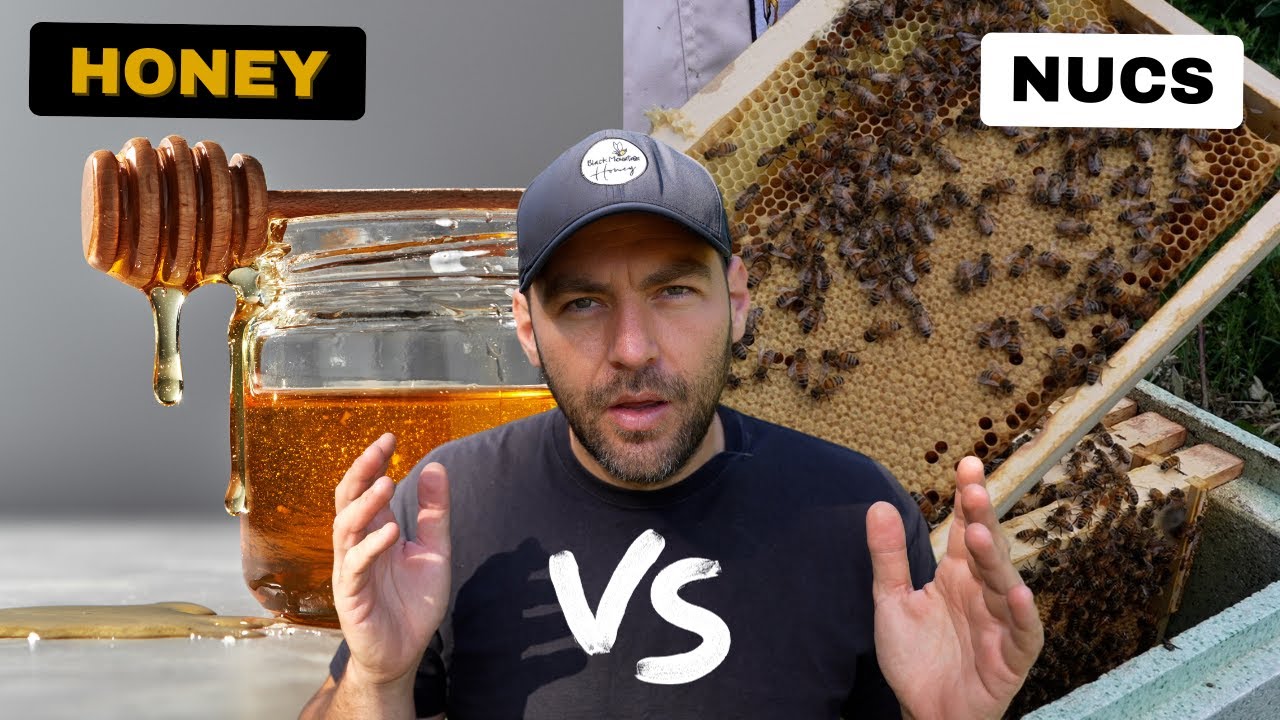
In this interview, host Laurence Edwards talks with professional bee farmer Richard about why and how he runs two completely separate apiaries—one dedicated to honey production and another to queen breeding and nucleus (nuc) creation. Richard explains that segregation prevents disease spread, simplifies logistics, and allows focused swarm‑management tactics without compromising honey yields. He discusses his practical approaches to swarm control, including queen clipping, cutting back swarm cells, and handling escaped queens, acknowledging that complete prevention is impossible. The conversation covers how he deals with drone‑layer colonies by melting down brood and rehiving nucs, and his overall low overwinter loss rate (~4%). Richard outlines his seasonal nuc‑building workflow: starting in spring with brood‑only hives, using full‑size polyhives for splits, and expanding the nuc yard throughout the year. For hobbyist beekeepers, he advises maintaining at least two (preferably three) colonies, timing splits in late May–early June, and optionally merging nucs back into the honey hive before winter to improve overwintering strength and allow selective breeding. The interview blends operational insights for large‑scale producers with actionable tips for backyard beekeepers seeking to balance honey harvest and queen rearing.
Chapters
Richard is a professional bee farmer. He manages bees for honey and he manages bees for nucs. In this video, we're going to talk about the interaction between the two and how to get the very best out of your bees. Right, so tell me a little bit about your operation, Richard, the honey side and the nuc side.
So I do, I do have two basically separate operations. So I have one to breed queens, produce nucs, and then the other one is just a honey-producing setup. Now the honey-producing setup I keep totally separate for a lot of reasons. But to me, as soon as you're putting supers on a box and then you obviously extract and you put back, with my setup, I can't put them all back on the same hive. So there is the risk to spread whatever around them particular hives. So over the years, I've sort of channeled off the nuc side of it. And so now I run sites either for honey production or for nuc production or queens. And actually, when you go to a site and you've got both, It really is a pain because you usually spend a lot more time in the nucs because you're keener to see where they're at. And then you'll say all of a sudden you're wanting a super to go on a hive that you've got there. Well, if your vehicle is not bee tight, by the time you go to get that super, the whole apiary has visited it. Now, and that is one of the main reasons why I either run one or the other.
So it's interesting the way you split it. And obviously I know that you split them like that, but for people at home who have got like a beehive in their garden, We'll cover this a little bit later in the video in terms of how you can merge those 2 different and distinct areas of beekeeping together to give you the best of both. Like, nuc production and honey production really do go hand in hand. Richard keeps them separate for very, very good reasons. And like, going on my DASH training course, one of the things that you learn is you need to segregate everything as much as you possibly can. Richard does that in an operational level, but he also does it on an apiary level as well. And he even goes down a little step further and does it on a beehive level. So Richard isn't going into his honey production colonies and taking some frames of brood out and putting them into a nuc and making up a nuc and giving it a cell and knocking back his honey production colonies so that they don't swarm. He's leaving all of the bees there using different forms of swarm management that we'll cover in a little bit to maximize his honey crop whilst keeping that kind of protective barrier around his honey production colonies and focusing on his nucs Elsewhere. So for your honey production colonies then, how do you stop them swarming, and is stopping them swarming important?
I laugh really, because to actually stop a hive swarming is probably impossible, totally. Now prevention, there is certain things you can do by either increasing the brood nest, by clipping, by just going through cutting themselves, but I would say most methods, most years, some will be successful, Some will fail. And I think it's just accepting what we are working with. We are working with a very natural bee that's been around a lot longer than us. So its main aim is to reproduce. Now you can work with nature or you can fight it. The people that fight it spend all day fighting it and actually don't do any work.
So I—
So, right, let's have an example then. You go down to Hereford in the morning, you come to the first colony, you open it up, there's 20 swarm cells, colony's packed, the queen's still there. What'd you do?
I mean, if the queen's clipped, I would cut back the cells. And then I'd visit them within 10 days. Sometimes the queen will be out under the pallet or on the floor in the grass, at which point if you can find her, then kill her and then leave a cell. And generally that is enough actually to get you through the season. And you've got a young queen for the next year.
It's an interesting way of doing it, isn't it? I would never think of that, that you've got a perfectly good mated queen in hand and you just think, right, I'm going to kill that because I've got a cell. But in a big scale, that's actually a really kind of effective way of doing it, isn't it? Because you're knocking the colony back a little bit, you're knocking the cells down to one, so they're not going to chuck out cast swarms. You get a nice young queen towards the end of the year, and you still keep all of the bees to get you your honey, which for you in a honey production apiary, a honey production colony, that's what you're trying to do, isn't it?
Yeah, yeah.
And you've also got the best start you can for the year after in terms of that young mated queen. The only thing that I'm not very good at actually is going back around and making sure they're mated. Because I usually put a mark on the hive to say that that doesn't need looking at for 2 months. And when you go back, if that's a drone layer, it's usually throw it out and start again, which is good in terms of biosecurity.
It's a lot of work.
So we've covered this on a previous video. You go back in, what would you do if you went back and you found a drone layer?
I would shake everything out, take that brood box back, melt it down, and then I would just rehive a nuc if the numbers needed to be at that site that year, or I'd just make it up the next year. I tend to work the spring with a certain number, and by the autumn I've probably got a lot less, but then my overwinter losses are probably only about 4%.
That's good.
It's a really important one to note there, and something that I would have been so guilty of previously, which is you go into a colony, say big colony, maybe full of 6, 7 frames of bees, you pull out the first frame, it's all drone brood, you pull out the second frame, it's all drone brood. My immediate thought at that point would be, right, let's find this queen, we'll kill the queen, we'll introduce a new queen into it, And we'll see if we can get that colony back up again. And that never comes into your thinking, does it? It's just immediately—
Because it is a big operation, you literally have to go to a site and that decision has to be made on that day because the following day you've got the next 40 to go to and the following day after that you've got the next 40 to go to. And there is no window of opportunity just to go back. It's not fuel efficient to visit individual hives before that 8-day, 10-day interval which you've set out. At the start of the year, really.
So you mentioned earlier in that as well, clipping queens. Are you a fan of clipping queens?
Not really, no, no. I hate the way that they end up under the row of floor in the pallet, but it is a very effective way of stopping your honey crop flying over the hedge.
That's the reason I'm a real big fan of them, but my operation's completely different. All of my apiaries are really close to home. I know that if I go and do my regular inspections, I'll always catch either the swarm or I'll catch the clipped queen underneath the varroa board. But yeah, like you say, if you're miles away and you can't get down there, it potentially does more damage than it saves. Right, so going back to making up your nucs then, so you have completely separate nuc yards. So talk to me just through how you kind of build up your colonies throughout the year in terms of like producing nucs in the summer and the spring.
So we start off in the spring, there might be 30 hives or 20 hives in that apiary, and I would only ever give them Brood frames. So that is the start then to splitting.
So you got like, got them on a 6-frame, what, you, you add like an extender on top?
Yeah, no, I, I mean, I, I'm, I think I would put them all in, in polyhives if I could, and then sort of at about a double sort of polyhive or wooden hive level, they'd be easier to manage.
Okay, so you, you, you're actually putting them into full-size hives, not for honey production, but you just want the extra space?
Yeah, so, so you can keep pulling the, the 4 frames for a split out, and you can keep putting your wax back in. You can run your feeder on top. There's no chance of contamination between feed and honey because I'm never ever going to take honey from this. This is just literally to produce bees. And then obviously you've got your cell-building hives, which you do a little bit different. And by the end of the year, you end up with a yard that's probably just a headache.
Yeah, we look at it now, it's definitely not a headache. Like, I'm looking around here, loads of nucs, really nice, calm, friendly, gentle nucs. That you can buy at blackmountainhoney.co.uk. So let's say you just had a couple of hives in your garden, you weren't a professional bee farmer, you just wanted to manage your bees to get some honey, and you maybe wanted to do some splits as well. Like, would you have a system or some advice for my viewers in terms of like, how would you manage both of those in your back garden if you just had a couple of colonies?
I think that is, is the thing. You definitely need 2 colonies, if not 3, and that just gives you the chance To, i.e., put colonies right through your own methods, whatever that is. It's not impossible to do small-scale queen rearing. It's not impossible to do your own splits, but you just need to follow a process that works for you. And not only that, everywhere, no matter where you are in the country, everywhere is different. So you might say to your friend, he does this, you know, he'll give you the advice, you follow it, and it might not work for you. Sometimes it is a case of finding out what's good for your area. Understanding at what point in the season to do that. I would say a small-scale person wants to do it at the end of May, beginning of June, and then you've got all season then to see what your success is, and then go into winter with it, with a very strong colony of bees, which is basically what we work for, is the healthiest colonies you can put into winter. The success then is next spring, which is that year then you'll, you'll produce a good honey crop off them.
So I think that's really good advice, and the way that I used to manage some of my colonies was I'd build them up, Get them nice and strong in a single brood box, maybe up to 10 or 11 frames in a brood box. And you get into like the middle of May, and in the middle of May I'd take a nuc, and I would take a really, really small nuc out, either 1 frame of brood and a frame of stores, or 2 frames of brood and a frame of stores. And I would leave the colony behind, and I would leave them to go queenless at that point. 8 days for the main colony, and then either knock down all of the cells, or knock down all of the cells and leave 1 cell for them to use to create themselves a new queen. What you can do is that if they don't create themselves a new queen or they create a dud queen, at that point you can either take the nuc or the queen from the nuc and introduce it back in, or you can buy yourself a mated queen and add it in. And then ultimately then you end up with 2 colonies, your original colony and the split that you've made. Now the problem with that is that if you do that year after year, you end up with loads of colonies. But what a lot of people don't realize is what you can do is just at the end of the year, just merge them back together again. You get great overwintering success by doing that, and you'd be able to build in a little bit of selection as well. So you can say, right, I've got one colony here with a mated queen that's doing well, let's give that one an 8 out of 10. And then I've got a nuc that's looking all right, I'll probably get it through, not too keen on the pattern, and maybe they're a little bit more angry, so I'll kill that queen, merge the 2 together. You've done like a little bit of selection, and then you end up with a really strong colony going into winter. The benefit of that system there is that you've keeping the majority of the bees in your honey production hive, you should still get a really substantial crop. And if you've got good strong bees that are prolific, you can do that a number of times throughout the season without making too much of a dent in your overall honey crop. So there we go, we've had a little bit of a discussion there about how to manage colonies for honey, managing your nucleus colonies, and how they interact with one another.