How Much To Feed Bees - Feeding Colonies to Weight - Feeding Bees to Weight - How To Weigh Bees
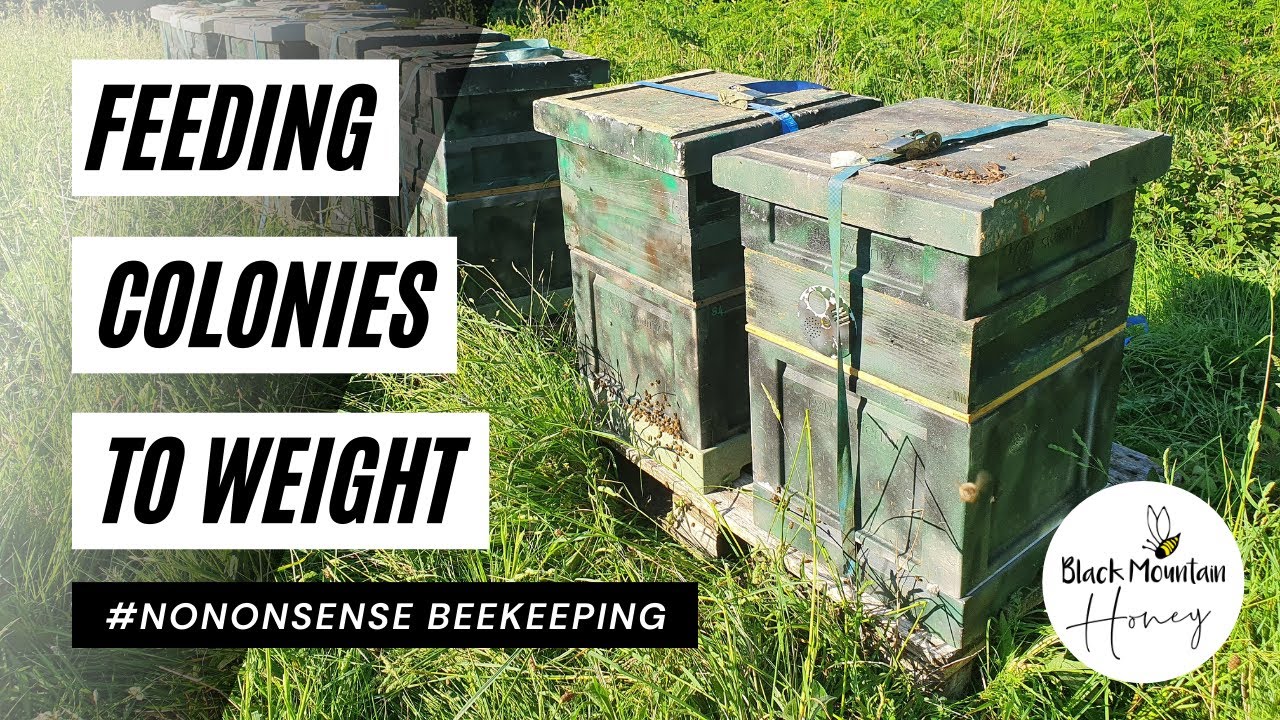
Laurence Edwards explains how to feed bee colonies for winter survival using different syrups by season: 1:1 in spring, 2:1 in early winter, and invert feeds for the final feed. He shows how to weigh hives to set target stores (40 kg for a wooden 14x12 box, 35 kg for poly, 20 kg for standard national) and demonstrates two weighing methods: lifting the whole hive or using a quick side-lift estimate.
Chapters
Hi, I'm Laurence Edwards from Black Mountain Honey. Welcome to another episode of No Nonsense Beekeeping. Today I'm going to talk to you about feeding your colonies to get them up to weight for winter. So we're going to cover a few kind of semi-topics in this video. We're going to talk about what to feed your colonies and what I'm feeding my colonies at this time of the year. We're going to talk about the different formats and sizes of hives and the weights that you're looking to achieve, and then we're going to look at how you kind of get your colonies up to weight and how you measure that your colonies are up to weight. So we've discussed this in a previous video, we talked about the differences between kind of 1:1 sugar syrup mix, 2:1 sugar syrup mix, and Api-Invert or Api-Mix or any of the other inverted sugar syrups that are on the market. and when we use them throughout the season, or when we use them here at Black Mountain Honey. And just to summarize, what we're going to do is early spring feeding for kind of brood rearing, colony expansion. We're going to use 1:1 sugar syrup that we make ourselves out of granulated sugar. Early feeding in winter to boost colony size and boost the number of bees and also the brood, we're going to mix up our own 2:1 sugar syrup mix using granulated sugar. And then the final feed of the season, we're going to use an Api-Mix or an Api-Invert or any of the invert sugar syrups that are on the market. And we've kind of covered the reasons why we're doing that in the previous video, but just to summarize, we've got the correct moisture content, we've got the correct specific gravity of the sugar, there's the added nutrients and vitamins that aren't present in the sugar syrup that are good for overwintering the bees on, and then we don't have any issues with fermentation and And they don't need to wax over all of the storage. It can sit in the frames without any wax cappings. So they're the reasons that I'm moving over to kind of an appy mix for the last feed of the season. I'll pop a link up to the previous video that just discusses the differences between appy mix and then the sugar syrup. So overwintering your bees is really, really difficult. It's one of those things that it's quite easy to overwinter your bees, But to get them through perfectly on the perfect amount of sugar syrup is difficult, and it's difficult because it's a real fine balance to achieve. Worst case scenario is your bees starve. That is the most gutting and heart-wrenching way for your colony to die over winter. If they get dysentery or they get a disease or it's isolation starving, you can kind of say, okay, it didn't go to plan this time, but it wasn't my fault. If they starve because they've not got enough food in there, either because you've not fed them enough or you've not left them enough honey, it's kind of on you as a beekeeper. So you want to kind of minimize that as best as possible by giving them feed. The best case scenario is getting them through winter successfully so they're healthy coming out of the new year with as minimal feed as you possibly can. That's the best case scenario. And then the kind of middling case scenario where I think the majority of people end up Definitely where I tend to end up, is you get them through the winter and they've got quite a lot of excess feed left over. Now for us at Black Mountain Honey, it's not the end of the world because we make up loads of nucs and we can reuse all of those frames of stores and syrup, and we send them out with the nucs so that the nucs have a couple of frames of stores and then 4 frames of brood. So it's not the end of the world for us, but when you're managing it and you have it in all of your production colonies, it can be a real, real nuisance. So what you're trying to do is you're trying to get your colonies up to the optimum weight, and that optimum weight is dependent on the type of hive that you're in, the material of the hive that you're in, the location you are in the country, location you are in the world. It's really dependent on a lot of factors, so it's difficult for me to say in this video, get your colonies up to 50 kilos, because I don't know if they're wood, I don't know if they're national 14 by 12, Langstroth. I don't know if you have early season flows, late season flows. I'm not sure when you're feeding. There's so many variables that come into place. So what I'm going to do in this video is try and give you the information to kind of establish that for yourself as to what you need to be looking into, what you— what factors you need to take into consideration, when you should be feeding, what you should be feeding, and some of the weights that you should be looking to achieve. So now I appreciate this This isn't for everyone, but this is the way that I weigh my hives. And the reason I say it's not for everyone is that it's a bit heavy, but it gives you the most accurate way of measuring your hives. It's really, really accurate. And what I use is one of these. It's like a hand luggage scale. So you get these kind of— I mean, these are the ones that come at the airport. They weigh up to 50 kilos, so you can just lift them up. They're really, really accurate. You don't need to be overly accurate when you're doing this for beekeeping. You need it kind of within maybe like a couple of kilos, but these are accurate down to like a few, few grams. But these are great, and these will give you a very accurate reading of your whole colony. So you're not just weighing your stores, you're weighing your stores, your brood box, your frames, your bees, and you need to take into account all of those. So the first thing I'm going to show you how to do is just how to weigh Brood box. So I just turn my luggage scales on like that. Turn the luggage scales on, they come with a little hook, and then you're just going to hang the hive in there. So what you need to do first is you need to weigh an empty hive. So do this at the beginning of the season, do it when you buy a hive, or you can get some kind of rough idea of this from the internet. What I've got here is one of our pretty much standard floors, A 14 by 12 brood box, all of the frames in, drawn out, a feeder and a roof and a strap. Then all I do is I lift that up and I'll look at the weight. Now then, what you need to do is you need to add on a little bit of weight for your bees. So I think kind of like a good estimate in a colony this size is maybe 5 pounds of bees, so like 2 or 3 kilos. So I'm going to round that up and I'm going to say the colony with the frames, with the boxes, with the roof, with the strap is 16 kilos. Now then you need to establish how much feed you want to add into your colony, and again that is completely dependent on so many different factors: your frame sizes, how prolific your colonies are, If they're on double brood, you need to just take all of that into account and try and work it out as best as you possibly can for your own circumstances. So for me, we assume that there's 10 frames in the brood box for the 14 by 12. The 14 by 12 frames will take maybe kind of 6.5, 7 pounds. And if I want them completely full, you're talking about kind of 70 pounds. Now that is a little bit too much, I found in previous years. So you might want to kind of simplify it. On a national brood box, if you've got 10 frames and you're saying that they're £5 per frame, you're talking about £50. I think it was Ted Hooper who said for a standard national hive, you're looking at about £40 to £45 worth of stores. So I would go with somewhere kind of around there. I like to work in kilos, so I think for a national standard, you're looking at about 20 kilograms of stores to get the bees through. In a 14 by 12, I like to up that a little bit, and I like to go up to about 25 kilograms of stores. So if I take my 25 kilograms of stores and then I add that into the, the weight of the hive and the weight of the bees, it takes me to around 40 kilograms. And I know that's not an exact science at all, and the numbers are rounded up and rounded down there, but it's a nice easy number for me to remember. So 40 kilograms For a 14x12 hive. If you're doing this on a kind of poly national, I'd go with about 35 kilograms. It's not that much difference, but you do want to add a kind of a little bit more onto a 14x12. The final thing to say is make sure you don't underfeed. Just get them up to that weight and make sure that you get them up to that weight as they go into cluster. Don't get them up to that weight in the middle of August and say, right, I've got my colonies up to weight, I can just leave them now until March. because they will turn those bees into brood. This is late, late winter feeding, do you know what I mean? We're not feeding in November, December, although you can feed that late, but you just need to make sure that you're feeding once the bees have really kind of like ramped down for winter. You're feeding to store energy through the winter to get them through them cold months and get them into the new year. You're not feeding them at this time of the year them to rear brood. So this is a really, really useful tool. I recommend anybody kind of who wants to weigh hives to get one of these. They're cheap, they're like a fiver, and they give you a really, really accurate reading as to how much weight is in your colony. Then you just need to do a bit of simple maths to work out how much stores that colony needs. Always good to work on the basis if the colony is full, but if the colony isn't full, obviously don't go filling Do you know what I mean? A colony that's only over 5 frames with 10 frames full of feed, it's just a complete waste. What you're much better off doing there is either taking that colony, putting it in a nuc, and then feeding it up as a nuc, or putting in a dummied insulation board that we'll do in a separate video, and then just taking out the weight of those 5 frames. So, do you know what I mean? If it's 5 pounds a frame, 25 pounds, take out 12.5 kilos of weight. And then you'll get them to your optimum weight. It goes back to what I was saying before though, it makes so much sense to standardise all of your equipment across all of your apiaries. I mean, this here is our standard. We have a floor, 14 by 12 brood box, feeder, and a roof, and that is the same on all of the colonies everywhere across all of my apiaries. So I know that they're roughly kind of 15, 16 kilos each, And I can just go around, feed them up, let the bees take it down, go back, check. Yep, 40 kilos, they're good for winter. It makes it so much easier. If I have to go around to each one, weigh it before with the bees in, and then feed the colony, and then go back and weigh it again and take the kind of the minus one away from the other, it turns into a really long, arduous process. So much easier just to standardize all of your equipment across all of your apiaries. Work out what your standard colony weight is, plus the frames, plus all of the boxes. And then all it is then is a simple workout. What that number is for you. For me, it's 40 kilos. For you, it might be 35 kilos, or if you're on double brood, it might be more than that. And then you just go around one by one, weigh them, feed them, weigh them again, and then you're good to go. So the final thing I want to say about timing of these before we kind of go in and weigh a couple of the colonies is get the timing right. We're in a really strange patch this time of the year in North Wales, and we kind of get to this patch every year where it is back end of September. So I think it's 27th of September today, it's about 12 degrees, and you'll see that there's very, very limited bee activity here today. It's lovely and sunny, the ivy is out and flowering, but it's just probably not yielding a huge amount of nectar at the moment. Because it's so cold, and even if it is yielding the nectar, the honeybees just, they just can't get out to it. It's too cold. Tomorrow is forecast 17 degrees here, and then the next day is forecast 16 degrees. So these colonies are going to put on weight over the next 2 days, guaranteed. I'm going to do a separate video showing that because I know that they're going to go crazy for this ivy, the nectar and the pollen, over the next couple of days. So I'll do a video showing how much they can potentially put on over those next 2 But just, I'm just saying to you, make sure that you get the timing right. Don't leave it too late in the season because then they might not take the syrup down. Although I found with the Api-Mix and the invert, they will take it down really, really late into the season, like kind of into November, December. They will still take that syrup down. It's quite remarkable. But don't do it too early. Don't kind of do it too early, wash your hands of it and say, right, my colonies are fed for winter. It really doesn't work like that. If there's pollen available and if there's warmth available, colonies will just keep on expanding. And you see this from the difference between the colonies that we take to the heather and the colonies that we don't take to the heather. The ones at the heather are massive in comparison to the ones that we don't take there, and that's because of the kind of the forage availability for them. There's a flow-on, they know there's a flow-on, so they expand accordingly. With the other ones, they just ramp down way earlier. So get that timing right. For us, we're just going to wait and see what happens over the next 3 days. Like I say, it's 12 degrees and sunny today, and there is barely any activity, maybe kind of like 1 or 2 bees every 10 seconds, not a huge amount. They're coming back laden with pollen, which is really good. Want them to pack the pollen in this time of year to give them that protein over winter. Next 2 days I've got 17 and 16 degrees. I'm guaranteed pollen, I'm guaranteed nectar. We'll do some weight tests, we'll do some shake tests and show you what's coming in over the next 2 days. And then I'm forecast 3 weeks of rain and it's not getting above 10 degrees. So from that Wednesday onwards, I'm coming in and I'm going to feed all my colonies up. I'm drawing a line in the sand and I'm saying the season is over. I need to get the colonies up to weight because they're not going to be able to get out again and forage. Now that's going to be completely dependent on where you are in the country. The further south you are, the easier it's going to be for them to get out and forage on that ivy. So you almost want to time your late season feeding to coincide with when the ivy flow is definitely finished. And you can see that from the plants. I mean, once you stop seeing bees or any insects on the ivy on nice warm days, it's pretty safe to say that that kind of nectar flow is gone. They'll still maybe reach it and visit it and go and get some pollen, but they're not going to get any weight Added onto their hives, and then you're safe to go out and start feeding your colonies. Right, so this is the colony I'm going to show you here. I'm just going to show you how I weigh them. I'm going to show you a little bit of the math that's involved, and then I'm going to show you how I feed the colonies. So first thing you want to do if you haven't got a strap, just get a ratchet strap or any kind of strap. Make sure it's a strong one though. Last thing you want to do is lift up a ratchet strap that's kind of rotten or broken, lift it up and everything breaks. So make sure you've got really, really good quality ratchet straps. And then you want to get your hand luggage weigher and just kind of wrap it around like that. And then you want to lift up your colony and you can use your other hand just to kind of guide it so it's not shaking all over the place. Try not to take any weight with your other hand though. Right, so I just want to get out of the way of the bees there. Obviously they're kind of, I mean, active colony there. They're out foraging. I weighed them there and they were 21 kilos. So you take away the weight of the hive that we weighed, plus our kind of estimate of the colony of bees in terms of their weight. So we've got 21 kilo hive minus the 16 kilos, that colony there has got 5 kilograms of stores. We're looking to get that colony up to about 25 kilograms of stores. So as you can see, this colony is massively light, it's not prepared to go into winter. I think this colony, if left as it is, would starve over winter. So as I said before, we've probably got a few more days for the bees to get out and do some foraging. They're going to go out, they're going to bring back the ivy nectar, they're going to pack it full of pollen that obviously doesn't weigh that much. I reckon this colony though, if we're lucky, will pack on another 5 kilos over the next 2 to 3 days. That's probably a bit optimistic, but all it goes to say is don't do the weighing before you're kind of ready to feed and before that ivy flow has finished. Summarize again, we weighed the standard one, it weighs 16 kilograms once we put in the estimate for what the bees weigh. We've weighed this one, which is exactly the same in terms of frame composition, hive composition, hive material, all that good stuff, and we've worked out that we have 5 kilograms of stores in this hive, so 12 pounds of stores. We're trying to get that up to 25 kilos, so we need to add 20 kilograms of stores to this colony. Now, the best way to add a lot of feed into your colonies is to use a huge feeder. Now, you know, I've got big feeders here. We use an Ashforth-style feeder, so we use the Swienti one. Takes 14 litres of feed, and the specific gravity of the feed's around 1.4, so it's probably kind of around 18 kilograms of feed if you absolutely kind of top out the feeders. So that's what I'm going to do with this colony. I'm going to give it a few days I'm going to see what they bring in through the ivy flow, and then I'm going to stick my syrup into these colonies and get them up to weight. So I've got hundreds of colonies to do. For the purpose of this video though, I'm just going to feed these guys early just to show you kind of how I get that syrup into them, how we get them up to weight, just for kind of like the fullness of the video. So we take a big bucket of syrup feed, taking that straight out of that Apimix IBC, which you've seen on a previous video. You open up the feeder, and we leave our feeders on the whole time because it makes feeding so much easier. Syrup looks remarkably like honey, and it's not, and it doesn't taste as nice as honey. And then we just dump it in. Nice thick syrup this time of the season. Make sure you don't get any spills anywhere around the hive. Really easy to attract robbing bees and wasps at this time of the season. Just get your syrup in, get the lid on straight away, you'll be good to go. So a bit of a close-up there, you can see that's a huge amount of syrup to go in there, and that's what you're looking for. You want a huge Inburst of syrup, because then all they're going to do is they're going to take that down and they're going to store it. So I'm just going to get the lid on now just so we don't get any robbers coming in. So like I said, you want a big, huge amount of syrup this time of the year. You're not looking to trickle feed, you're not looking to simulate a flow, you're not looking to get them to rear any brood. You're looking to get them to take that syrup, bring it down and store it. That's all you're looking for, to bring them up to weight. So it's very, very different from early kind of autumn feeding or late summer feeding, where you're looking to trickle it, you're looking to do it slowly, look to build your colonies up if they need it. It's late summer feeding now, early autumn, and you're looking to build weight within your colonies. So you want big feeders, get them to draw it down straight away. Now it's going to be a little bit difficult to do this. I'll try and do it as best as I possibly can, but I just want to show you how much weight has gone into that colony. Ideally, you wait for the bees to take this down and then you weigh them afterwards. But I just want to show you how much weight this should weigh now. I want to show you how difficult it is to lift it up as well. So you see it there, don't you? You don't need to lift it up and kind of dangle it a meter off the ground. You need it a millimeter off the ground. As soon as it stops rising, you're lifting it up, the weight's going up and up and up. As soon as that stops, it's just off the ground. That gives you your weight. So we've taken that one up there to 33 kilograms. Now the bees will bring that down. There shouldn't be a massive reduction in terms of what I put in the feeder versus what ends up in the frames. Now with sugar syrup, with 2:1, you do get a bit of fanning. So if you put 10 kilograms in the feeder, you might get 9 kilograms in the, in the frames. They lose a little bit, it seems, whereas on the invert they don't lose anywhere near as much. So we've got 33 kilograms there with a target weight of 40 kilograms. So we'd come back here and we'd make sure, do a late season check and just get them all round. So what we do with our late season feeding is we go round, we check the colony's weight, we top them up if necessary. Generally we fill the feeders, let them bring that down kind of over like a week or so. And then we go back around and then we top them up again. And it's at that point where you need to be a little bit more kind of specific and a little bit more careful in terms of how much you're putting in. So we might go back to this colony kind of next week, for example. They've put on 2 or 3 kilos from the IV. We've got them up to 36 kilos. We weigh them, 36 kilos. And then what I would do to get them up to 40 kilos, I'd give them maybe a 2 kilogram buffer. I'd add 6 kilograms of feed, and then I'm relatively confident I'm up to weight. You can go around and do a final check if you wish, but then you're getting into the period where you're kind of trickle feeding, and that's not really what you want to do. You ideally want to kind of get them, hit them once, get them up to weight. If you go a little bit over, that's not the end of the world. Just get them up to the correct weight and leave them, and then you've got a really good chance of getting your bees through the winter. So the final thing I kind of want to show you is a little different method for weighing your colonies. So I appreciate, I mean, that's pretty difficult for me. It's definitely not very good for my back. I try and kind of keep the best posture at times, and it is difficult doing it on camera like that to show you how I'm doing it. I just want to show you a slightly different method for doing it. It's not as accurate, but it means that you don't need to lift the colony off the floor. So it's a bit of a beekeeping hack for anyone who doesn't like lifting Heavy things. So we know that colony there weighs 33 kilograms. I'm going to show you a quick way of doing it so you don't need to lift it off. And the way to do that is, on the original one, I lift it from the middle. On this hack, I lift it from the side. And all I'm doing on the side is I want to just lift it up just to get the side off the ground. I've still got one edge, one corner on the floor, And I'm going to repeat that on the other side. So that gives me a reading there of 21 kilograms. Now when I lift it from the other side, I get 21 kilograms as well. So if I add those two up, I get 42 kilograms. So the calculation that you're looking for there is that you want three quarters of the combined weight of the two. So took a measurement on that side; it was 21 kilograms. Took a measurement on that side; it was 21 kilograms. My total weight is 42 kilograms. Now I know that that colony weighs 33 kilograms. So the calculation, and like I say, is nowhere near as accurate as actually lifting it. is that you want 3/4 of the combined weight of both sides. So doing that calculation there, it probably gives you around 31 kilograms. So it does slightly underweigh it, and it does change slightly depending on the straps that you use and depending on kind of how much weight you take on and take off. But it's a good rough estimate, and it means that you don't need to lift the whole hive off the floor. So just to summarize it again, take one on that side, 20 kilograms, 21 kilograms, Take one on that side, 21 kilograms. Add them together, 42 kilograms, and you're looking for 75% or three-quarters of that overall weight. Should give you a rough indication of what the overall weight of the hive actually is. So I'll come back here in a few days. I'll do some more checks, but that's pretty much the end of this video. I just wanted to give you a bit of advice and a bit guidance of getting your colonies up to weight for winter. Make sure you do it at the right times. Make sure you're using the correct syrups. I'm moving over to an invert syrup for these late feeds. Make sure you don't do it too early. Make sure the ivy flow has finished. Make sure you err on the side of caution. If you need to put a little bit more syrup in, that's much better than trying to kind of like be a bit penny-pinching and put not enough in. And just keep on monitoring your colonies. Don't think that once you get to October and you've weighed your colonies that your bees are done until March. That's how a lot of kind of colonies starve out. You can regularly come back, you can regularly weigh them, you've got the weight of the hive and the frames and the bees, you've got the weight of the colony as it starts out, you could chart graphs if you want to do anything like that, but you should have a kind of rough estimation of how much stores is in there at all times. And then if you need to feed fondant as an emergency feed, I'll do that as a separate video. It's a really good insurance policy keeping some fondant at hand. Because the bees will make use of a lot of fondant. We feed big 12.5 kilo slabs here at Black Mountain Honey, and if we find some colonies are really prolific and just get through their feed too quickly, we'll give them a slab of fondant in the middle of winter. So thanks for watching the video as always. Hope you've enjoyed this one. Please hit the subscribe button, please hit the bell so you're notified of every video, and I'll see you next time.










