How To Apply Thymovar Properly - Timing Is Everything
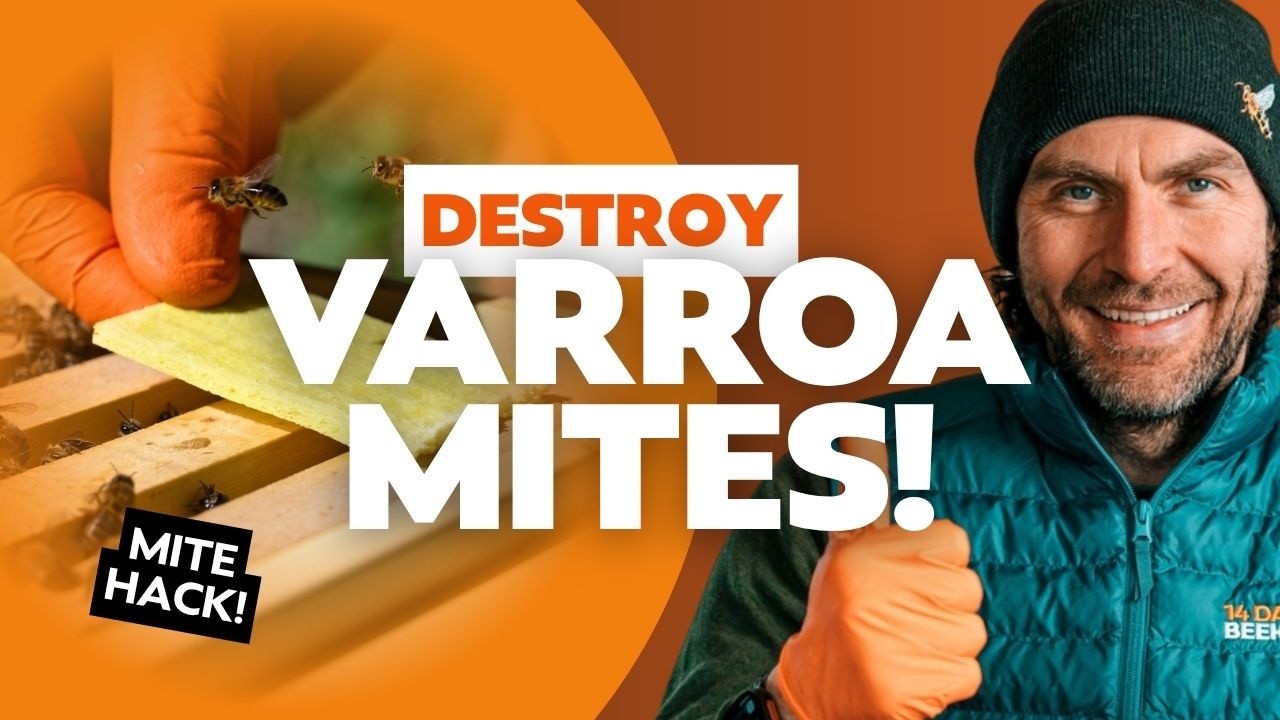
Laurence Edwards demonstrates how to apply Thymovar, a thymol-based varroa treatment, using half-strips placed in colonies for 3-4 weeks. The key constraint: it only works in a narrow temperature window of 20-25°C. He rotates Thymovar with other treatments like Apivar and Apibioxal to prevent mite resistance.
Chapters
Hi, I'm Laurence Edwards from Black Mountain Honey. Welcome to another episode of No Nonsense Beekeeping. Today I'm going to review a new thymol-based varroa product called Thymovar. So I was approached by the makers of this called Andamat, they produce loads of different beekeeping products and they've supplied this to me free of charge. Just to give you an honest review of this product. So I'm not paid for the review, but the product has been provided free of charge by Andermatt just for me to kind of give you my take on what the product's like. So a little bit of background about what the product is. Varroa is a big issue in the UK and across the world. Colonies really struggle with it, and I know that there's people out there who go treatment-free, but I think they have to go through a really, really long, difficult process to get to a point where their bees can cope with varroa. I'm definitely not one of those beekeepers, and like a number of us, we treat religiously. So you can either test your colonies for mites, or you can just treat religiously. What we have at Black Mountain Honey, and what most bee farmers have, is what's called an integrated pest management plan, and that means that you're not using the same product year in, year out, or month in, month out. You don't want the mites to build up a resistance to any of the chemicals or any of the kind of organic oils that you're using. So this product here is made from thymol, so it is just kind of like an essential oil derived from thyme. It's a proven organic oil to use within beekeeping, and it impacts the proteins within the varroa mite, so it physically alters the proteins and damages them within the varroa mite. So the chances of building up resistance are slim, but it's not to say that you can't kind of build up a resistance to it. The mite might somehow modify itself to kind of resist this. So in all good integrated pest management plans, it's good to kind of move around from product to product. So don't use the same product year in, year out, because then your bees or the mites on your bees or in your local area may become resistant to that particular treatment. So I'm always on the lookout for new effective treatments. This one is based on thymol, and the only other treatment that I know for autumn varroa treatments based on thymol is Apiguard. And I've got quite a lot of experience with Apiguard, used it for kind of 5 or 6 years on and off, and I wasn't overly happy with it. I found it a bit of a difficult process to follow. You had to go in twice, which I didn't like, and also I just wasn't sure that I was getting the drops of mites that the product promised. Now I think there's a few reasons why Apiguard wasn't giving me the results that I wanted. One is that it's temperature dependent, which is a bit of an issue when you're using it late in the year in North Wales especially. And the second one is that because it comes on a tray, the bees are quite good at getting out of the hive quite quickly. I understand Apiguard, that's, that is how it was kind of designed, is that the bees don't like it and they get it out and they rub it on themselves, and that's the way that it gets spread throughout the hive. But I found, I mean, if you went back into kind of a hive 2 days after you put the treatment on, it had gone and they just removed it out of the hive. Now I don't know whether that's kind of given them enough of an exposure to it to damage them, but I just wasn't entirely sold on it. So they were my kind of gripes with Apiguard. So let's get to the product review for Thymovar. So I'm going to focus this review on the process behind the actual kind of use of Thymovar, how easy it is to use, and give you a bit of a background in terms of the process as well. So Thymovar, it is still a 2-treatment process. It's a bit of a pain. Um, doing— when I was speaking to the guy, I really wish that they could develop something with Thymol where it's just kind of you put it in once and you leave the colonies as they are. Um, so you need to put these in, but they don't stay in just for 2 weeks at a time, they stay in for 3 to 4 weeks at a time. So you're looking at a treatment period in the autumn here of 6 to 8 weeks, which is similar to Apivar, just I mean, ApiVar is a 6 to 8 week treatment, but ApiVar is a kind of one-stop shop. You go in, you put your treatment in, you put your feeders on, feed at the same time, come back 6 to 8 weeks later and take them out. Thymovar unfortunately isn't like that. It's a case of you put the treatments in, 3 to 4 weeks later you take out the original treatment, and then you put the second pack in. So it comes in like one pack and two packs like that. One of the really good things about Thymovar though is the fact that it's not kind of like a sublimate. So it's not a gel that needs to change into a gas or needs to kind of change into anything else. It's embedded within a mesh, so it's kind of impossible for the bees to get it out of the hive. So you're confident that the 3 to 4 weeks from each treatment, so 6 to 8 weeks in total, that the bees are being fully exposed to thymol, and obviously the mites are being exposed to thymol as well. So I'm hoping That we'll see kind of really good mite drops in comparison to Apiguard, just because they can't actually take the product out and dump it somewhere else. It has to remain within the hive. So obviously you can apply the thymovate to any hive, so you can apply it to a wooden hive or a polystyrene hive. I found that the Apiguard in particular, if you've got it on the poly, it could melt it a little bit. There was a bit of a reaction between the kind of gel from the Apiguard getting it on the poly. So whereas this one, because it's no gel and it's embedded within a matrix, you've got no risk of damaging your poly, which is really, really good. The other thing with Apiguard is obviously you needed an eke, so if you're doing it on a kind of a bigger scale, you needed 100 ekes or however many hives you've got, number worth of ekes. This one, because it's so much thinner, you can just place it underneath your normal crown board, so you only need a single bee space in order to place it on here. So that's a really, really nice touch with that product. It saves kind of keeping unnecessary kit just for doing your varroa treatment. So same as Apivar, you don't need any kind of additional kit, you just need your brood box, your floor, and your crown board on your roof, and then you can apply your treatment. So another good point about this treatment is that obviously thymol can be an organic treatment. Now I'm not sure whether you need to certify the treatment as organic for that to happen, but it's very different to putting chemicals in your hives. So if you're one of these beekeepers that doesn't like putting chemicals in your hives, and I understand the reasons for that, then thymol-based treatments are a very good way of keeping the number of varroa down whilst not adding any chemicals into your hives. The expiry of these products too is very good. So I found with Apiguard, you're often— it's difficult to buy the correct amount because you kind of bulk buy and then you treat all of your colonies and you maybe bought a little bit too much. And then it goes off within the season. So looking at these here, gentlemen, I've got an expiry of the 2nd, 2022. So I can use however many I've got this season, and then I've got the following autumn as well in order to use them, and they still remain viable. So that's really nice. A long expiry date is definitely something that's good within a varroa treatment. So the literature on this says that you can feed at the same time, but it also does mention that if there's any kind of impact on feeding as a result of putting this in, What you should do is block off the feeder until you take the treatment off and then give them a few days feeding, block it off again, and put the second treatment in. Now I'm really, really hoping I don't see any of those impacts. For me, the treatment needs to go hand in hand with feeding, especially in North Wales. We have a limited time from getting the colonies, getting the honey supers off them, to getting them to a point where they're ready to go into winter. Do you know what I mean? They come to a point early in the year up here where they start to cluster And I need to have taken the honey off, got them treated, got them fed, obviously making sure they're kind of queen right throughout the way. And if I can't treat and feed at the same time, it lengthens that process, which causes a number of issues. So I'm going to cut open a couple of these. I'm going to treat a couple of my colonies this year with the Thymovar. I'm just going to pick a couple of colonies at random, and I'll put the product on. And I'll see how it goes. Right, so we're here in the Valley Apiary. This is a colony that I bred from my F0 Buckfast. This is actually the, um, the starter that I used that now is just a normal colony again. It's about a half colony, so I'm only going to use half of the Thymovar on it. I'm going to read the instructions, make sure I use the correct dose, and I'll just show you how I do it. So what I thought was quite cool on this product is that each and every packet has got like a little kind of info pamphlet on it. In loads of different languages. It's, it's a nice touch because obviously you kind of take it out into the field, you might forget something, or you might want some kind of specific information. It's all there ready to go directly on the, on the actual product as opposed to in the box. So it talks a little bit about temperature in here. Best efficacy is achieved when the maximum daytime temperatures are between 20 and 25 degrees throughout treatment. Reduced product efficacy occurs when average temperatures fall fall below 15 degrees during treatment. Do not apply if outside temperatures exceed 30 degrees C. So that's a really, really important note to make. Obviously we don't have that problem in North Wales because it never gets that hot, but saying that, it is actually due to get to 26 degrees tomorrow, so I think I'm safe to use it and hopefully we'll see some good results. So in terms of the time of the treatment, it says, I mean, it's a late season treatment, so you want to get it on as early as you can. The late in the season. You cannot use it with your honey supers, that goes without saying. You don't want to taste it. Thymol is a very kind of recognizable taste. You do not want your supers anywhere near this, so make sure you've taken all your supers off, you're down to just your brood box. But as soon as you've taken those supers off, you can get these treatments on. So this is how they come. It's like kind of like a bit of a mesh, quite hard to explain. It's soft in some areas, really hard in other areas. Unmistakable stench of thymol, like it really does stink. You should probably wear gloves. So it says for a full brood box colony, so a full national colony, you should take one of these strips, cut it in half, and then that's your first treatment. So you're using 2 strips per colony per year, but you're doing 2 treatments. So for this first treatment, I'm going to take this up. You need to cut that in half to give you 2 half strips. And then you're going to place them in specific areas within the hive for 3 to 4 weeks. You'll come back, take these out, discard of them, and then you'll add another 2 half strips in there. They're really easy to cut. You can cut them with the scissors or you can cut them with a knife. It's kind of like a bit of a weird filling in there, and again, really, really strong thymol smell. So this colony here, it's over 7 or 8 frames of bees, so I'm just going to treat it as if it's a I think you want to slightly over-treat with this as opposed to under-treat, so I'm not going to start cutting the strips down into thirds or two-thirds. And really, really simple, all you do is you take your 2 half strips and you just place one there and one there. Simple as that. Really, really thin strips. You don't need an eek for them. Really, really easy administration. So we're going to keep the feeder on with this one because obviously we're using our Swienti feeder with the rim. That's my crown board. Place your feeder back on and then you can try and feed, see if they take it down. I'm going to stick some feed in here and see how they get on. I think they'll take it down. I've had good success feeding with Apiguard in the past, so hopefully they're not going to have any issue with that. And that's it, it's as simple as that. Like, it's a really quick, easy treatment. Um, I've got loads more strips there So I'll go around, I'll do a few other hives within the colony, and I'll see how they get on. So that's it. It's a really, really simple product to use. Like I said, I'm reserving judgment on it. I can't kind of give you any information in terms of its efficacy until I see the drops from the colonies that I've put it on. But more importantly, I want to see those colonies get through into the new year with very, very minimal signs of varroa, preferably no signs of varroa. So we'll do a follow-up video next year showing you these colonies again, and obviously, do you know what I mean, that's the product that we're using on them, Thymovar, and if it works well, then definitely we'll adopt this product within my integrated pest management plan. I don't want to be using religiously the same products year in, year out. I want to have that variety, and the alternation between kind of like a chemical and an organic treatment is really, really good. So hopefully this will work, and then we can add that to the integrated pest management plan, and we can use it alongside Apivar, which is a miticide, Amitraz, Apibioxal, which is an oxalic-based treatment that you sublimate, and then Thymovar. The 3 very, very different treatments that all impact and affect the varroa's life cycle in a different way. So by kind of like combining those, using them at different times of the year, should have a really, really good chance of keeping the, the varroa load and the pathogenic load on the bees to an absolute minimum. So I hope you've enjoyed the video. Please hit the subscribe button, please hit the bell so you're notified of every video, and I'll see you next time.










