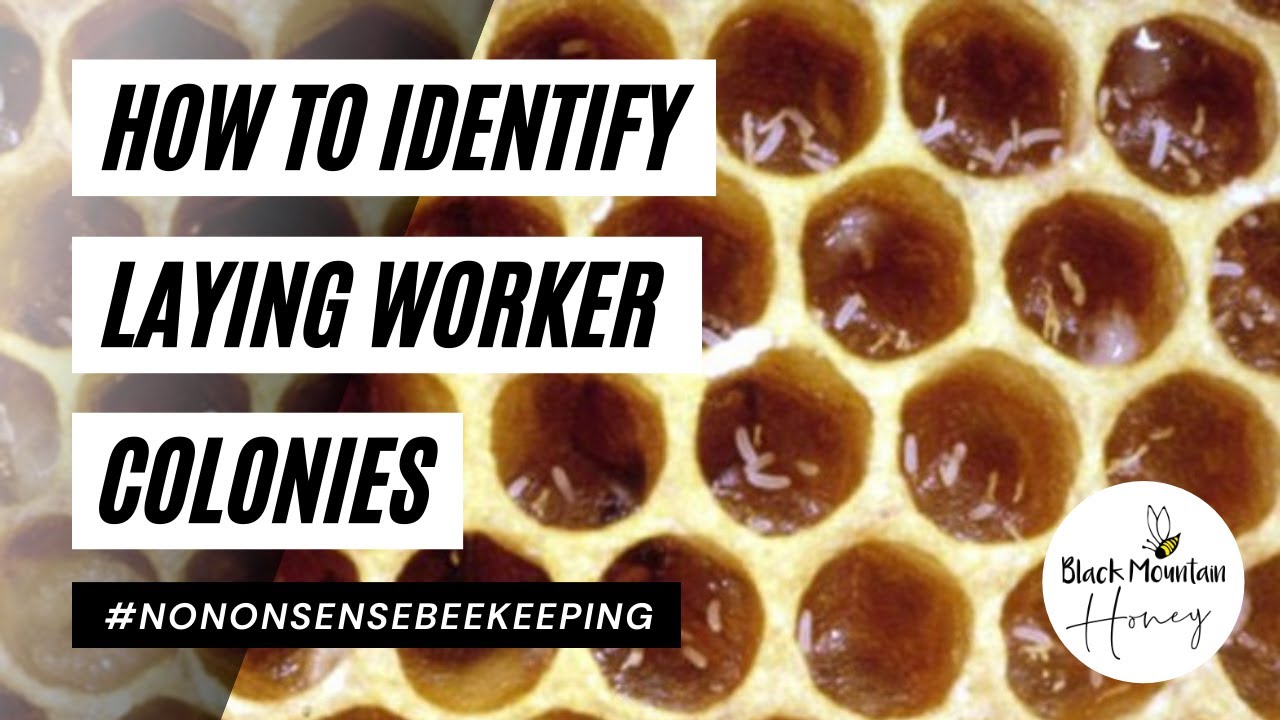
In this episode of No Nonsense Beekeeping, Laurence Edwards of Black Mountain Honey explains what laying workers are, why they arise, and how to recognize and deal with them. Laying workers develop when a hive remains queenless long enough for worker bees to start laying unfertilized eggs, which become drones. This quickly leads to colony decline. Edwards outlines the visual and behavioral clues of a laying‑worker colony: heightened aggression, presence of queen cells, drone brood laid in normal worker cells, multiple eggs per cell, and a reduced number of frames. He argues that, in most cases, attempting to rescue a small laying‑worker nuc is not worth the effort; instead he prefers to “shake out” the bees, letting them drift into other queen‑right colonies where the queen’s pheromone suppresses further laying. When a larger, valuable nuc is involved, his only rescue method is to unite it with a strong queen‑right colony using the newspaper method; he warns that simply adding a queen or virgin queen almost always fails. Throughout, Edwards balances practical beekeeping economics with colony health, emphasizing low‑risk, resource‑conserving decisions.
Chapters
Hi, I'm Laurence Edwards from Black Mountain Honey. Welcome to another episode of No Nonsense Beekeeping. Today I'm going to show you how to identify and treat laying workers. Now, laying workers are an absolute pain in the bum. They're really, really annoying, and they come about when the colony is queenless for such a length of time That the worker bees, who are all female, who all have the capacity to lay eggs, sense that the hive is queenless, and then they think they can take it into their own hands and lay eggs. So they do that, they lay eggs, and instead of laying a single egg into the cup, they lay multiple eggs into the cells. It's really, really easy just to see from the eggs that you've got laying workers. Unfortunately, these eggs are unfertilized, so what you end up with is drones. So a laying worker colony will dwindle to nothing within a case of a few weeks and months. You need to do a positive intervention if you're going to save that colony. Now for me, I generally don't bother saving laying worker colonies. It's too much effort and there's too much kind of resources that need to go into saving that colony, so I don't bother doing it. So that might sound a little bit harsh, but it's the same with the colonies where there's a really, really bad kind of temperament queen and you go ahead and you kill that queen, what you're doing it for is you're treating the apiary as a whole. So you're saying, well, I could take the resources from another strong colony and give it to that poor colony with some risks and some caveats, or I can just say, right, I'm going to get rid of that colony and not put any strain on any additional colonies. So that's my preferred method. So what I'm going to do today is I'm going to show you firstly how to identify laying workers. So we're in the forest apiary here today. We've got about 15 or 20 nucs here that have all mated. Been absolutely glorious weather for mating except one, and one of them's not mated and they've turned into a laying worker colony very, very quickly. So if I was going to save this colony, what I would do, and the only real method that I will ever use to save a laying, uh, laying worker colony, is to unite it With a strong, strong queen right colony, and I do that using the newspaper method. So I would take the laying worker colony and I would go and put that onto a queen right colony with a sheet of newspaper in between. That's the only method that I'll ever use, and I'll show you that in a separate video. What I'm going to do today though is I'm just going to shake them out. It's 2 or 3 frames of bees, do you know what I mean? If they were mated, they'd grow into a 6-frame nuc within a matter of weeks. The fact that they're not mated, I'm not going to waste any of my resources on it. So all I'm going to do is I'm just going to take the nuc away, shake them out into the apiary, and those laying workers will go and they'll find a hive to go and live in. So every single bee will still find a home. And then what that does is when the laying worker goes into one of these queen right colonies— Little bee saying hello. Is the pheromone from the queen suppresses her urge to lay. So then she just becomes a normal worker bee again. As opposed to a laying worker. So that's how it works. So let's jump into the hive and I'll show you how to identify the laying workers and then how to deal with them by shaking them out within the apiary. So this is the nuc in question. What's probably happened here is that the virgin has flown off, she's gone off to mate, and she's either died on her mating flight or she's gone back to the wrong hive and they've killed her. And then that would leave the hive hopelessly queenless, and then it would turn into a laying worker colony. Almost certain that's what's happened with this one. We'll open it up, take a look. So the first thing you'll always notice when you open a worker, laying worker colony is they're, they're tetchy. I mean, they're really aggressive. They're not nice bees because they haven't got the queen to calm them down. So it's always, I mean, the first thing to be thinking about if you open a colony and they're really like a lot more aggressive than normal, are they queen right? Yes or no? Even if there's a virgin in there, they're probably not going to be very nice. But it's just kind of ticking those things over in your brain, so I expect the bees to fly out and get me. Luckily though, I've got my Ultra Suit on, so I don't take any stings anymore, which is amazing. So this is the colony here. Absolute dead giveaway is the fact that there are queen cells in it. So this colony had queen cells in it about 6 weeks ago, maybe 5 or 6 weeks ago. There is absolutely no way there should be queen cells in here. The only plausible explanation for that would be that they had a queen, a virgin queen, she went out and mated, didn't get a very good mating flight, and then she came back and then they were trying to supersede her. Now that's definitely not what's happening here because as you can see around here there is drone brood, but it's not normal drone brood, it's drone brood that has been laid within normal worker cells and that is a classic sign of laying workers. So if you were to look in these cells here, and it's a little bit difficult because they're a bit broken, but there you can see I've just opened them up There's grubs, so you might mistake that for thinking, oh well, I'll let them have another go at mating because these are going to be queens in a few days and then they can go out and mate again, and that's the wrong decision to make because you can see that this brood here is drone brood. You can make a really, really safe assumption knowing the history of this nuc that that is going to be an unfertile egg that they've tried to create a queen cell from. So that's not going to turn into a queen. Um, it's not going to work. So the other things to look out for, and it is a little bit difficult to get it on camera. So if you can see in here, there are multiple eggs, and that's always what I look for when I'm trying to kind of identify laying workers— multiple eggs in the cell. Now sometimes you will get multiple eggs in a cell with a normal queen when she's just coming into lay. She kind of works it, working it out, and she maybe misfires a little bit. But when you're seeing it in pretty much every cell, you know there's laying workers on this one. So the other dead giveaway with this colony is the fact that it started off on 2 frames. So if a queen had gone out and mated and laid it up for a few weeks, the colony would be so much bigger than it is now. Like, even just one cycle of brood, I would expect to see kind of like an additional frame on the colony. This one's gone down from 2 frames down to 1 frame, so it's dwindled. So I know in that whole time there has been no Laying of fertile worker brood to kind of boost the colony's numbers. And then the other one is the kind of absence of a queen. But you can have an unmated queen in the colony with laying workers as well. I've had that once or twice. It does happen. It's a bit more rare. They tend to kill the virgin before turning into laying workers, or the virgin dies for one reason or another. So how do you deal with it? It's a sad one, but all we're just going to do is we're just going to take this nuc away. We're going to shake the bees into the air. They're all going to come back here and think, where's my hive gone? And then they're just going to kind of join other colonies, and that will suppress the urge for them to lay. So the numbers of bees in my total apiary will not drop, but the number of nucs will be reduced by one. And for me, that's the safest, easiest method of doing that. So what you could do Is you could bring a queen right nuc underneath this one. Let's put that frame back in. A queen right nuc underneath this one, and then put the frames on top of that new queen right nuc separated by a piece of paper, making sure that all of the laying workers are in the top, and then you get a slow introduction. But I've done that a number of times and they've killed the queen, and it really, really annoys me when I do that because I turn a problem with one nuc into a problem with 2 nucs. Um, and when you've got so many hives, even if you've only got kind of like a handful of hives, why, um, create a bigger issue than you need to by interfering with other nucs at the same time? So it's never my preference to combine laying workers, but that really is the only other way out of it. So you might have seen people though who say that you could just take a mated queen or a virgin and chuck in here. I've never seen that work. I'd say 999 times out of 1,000, they'll just kill her. So if you're in the— if you like burning money, that's a really, really good solution for you, but I definitely, definitely wouldn't recommend it personally. So I'll just show you what I'm going to do now. Like I say, just going to shake them out and move the hive. So first thing, move the hive away. And then shake the bees out. Take away any other landmarks like a stand. And just shake them all out. So like I said, it seems like a really, really drastic solution doing that, just shaking them out and you've lost a nuc, but that nuc will not come to anything unless you steal the resources from another colony, or more than likely what you're going to have to do is combine another colony with that. You could see it was 1, maximum 1.5 frames of bees, so that's not going to have a massive impact on the colony that you're putting it on. So if you see it from a different perspective as to, am I willing to increase another colony's frame or bee count by say 10% and risk it dying, it becomes a bit of a no-brainer and you just think, well, no, I'll just leave the other colony as it is. I don't want to take the risk for such little gain. So that's my solution 9 times out of 10 for laying workers, unless it was, do you know what I mean, a 20-frame colony. Absolutely massive, and it had the potential to give me honey, or it had the potential to give me splits, or I wanted to use those bees, then I would do something different, and I would combine them via the newspaper method with a really strong queen-right colony. And then you've got a bit of a way out because you've got something to gain from it. But in that scenario, the only way out— shake the bees out, let them go and join some other colonies, boost the other colonies at the time. So you're not, you're not just losing that nuc, you're gaining still from those bees. Um, but it's the lowest risk possible. So that's it, really quick one today. Thanks for watching. Please hit the subscribe button, please hit the bell so you're notified of every video. I'll see you next time.