🐝 How To Keep Bees Without Making Splits - Episode 7 - Recycling Nectar After Demaree
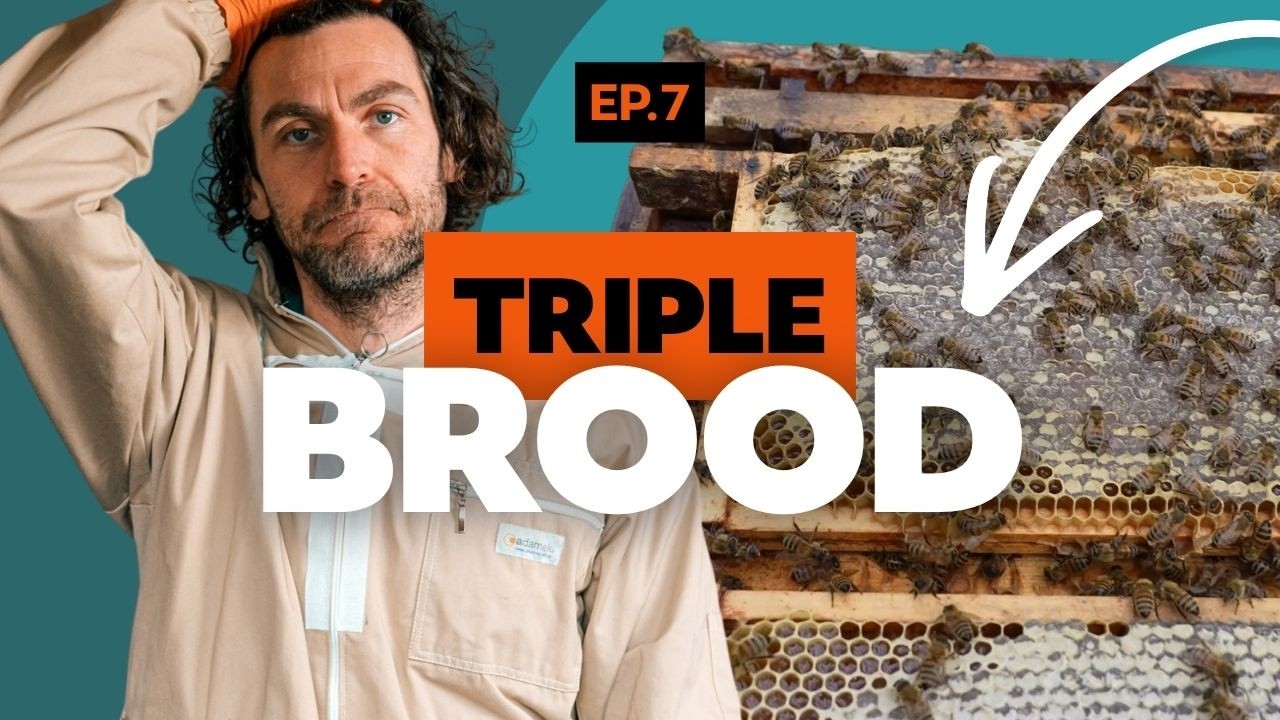
A beekeeper returns to inspect a Demaree split colony and performs a "recycling nectar" manipulation: moving the heavy nectar-filled box to the bottom, placing the queen back in the brood area, and adding empty supers above so bees move nectar upward. The trick keeps the colony from swarming by making it think it already has.
Chapters
Right, we're back at the River Apiary and we're going to take a look inside the colony where I'm doing everything I possibly can to avoid that colony swarming. Previous episodes, we did a Demerara split, we took all of the brood upstairs, we introduced new brood boxes down underneath the queen excluder, and then we followed that on, we knocked down all of the queen cells, and we saw that the new queen had laid up that box really, really well. We're going to go in there today. Hopefully they've not swarmed. If they haven't swarmed, we're going to do that manipulation again, depending on just how full those boxes are. Let's go and take a look and see we're getting on. I'll get my bee suit on. Hopefully the bees haven't swarmed. So things are just getting completely out of hand at this apiary. We have got beehives that are taller than me and they need more boxes. I can't wait to see what's going on in this colony here. Hopefully they haven't swarmed, 'cause that's definitely going to scupper this series, isn't it? Let's look inside though, see how well the bees are getting on, and we're going to do another rejig today to really give them the best chance of not swarming. So if you're catching up with this series, the bees are on a double brood. We did a Demaray split on them, Queen had lots of space and she was laying in there last time. Then we've got a queen excluder, then we got 2 shallows, then we've got 2 deeps, one 14 by 12, one national deep, and they were the original brood boxes. Let's get inside now, see what the bees have done. Right, it's lucky I've got a step here because there's no way I could look inside this colony without this step. Bees all the way to the top, absolutely fantastic. Quite a lot of drones in here because there's no way for the drones to get out. But I'll release them out every single week like this. Let's take a look inside this box, see what the bees have done. Right, that's backfired massively because that is the heaviest box ever. 14 by 12, they have backfilled it with honey. This is not what I wanted, but at least they've not swarmed yet. I'm going to put this down. Oh my God, this is heavy. So this is what always happens with a Demerara split. The brood emerges. You can still see a couple of dots of drone brood knocking around. And then the bees backfill it with nectar. Obviously, if you've not used these for Apivar treatment or any treatment that taints the wax, you can just use these as supers if you've got the ability to actually extract them, which funnily enough I do. And some of the boxes, I've not used them for Apivar, so I can extract them. This one here has been used though, but what I'm going to do is I'm going to recycle this back down to the bottom now, and I'll show you how to complete that technique in this video. Right, next box down, lots Lots and lots of bees again. It's looking pretty good in terms of them not swarming. I'll pull out a couple of frames. This one here we can actually use as a super, so I'll be really interested to see how the bees have done in this one. So same as the one above, lots and lots of nectar. They've started capping this one a little bit more as well. I can use this one as a super though, and then you can see in there the remnants of that drone brood. So far so good. Again, that is such a heavy box. Really is difficult to lift these boxes. Those boxes are so heavy, and I do appreciate this isn't going to be for everyone. Like, if you can't lift a shallow full of honey, there's no way you're going to be able to lift a 14 by 12 and a national deep full of honey from that height. Just trying to show you some of the methods that you can use and then maybe try and manipulate them or amend them to suit your lifestyle. I'm really pleased with how this is Going though. Let's take a look at the first shallow box now, see if we've got some nice frames of honey in there. So these boxes look fantastic. So many bees. Crazy to think that this colony started off only over a few frames, kind of like a few weeks ago now. They do expand at a crazy rate of knots. Just looking over there as well, they're full of bees. Both those boxes full of bees, and then all these boxes here are full of bees as As well. Absolutely insane. So kind of what I expected to see in this super, lots and lots of honey, and the bees have capped it over because it's been in the position where they're kind of going to cap it over, which is closest to the brood box and as low down as possible. Lovely, lovely frames of honey, beautiful cappings. These bees are working so, so hard. And then the next box down, we've got pretty much more of the same. That one there, not so full. This one's full, mostly capped as well. We are going to be on for a bumper crop here. Right, enough of me gloating about how much honey's in this colony. Let's get inside and double-check they've not swarmed and there's no swarm preps. So really nice to see the queen. That shows that they've definitely not swarmed because I've got my poorly marked white queen in there. I've been through all the frames as well, no swarm cells. Lots and lots of brood and a surprising amount of space as well. She's not taken over all of those frames yet. She's just using what she needs. But I'm going to give her now a little bit more space to lay. Right, so I've got my queen on this frame. I'm going to put her back in here now. I'm going to show you a really quick adaptation to this Demaray split to try and relieve the pressure on that 14 by 12 box. Might seem a little bit backward, a little It's a little bit counterintuitive, but it actually works really, really well. So first thing I'm going to do, I'll put the queen back in this box here. I'm going to lift the entire brood box off and place that over a queen excluder. That means I know the queen is in there and she can't get out anywhere. I'm going to then take my really heavy 14 by 12 brood box, and if you can time this so it's not as heavy, it's going to work a lot better. And I'm going to place that back as the original brood box like that. I'm then going to take my double brood colony again and I'm going to place that onto that brood area. If you want to double check at that point, check your queen's still there. I'm happy, you can see the queen. So the queen is going back into that colony and they are now over a treble brood. Doesn't matter what size the box is here, you can use different size boxes, it really doesn't matter. But I've got a treble brood configuration, national deep, national deep, 14 by 12. I'm then putting my queen excluder back on, and what I'm going to do now is I'm going to introduce 2 more empty supers into this colony here, giving the bees additional space. Because what I want them to do is to take all of the open stores from that 14 by 12 box underneath, bring them up, and just store it in the new boxes I'm going to put in there. If you just stacked everything back up here, the bees wouldn't be able to move it, because although they don't like nectar underneath their brood nest, if there's no space above for them to move it into, they're not going to move it. So you need to create that space. You're setting the bees up here for a really simple manipulation, which is doing what bees do best— moving nectar upwards. So what I've got here is 2 empty supers, as in there's no stores in them. They're actually drawn comb, bit of foundation in some of them as well, and that's going to go on the And then all I'm going to do is build everything back up as best as I possibly can. It's going to be so, so tall, but don't worry, it should be fine. The bees will stick it all together, and then we'll talk a little bit about it at the end. So there we go, that's the manipulation complete. We are now on 1, 2, 3, 4, 5, 6, 7, 8 boxes down on a treble brood system. The bees have got a double National deep brood area. And then I've put a big box of 14 by 12 that's got open stores in it. That was the previous manipulation of that Demarest split. Horribly confusing, but that's what's happened. What we're going to hope to happen now is the bees will move all of that nectar upwards, fill out these new 2 shallows here, and then what we can do is we can just remove that box completely. I don't want to store honey in it. And I find this manipulation works a little bit better when you've not got a 14 by 12 box hanging around in the mix. Once we get to that point, what we will do is we will do another double Demarais split, taking the 2 national deeps, lifting them to the top, taking down one frame of brood, introducing that into 2 new national deeps, and we will just keep the cycle going forever. It's a very, very good way to stop your bees swarming because you're continually tricking them into thinking that they have swarmed. I hope you enjoyed that video. I really like this manipulation. I'm really enjoying this series. If you want to check out some previous episodes in this series, here's the playlist. Get up to date.










