How to Kill Varroa Destructor - Know Your Enemy and Control Mites Properly
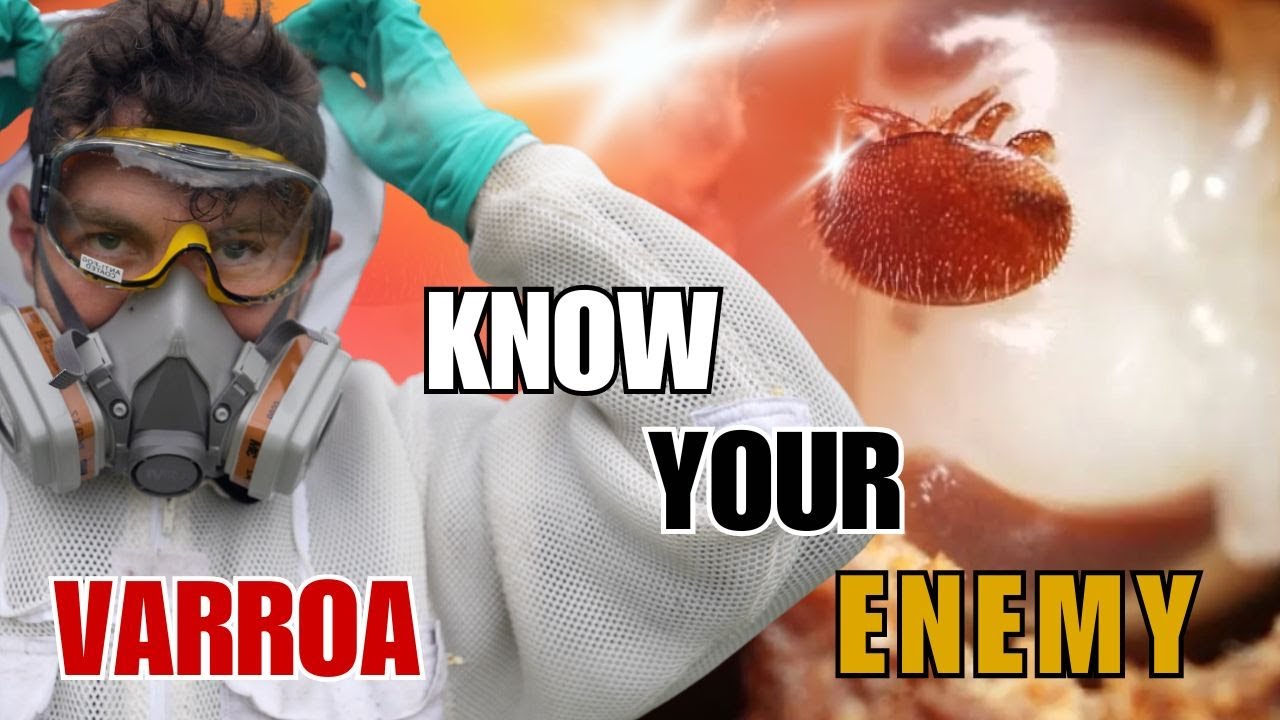
Laurence Edwards explains why Varroa destructor mites devastate UK honeybees and how to kill them. Treat with Amitraz by mid-August for eight weeks, then oxalic acid in late November when brood is gone. Timing matters more than frequency because mites spread viruses, not just damage bees directly.
Chapters
Varroa destructor is the honeybee's worst enemy. I found in the UK, if you do not treat them, they will dwindle away within about 2 to 3 years. Some people may disagree with that, but in my own experience, to keep my bees healthy, I treat for varroa every single year. But treating your bees for varroa just kind of like haphazardly isn't enough. You need to understand the cycle of the varroa mite. You need to understand why that cycle is so destructive to the honeybee. And you need to time your treatments at points within the year where they're going to have the maximum effect. So Varroa mites look really small and inconspicuous within the hive. In terms of a comparison with a honeybee though, it's like having a rabbit literally biting into your shoulder or the fatty underside of your belly. For a honeybee, a Varroa mite is actually very, very big. They're hardy little things and the bees don't really have too many mechanisms to control them. They have hygienic behaviour, which is they're trying to clean the mites off the bees, but they have no real natural defences against the viruses that the Varroa mite can bring into the hive. Now, Varroa is across every single hive within the UK. I don't care what anybody says, if you're in the UK and you're keeping honeybees, your bees will have Varroa. There might be one Varroa mite, there might be 100, there might be 10,000, but whatever happens, you've got them in your beehives and you really do need to do something to control them. Now, varroa mites are a perfect invasive pest for the honeybee. They're in the beehive, they hitch a ride on a drone, go out for a mating flight. If that drone is unsuccessful, it comes back and just goes into any hive it likes, doesn't necessarily go back into its own hive, and that's how the varroa mite is so easily spread. So there's absolutely no doubt that the varroa are in the colony and they're doing damage to your bees, but it's understanding their reproductive cycle that gives you the best bet to time your treatments to have the maximum So your varroa mites are walking around in your colony of bees, and a female varroa mite will enter into the brood of the honeybee when it's in the larval stage. They tend to go for drone brood, but they will go for any brood that they can get their hands on. And a single female will go inside and she will lay about 3 or 4 eggs. Now these eggs are absolutely tiny. They are 0.5 millimeters wide, and they'll lay them either on the wall or sometimes they'll lay them directly on the actual larva. Now the interesting bit, well, at least I found it interesting, is that the The first egg that the female adult varroa mite will lay is a male, and then any subsequent eggs that it lays within that cell are female. So in each individual brood cell where you've got like a larva of a bee, a varroa mite might go in there and lay up to like 3 or 4 eggs. First one is a male, and then all of the subsequent eggs are female. So within the brood cell, you've got this male varroa mite egg and these female varroa mite eggs. And the males take about 5 to 6 days to develop, and the females take about 7 to 8 days to develop. So the males are the first ones to come out, and the important thing here is that they come out before the bee emerges. So what you've got is this perfect environment within your colony of bees for these varroa mites to actually reproduce underneath the cappings of your brood. So your queen bee goes in, lays an egg, the egg turns into a larva, the larva is capped over, turns into a pupa, and then the honeybee emerges. And it's during that pupal phase for the honeybee that the Varroa mite's reproductive cycle takes place. A fertile female lays her eggs, and by the time that that honeybee emerges, you've got 3 or 4 fertile females that will emerge. And the reason that they're fertile is because that first Varroa mite egg that was laid is a male, and then before the honeybee emerges, the mating takes place with in that cell. This is why they're able to reproduce at such an incredible number, and this is why the timing of the treatments is so, so critical to make sure that you're giving yourself the best chance of actually knocking down the varroa mites and not just killing the phoretic mites, the mites that are not within the cells, and leaving the ones that are within the cells to reproduce. So once the fertile female varroa mites exit from the cell, it takes them about 2 weeks before they can actually go and lay their own eggs. But that's a really short amount of time, and you can see just how quickly the varroa population gets out of control within the beehive. Now let's say, for example, you've taken delivery of a very healthy overwintered nuc from Black Mountain Honey. Your bees will have been treated over winter, and they will come to you with a very low varroa load. Now, over the course of the summer, that varroa load starts to increase as the colony is producing more and more brood. As the bees produce more brood, there's more space for the varroa to go and lay their eggs, which means that the varroa can expand at a really quick rate. And they can actually expand at a far quicker rate than the bees because of their ability to lay multiple eggs within the cells. Now all the way throughout the summer, the honeybees are kind of able to cope with this because of the sheer number of bees that are within the colony. The problem comes after the summer solstice when the days start shortening. The queen bee in the colony takes that as a signal to start reducing the amount of brood that's being laid, which means that you get this quite drastic reduction in bees. But because the varroa cycle is delayed by a couple of weeks, what you end up getting in the autumn is this real mismatch. There's lots more varroa per honeybee within that colony. This is the point when you're going to start seeing real, real issues, and this is like the first line of attack, your early autumn treatment. And I know it's called an autumn treatment, but for me it's definitely not an autumn treatment, it's a late summer treatment. Now I've done videos on this, quite a lot of videos on this in the past, talking about the system that I use. But for me, really simple, my cutoff date is the 15th of August. Middle of August in North Wales, I take off all my honey, I give my bees a good feed, and I treat my bees with an Amitraz-based miticide. Now I used to use Apivar, but next year I'm not going to use Apivar. I'm going to use something completely different but completely identical at the same time. There's one reason for that. Apitraz is cheaper than Apivar, and it is identical, exactly the same product using exactly the same chemicals, exactly the same dosing. It's just a little bit cheaper. So next year, August the 15th, late summer treatment, early autumn treatment, I'm going to do an 8-week cycle of Apitraz. Now a lot of people use that exclusively as their only treatment, and I think that's a really good idea as long as you're using a good amitraz-based product at the right time of the year before the bees are getting anywhere near to the point where they're actually laying up their winter bees. That should be sufficient to keep varroa at bay. There is an important point there. You need to make sure that the varroa load is low before they start creating the winter bees. Don't try and treat the winter bees with Amitraz. The damage is already done. So don't start putting Apivar or Apitraz in at like the middle of October and think you're going to do a good job. It is far, far too late to do that. Get it in middle of August, back end of August at the latest. Treat the bees early and you will knock down so many mites over that 8-week period. However, what I like to do is I like to go back in maybe late November, which coincidentally is around the time of this video, or early December, and try and identify a period where the colony is broodless or as close to broodless as you can possibly get. At that point, I'll go in with my Instant Vap and I will sublimate oxalic acid to take down in a single blast as many of the phoretic mites as possible. Again, the phoretic mites are mites that just live on the bees. They're not the mites that are within the cells. However, if you time it at the right point where the colony is broodless, that means that there shouldn't be any varroa mites or any varroa eggs in any of the cells anyway, and you should be able to get kind of upwards of 95% knockdown rate of the phoretic mites using oxalic acid at a point where they're broodless. Now, don't go through your colonies checking to see if they're broodless. I am going to go through a colony here today, and I'm going to show you the state of the colony and see whether they're broodless or not. Obviously subscribe to the channel if you want to see that video, but I don't recommend people going and doing that. I'm only doing it so you don't have to do it. But if you're in the UK, anywhere between say like the middle of November and the first or second week of December, that's going to be your best bet for finding a point where the bees are broodless. Give them a single blast at that point and you will drop the varroa load down so low in that it takes the varroa mites so long to build back up to a level where they're actually doing damage to your Now remember, they're not doing physical damage to the bees, they're passing viral loads to them which makes the bees ill. And a really good analogy is when your kids for the first time go to school and they come back and they're just so ill, and then everyone's ill because of all this spreading of viruses. That is exactly what the varroa do. All they do is they just spread these viruses, give them to the bees, and then that's what kills your bees, as opposed to the varroa doing anything. physical damage. So there we go, hope that was useful, hope you learned a little bit about the varroa cycle. 2 methods to treat: late summer treatment with Apivar or Apitraz, and then a zap of oxalic acid sublimation in a broodless period in the winter. Do both of those things, your bees will thank you for it, and you'll hopefully get your bees through the winter.










