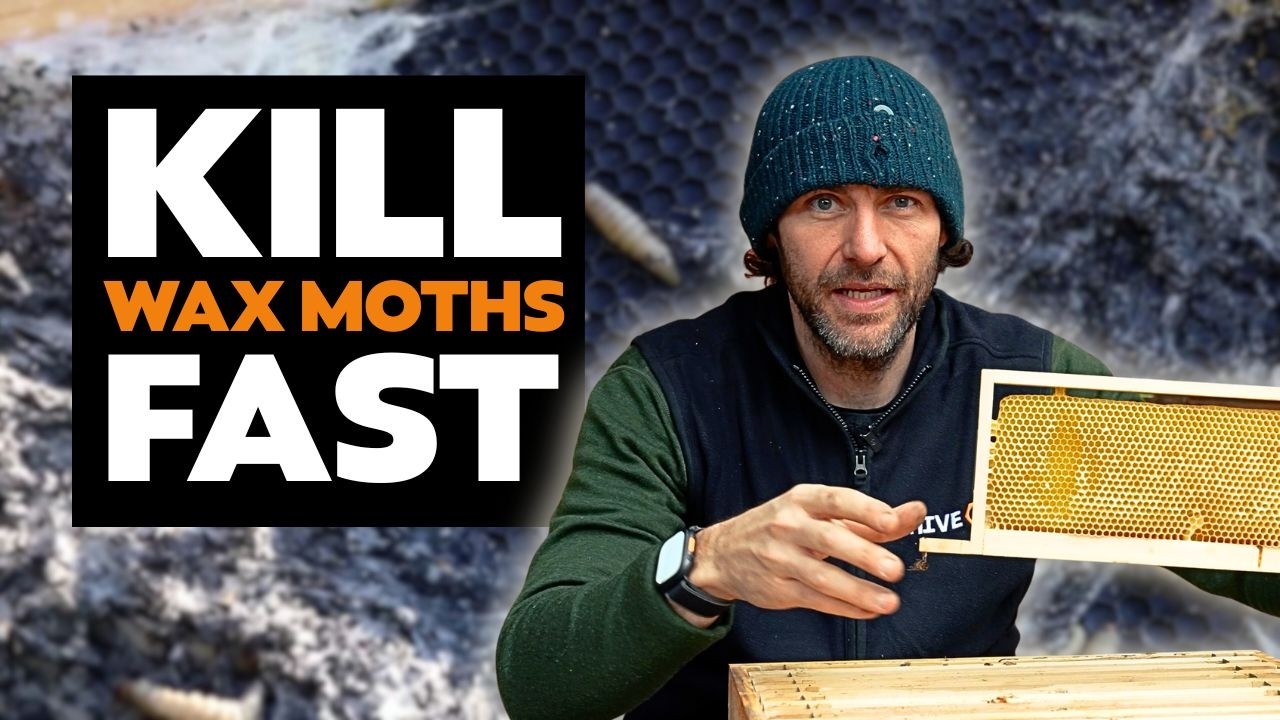
In this instructional video, the presenter explains a chemical‑free method for eradicating wax moths from stored beehive frames by exposing them to a sharp, hard frost during winter. He first outlines why wax moths become a problem—especially in dark, old brood comb or comb with pollen debris—and why cold temperatures are lethal to all life stages of the moth. The speaker then demonstrates how to assess which frames are most at risk by examining the amount of brood, honey, and swarming cells present. He provides a step‑by‑step protocol for setting up the frames: stacking them in supers, sealing the sides, bottom, and lid, and protecting the assembly from vermin, either under a permanent shelter for the whole winter or for a single night during a severe cold snap (‑3 °C to ‑4 °C with no rain). He stresses the importance of using a true hard frost—not mild cold—and of resealing the frames after treatment to prevent re‑infestation. The video also covers limitations, advising beekeepers to discard heavily damaged comb that is already webbed or collapsing, and to consider alternative storage for large volumes of brood comb in milder climates. Finally, the presenter promotes his online beekeeping course (14daybeekeeper.com) as a broader resource for managing bees without chemical interventions.
Chapters
I'm gonna use a hard frost to kill all forms of wax moth dead. Now, if you don't look after your beehives, you don't look after your frames, and you store them in the wrong conditions, the wax moths will get in, they take over, they eat all of your brood frames, and they can cause destruction even in well-managed colonies. But what the wax moth does not like is cold. Now, if you get a sharp, hard frost around this point in the year, it is so easy to treat all of your frames and make sure that you kill that wax moth dead before it becomes a major problem. That is gonna be exactly what I show you how to do in this video. Wax moths are usually not the villain in a strong colony of bees because they keep them in check as long as there's not empty voids within the beehive. Wax moths become a problem when comb is stored, especially if it's dark, old brood comb or comb with pollen or debris in it. That is the perfect food for the wax moth larva, and once they get in, they can ruin the frames really quickly. Take a look at some of these videos I found on YouTube. It shows serious wax moth destruction. So here's the twist. What most people do is they try to treat wax moth when the problem becomes too bad. They go inside a frame and they find some wax moth damage and they panic and they reach for some chemicals and they try and fix everything. But what you really want to do is do it proactively before the wax moth are in. And the beauty of a nice sharp cold frost in winter is that you can do that very, very effectively with no chemicals at all. And the other thing that most people miss here is that unless that cold can get in and penetrate the comb for long enough to kill all of the stages of wax moth, that cold sharp treatment might not work. Before we talk about how to set it up, let's take a look at some of these frames here because some of them are perfectly set up for storage over winter, but some of them carry a lot more risk than others. So this is the kind of frame that you would generally see within a super like this or any boxes where you've just stored honey. The wax is quite brittle, it's nice and dry, it's Perfect for storing over winter. And generally wax moth won't go for frames like this. This isn't their food of choice, although they will take it if there's nothing else available. So do be warned. So what's perfect with this box here is that it shows you all of these different stages. So we start off there with some combs that have only had honey in them. But what's happened with this box here is I had a swarm come in and land and the different frames have had different amounts of brood in them. It's pretty cool. So as I pull out this one here, you can start to see What I mean. On this side over here, we've got pure virgin wax that's just been used for honey. But then as you look over this side, those darker areas alongside the drone comb over there, that's where it's maybe had 1 or 2 rounds of brood. What I've also got on this frame here is a couple of swarm cells as well. So swarms come in, swarms gone out, they've wrecked all of my frames. Fuck. So I'm going to show you every single frame in this box here, try and work out the ones that have got the honey in, try and work out the ones where the brood has been. So why am I telling you all of this? These 4 or 5 frames in the middle where there's quite clearly been brood are Perfect for wax moth. These are the frames that they're going to target. If you keep them in a closed-off, poorly ventilated, warm, damp environment, which is where most beekeepers do tend to keep a lot of their equipment over winter, the wax moth will get in and they will destroy all of those frames to the point where they are not recoverable at all. You'll have to clean them all out, re-sterilize them, get new foundation in them. What I'm going to show you today is going to save you all of that time and all of that money, and it's not going to cost you a penny, and you don't have to use any chemicals. It is by far and away the simplest technique on my Let me show you how to do it right now. So this method is about one thing and one thing only. It's about a sharp, hard frost. Not cool weather, not mild weather. If you can comfortably stand outside in a jumper, that is not what I'm talking about here. You want a proper real frost, the kind that makes puddles freeze and stiffens up that grass and makes your boxes feel icy. If you do not get that real frost, you shouldn't use this method because you probably won't get a reliable kill. So when is the best time to use this method? It's quite clearly a winter job. Designed for that time of the year when you get the really nice cold nights. If you're in one of these areas that gets this real sharp hard frost, you have to make the most of it and it will protect your investment in those frames for years to come. So if you're lucky enough to have an awning or something like this where you can keep the rain off your hives the entire way through the winter, then all you need to do is just stack them up under there and leave them out all winter long. That way when the cold frost comes, you know your hives and your frames are outside and they're going to get access to that cold. Be very, very careful doing this though. You need to make sure that you're protecting that access into these boxes because everything is going to try and get inside. Any vermin— mice, rats, squirrels, things like that— are going to try and get in and get to those nice sticky honey frames. But even though you're putting them in a really awkward position in terms of predators coming in, it's definitely worth it to get that knockdown on the wax moth. But if you've not got something like this, all you really need to do is just take them out for 1 or 2 nights in the winter to get that sharp frost to penetrate the frames, And it will kill all forms of wax moth every single step, from the eggs through to the larva and the pupa and the adult wax moth as well. So if you can do it early enough in the year, you should prevent any further damage to your frames. But the really important thing is that once you've done it, you have to seal everything back up again. Otherwise, all that happens is the wax moth come back in and repopulate the frames. So if you've not got a shelter, this is exactly how I set things up. I take one of these roofs. This is a pine metal-topped roof from Simon the Beekeeper. They're very heavy but they're really useful for things like this. I put it upturned on the floor like that and then I start to take my super boxes and I put them in. Now if you're somewhere like me where you're getting really good sharp hard frosts or you're going to leave them out for the entire winter, all you need to do is stack them up like this, ensure that nothing can get in and nothing can get out, and then that is good enough. You don't need to do anything more than that. And then the final thing that you need to put on, really important this one, is the lid. You're sealing the top, you're sealing the bottom, all of the sides are completely sealed. And then if you're somewhere that's cold enough for the cold to get in and penetrate the frames here, and you can measure that if you want, then this is my recommended setup. This is how I leave mine throughout the entire winter. But if you're somewhere that is a little bit warmer and you don't have an area like this to store all of these frames, This is my recommendation for you instead. So we start off at the bottom with the same board. All I would do is I would put the boxes on like this. I'd stack them up in the garden the same, and I would put the roof on like that. Ideally, you're going to get something like this under a shelter so it's not raining through, but all you really need to do is leave this out for one night. If you're forecast a really nice cold snap, -3, -4, there's no forecast of any rain, The chance of anything getting in here overnight is very slim, and all you have to do is when you put it back together, just make sure there's nothing inside any of the boxes. And that cold would have penetrated so far and so deep inside the beehive that it will kill every single form of wax moth that is present inside. So once the cold has had a really good sharp frost, you need to store it properly. Because the frost kills what is there at the moment, but it doesn't stop those new wax moths getting in and creating havoc once again. So keep it dry, keep it airy, and avoid those warm, dark, and still conditions. If you can, store the frames in a way that discourages the wax moth from settling, and keep checking back occasionally throughout winter. What's brilliant about this method here is that you can do it again and again and again, and the more that you do it, the better your comb is protected. The most important thing here though is do it before you see that damage. If the comb is heavily damaged and black with webbing or collapsing or even crawling, then do not waste your time. Bin it or render down what is left. The bad comb is not worth saving. If you're trying to store large volumes of brood comb in a warm place, frost alone will not carry you all the way through and you should probably look for a better storage system. This one works very well though for back garden beekeepers and side hustlers. I've got a few hundred hives and it works really well for me. So that is it. No chemicals, no fuss, just using that hard frost properly. If you want to get access to my full system for keeping bees without it taking over your life, head over to 14daybeekeeper.com. My online course is built to simplify everything you do and keep you moving in the right direction. Do it once, do it properly, and you'll save yourself a lot of mess later.