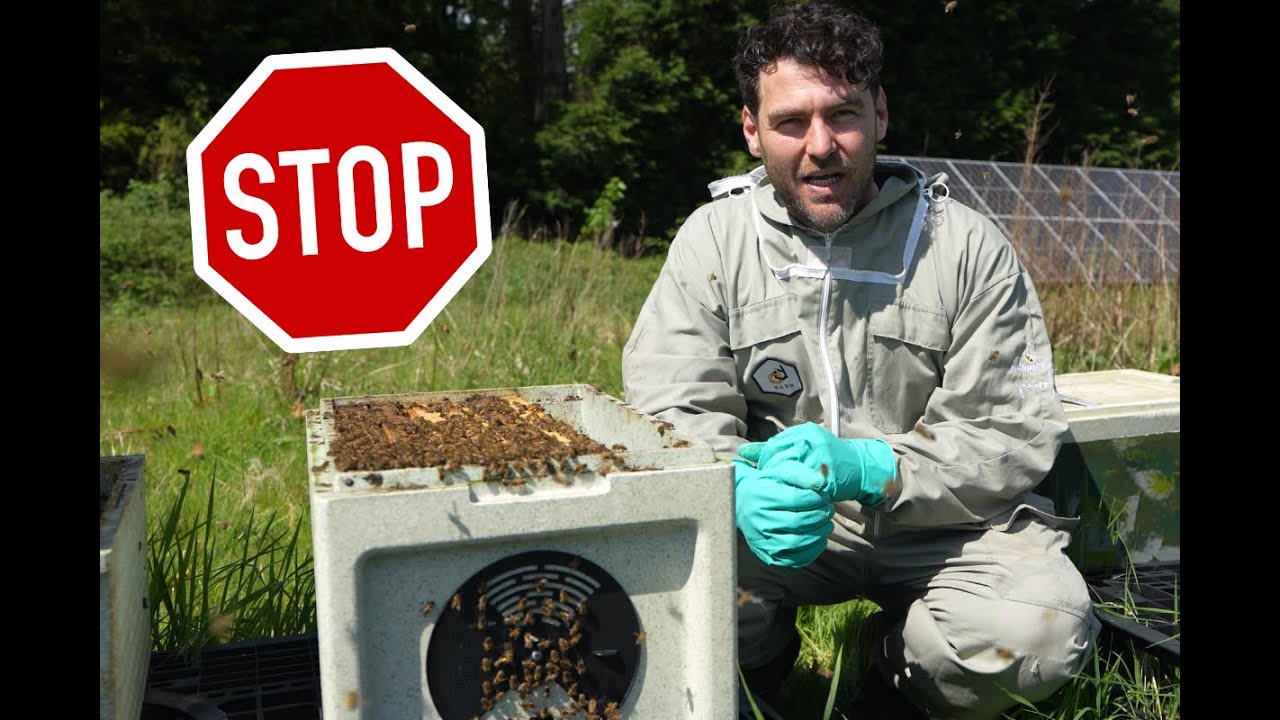
In this instructional video, Laurence Edwards tackles an extremely aggressive Langstroth nuc colony that lacks a viable queen. After having killed the original queen weeks earlier, he searches for and eliminates a runt virgin queen still present in the hive. He then requeues the colony using a mated F1 Buckfast queen sourced from Black Mountain Honey. Edwards demonstrates the practical steps: locating the virgin queen, using a dual‑tab Buckfast queen cage, removing both tabs for immediate release, and feeding the bees to encourage acceptance. He emphasizes safety (PPE, veil) while handling the hostile bees. Over a 4‑to‑8‑week period, he documents the dramatic shift in colony temperament—from constant stinging and defensive behavior to calm, non‑aggressive activity—and a rapid increase in brood and stored resources. He also refutes the myth that aggressive bees produce more honey, attributing improvements solely to the genetics of the Buckfast queen. The video serves as a step‑by‑step guide for beekeepers facing queenless, aggressive colonies, highlighting the genetic benefits of Buckfast queens, proper cage handling, and safety protocols.
Chapters
I have got an angry colony of bees in here that I'm in the process of requeening. These bees in here do not meet the standards of Black Mountain Honey, neither for queens or for the nucs. So I killed the queen a couple of weeks ago, and then I'm going to go in here today and I'm going to find the virgin. Without a doubt, there's going to be a runt virgin that's failed to mate in here. I'm going to find her, I'm going to kill her, and I'm going to replace her with a Buckfast queen from blackmountainhoney.co.uk. Now, our queens are perfect at transforming colonies like this. As you will see when I open them up, they're not nice bees. As soon as I open it, they're going to try and sting me, they're going to try and get in my veil. But the genetics inside this F1 Buckfast will transform this colony completely. Give it about 6 to 8 weeks at this time of the year, every single bee that's in here will be dead, and every single bee that will be in there will then be a daughter of the queen that's in here, and they will carry her genetics. Angry bees is no fun for anybody— not fun for the beekeeper, not fun for your neighbors. And don't believe the myths that they make more honey. They definitely don't. It's all in the genetics. Let's get Let's get inside, find that virgin queen, see how horrible these bees are, and let's requeen this colony. So like I said, these bees aren't the friendliest of bees. I'm going to open them up now and you will see them flying out and coming and getting me. And there we go. You can see them come. They come and have like a second go at you. And this is only a small colony. Like, I knew this colony here, the writing was on the wall last year when they were bigger than this and they were really attacking me. It's not helping at the moment because there is a virgin queen in here, so they're kind of Queenless. There's no brood. Brood does seem to sedate bees and keep them a little bit more chilled, but I think you'll agree this is not a nice temperament for a colony of bees. But we are going to fix it. We're going to fix it by putting in that F1 Buckfast queen from Black Mountain Honey. First thing we need to do though is we need to go in, we need to find the virgin queen. Now finding virgin queens, very, very difficult. It really is a challenge. I can spend 30 or 40 minutes going over a colony looking for a virgin queen. Sometimes they're not there. Sometimes they do just fly out, try and mate, and can't get back in. But It has been so cold at the moment that I'm pretty sure that we're going to find the queen in here today. Enough of me talking. Let's get inside. Let's take a look. So, you know, I love these Langstroth Panes nucs because you can take the feeder out. Absolutely love that. Gives me tons of space to work. Sorry, I've done this so many times trying to find a virgin on a video. I find the virgin on the video, go to get my camera, and she flies off. So I'm not going to make that mistake here. If I find the virgin, I'm going to squish her straight away. And then I'll show you the corpse. You can see though, absolutely no brood whatsoever. That's because I took the queen out a few weeks ago now. You'll see the remnants of some queen cells in there as well, and I've left it long enough on here now that it's very, very unlikely that there's going to be multiple virgins. You can't discount multiple virgins though, and as you can see from some of those frames on that side there, multiple virgins definitely emerged So that is really, really annoying. I'm gonna see if that camera over there could spot it because that is like the high-speed camera. I saw the virgin on the frame and I went to put it down to squish it and she flew off. It's really, really annoying. So even worse now because I kind of thought if I'd gone like 20 minutes and couldn't find it, I would have said, right, there's just not a virgin in here. I'll just treat it as a hopelessly queenless colony. But now I know there definitely is a virgin in here, which makes this job now loads, loads more difficult. I'm going to have to get a little bit more forensic. I'm going to have to go through the sides of the boxes, and I'm going to have to make sure that whatever happens, I do not let that queen, virgin queen, remain in this hive. So you can see all of the bees coming out trying to greet me, but they're going back in slowly now. And this is probably going to be the best bet that I've got of trying to find this virgin. Hopefully she'll just land on the face there and then she'll walk in and I'll be able to see her. You can see we've got a really decent amount of bees on there. It's gonna be difficult to see her, but I'm gonna do my very best. So this is my fallback way of trying to find it when I know there's a virgin in there, is I just shake them all into the bottom of the box like that and they kind of start walking up the walls and they spread out. But I'm going to stop filming now and try and get inside and have a look. So I managed to find her. She was underneath the vent. I had to lift the box upside down, but there we go, I found her. So we have one dead virgin queen, and you can see that bee thinking, what's going on here? You've killed my queen. Little do they know that we have a perfect replacement for them. You see, I had to empty out that box, take all of the frames out, and basically where I found her was underneath the Loads of bees clustering up at the bottom there, and that is where she was hanging out. So putting it back together, easiest thing in the world. So these bees now are hopelessly queenless. No brood, no eggs, no larva, no queen, nothing. Just bees and frames. What that means is I'm just gonna put everything back together, put all of the frames back in, put the queen directly in, pop the tab, feed them, and then we'll come back in a few weeks' time to see if the introduction was a success. So on the Black Mountain honey cages, you'll see on that side there, there's 2 tabs. And I've taken both of them off because the colony is immediately hopelessly queenless. You could put the queen in for 24 hours first and then do the tab, but this is a pretty weak colony. They're not gonna get through the fondant that quick, and it saves me a trip back. Whenever you're requeening though with these cages, make sure you open both of the tabs. The bees can get in one way, but the queen can only get out of one side. You see the bees there, really, really keen to meet their new queen. I'll take that frame now, put it in the middle, and let the bees get used to her. So there we go, requeening is done. This colony of angry bees is going to be an absolute pleasure in 3 or 4 weeks' time. I cannot wait to come back and see how they get on. 4 weeks ago I requeened this horrible aggressive colony with an F1 Buckfast queen from Black Mountain Honey, and the colony has transformed in just 4 weeks' time. Let's go back to the beginning of this requeening here. These bees were vicious. They would attack me as soon as I got outside of my car. And okay, I'm in my PPE here now, but if I take my veil off, I could take my gloves off, and I can just sit here close to this colony here with pretty much no risk of being stung. Okay, I advise people wear your PPE. You shouldn't be doing this, but I just want to give you a flavor of what these Buckfast bees can do. Just had one land in my hair there, and it just took a little bit of a rest in my hair No risk of stinging. I've got a beautifully calm colony of bees. Let's get inside here and show you just how well that requeening process has gone. So you can see the box is completely full of bees now. They were only on like 3 or 4 frames before as well, where they were super, super angry and aggressive. No bees flying up, they're just busy doing their work, and they've even expanded over to a second box up here as well now. So I've got about 7 or 8 frames full to the brim with bees. Now over in that corner you can see her running around there, the F1 Buckfast from Black Mountain Honey that we introduced into this colony about 3 or 4 weeks ago now. All of the older angry bees have started to die, there's still a few of them left, but this queen has taken over this colony and produced a copious amount of really nice calm Buckfast bees. I really don't have that much time for angry bees, as soon as I get a colony that starts to go aggressive on me Generally, the swarms, if I've caught any of those, I replace them as soon as I possibly can with an F1 Buckfast queen from Black Mountain Honey. Now you can see this queen here has been busy at work. The bees have got a decent amount of stores, and we've got some really, really nice frames of brood coming along now. Just had a count up in here, and we've got 8 frames of brood. So not only has this queen come in and completely changed the temperament of this colony, she's also transformed the size of the colony in as little as 4 weeks' time. Really nice frames of brood there. Just have a quick flick through showing you some of these amazing frames of brood. Another lovely frame of brood up there. And there we go, it's as simple as that. Don't accept horrible angry bees in your back garden or your apiaries. If they're aggressive, squish that queen, add in a mated queen, and you can have really nice, fun, prolific, calm colonies just like this.