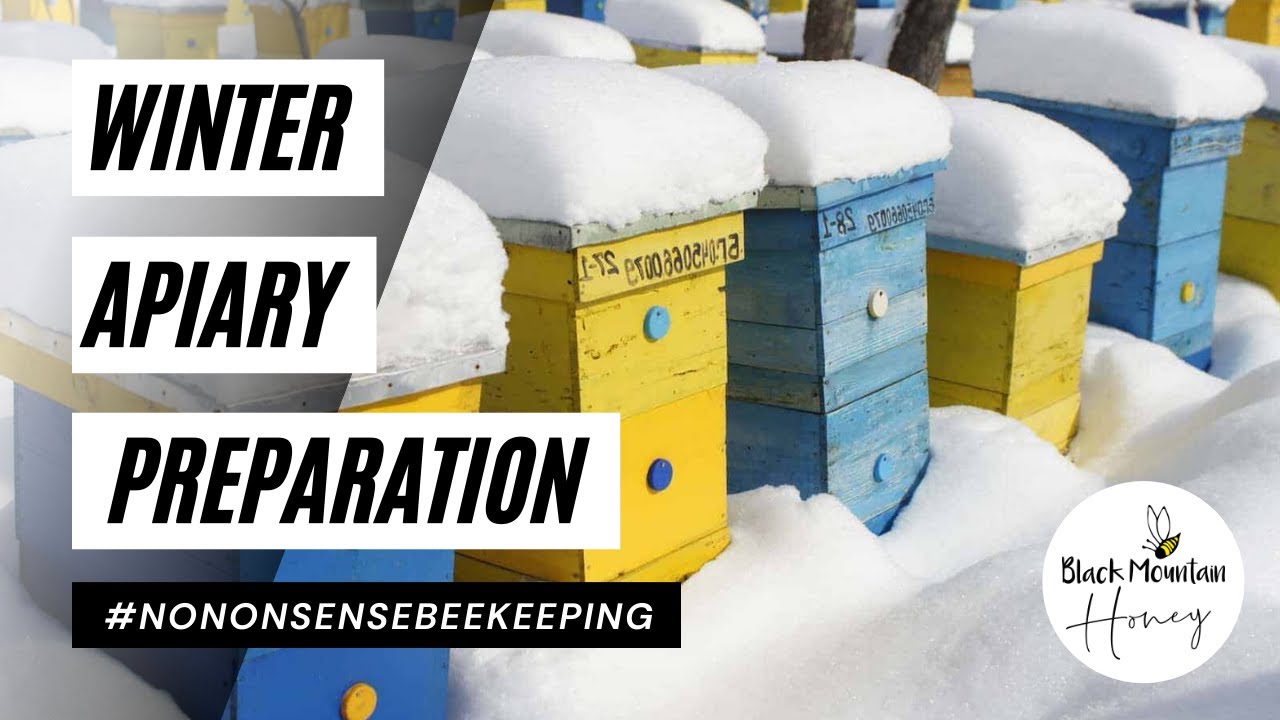
In this instructional vlog, Laurence Edwards of Black Mountain Honey walks viewers through the process of preparing an overgrown, damp apiary for the upcoming season. He demonstrates clearing excess vegetation with a chainsaw, strategically stacking cut branches and logs to create wildlife habitat for amphibians, birds, hedgehogs, and other fauna. Edwards discusses the condition of old, wet pallets and outlines a plan to replace them with a double‑pallet system that allows moisture to rise without compromising the top pallet. He explains past flooding issues and his intent to build a more flood‑resilient apiary. To improve accessibility, he cuts a new gate in a barbed‑wire fence, installs a pallet gate, and positions the gate to allow his pickup truck to pull within 10‑15 feet of the hives, reducing the need to climb over fences. He reflects on the importance of good road access, the challenges of field‑based apiaries, and his winter preparation strategy, including feeding logistics and the decision to keep bees on‑site rather than moving them to a central winter location. Edwards also mentions future video plans, including using a GoPro for live streams, and encourages viewers to subscribe.
Chapters
Hi, I'm Laurence Edwards from Black Mountain Honey, and today we're looking at how to clear out an apiary. So I've come down to one of my apiaries today and it's very overgrown. It's a bit damp, so there's a stream running very close to this apiary, but it's a really nice spot. It's secluded, it's completely out of the way, but it just needs a little bit of maintenance to get it up to scratch for the upcoming season. So all I've done is I've been chopping down some branches with a chainsaw I've been stacking up all of the logs that I chopped down into nice log piles, which kind of increases the biodiversity and the habitat for amphibians that come out of the stream. So wherever possible, we try and kind of work with the environment and help it along wherever we can. I've stacked up all of the brash, so I'll show you a couple of these videos in a minute. Stacked it up, all the brash, which means that the birds can get in there and create their nests. And like I say, we just try and work with the environment. So as opposed to coming in and cutting down all of the branches and taking it away and burning it. We kind of strategically leave it around the apiary to help with the wildlife. You'll see in the background there I've got some pallets here. They've been here about 3 years now, these pallets, and they're a bit wet, so I'm going to replace some of them next year. What I'll end up probably doing is leaving the wet pallets on the floor, and then I'll put another nice clean new pallet on top of it and hope that the moisture that comes along around here seeps up into the bottom pallet. and the top pallets stay nice and fresh. Also, we have had a couple of floods in this area before. It's not much at all, it's got really good flow, so it's never more than kind of 2 or 3 inches, but I have come down here and it's been completely underwater. So I've been meaning to turn this apiary into a double pallet stand for a good while now. So I'll show you around, show you what I've been doing, give you a couple of pictures of the apiary, and you can see what you think. So what I'm also doing today is I'm cutting a couple of gates into the fences. So a lot of the farmers around here will keep cattle and sheep. There's not a huge amount of kind of crop growing, so it just tends to be keeping animals. So all of the areas, we try and protect them as much as possible from any animals coming in. So they tend to be in woodland, out of sight. I don't really get many spaces where I can go in and just put them on a field, but it does help. I get to keep them kind of nice and out of sight. But what that does mean is that I end up getting places where I have to kind of clamber over barbed wire and it becomes a little bit difficult. So what I've been trying to do this winter is improve the apiaries so when I get back into them into the season, it's a lot easier for me. One of the, the number one criteria that I ask for when I'm looking for apiary spots is good road access. I don't like getting stuck in fields. I used to get stuck in fields all the time before I got my pickup truck, and since I got my pickup truck, I still always get stuck in fields. So I really do prefer to have some sort of hard track leading down to it. And also what I don't like is I don't like not being able to get the truck right up to the hives. Now in this particular apiary, it was quite good last year. I can get the truck within— you see it in the background there— within maybe 10-15 feet of the hives. But in between it, there is a barbed wire fence, and then there's a number of trees and an old cable kind of fence that I used to trip over, and it just caused issues. So again, what I'm trying to do this winter is make a lot of these apiaries more accessible. So what I've been doing today, I've been chopping down the branches, stacking them up to improve the wildlife habitat around here, and creating a new gate in the fence. And then I'm going to put a pallet on it so, um, it stops any livestock getting in but gives me nice and easy access. And that's about it. So I've been here for about an hour or so. Um, it's a lovely day. It's nice to be back out doing stuff as opposed to be in the house knocking up frames. So I shall show you some of the videos and see what you think. So you can see here that the stream is passing by quite close to the apiary. It's a very small stream and it flows quite nicely. If you look over to the left, I'm not sure if you can see it with this, it actually floods and kind of comes onto the plain that I'm in there, but there's a big mound in the way so it never actually gets in my way. So what I've done here is I've chopped a big set of logs. Now, I could have taken them home and stuck them in a log burner, but I've put them there in a strategic place. So in the spring when the amphibians start mating and you get the frog spawn, the frogs, they love to go somewhere nice and warm, somewhere secluded, just as they're kind of emerging out of the stream. And there's a few, couple of ponds just off to the right there where there's some real nice kind of stagnant still water that they love. They'll hop along and and find a nice pile of logs where it's nice and warm and they're safe from predators. And it took me all of 15 seconds to do it, but that should really help them along. Also hedgehogs, other mammals like to kind of bury themselves in these hedges— sorry, in these log piles. And it's just doing every little bit you can to try and help the wildlife in your area. So here is the big pile of brush that I've stuck there, and again, I could have taken that back and chipped it. To be honest, in a couple of other apiaries where it's really bad ground conditions, if I'm ever clearing wood like this, I might bring a chipper along and stick it through the chipper and then put it on the ground. And that's not so much to help the wildlife, that's more just to kind of improve the ground conditions so it doesn't become too boggy. But here it's not too bad and I can get away with the ground conditions as they are. But it's a really good dream. We're on a fully organic farm here. Not that the honey's organic, but yeah, it's a fully organic farm, so they do absolutely everything they can to kind of help the wildlife along. So putting these strategic stacks of A brash is an ideal place for early nesting birds to come in, create their nests in there, and then as that starts to rot down, I've got some big logs at the bottom, and you'll do the same, the hedgehogs will come along, and it's just a kind of good place for lots of animals to hang out and create their homes. So I'll give you a bit of a move around and see what else is in this apiary. So that's the last job for today. We put in the pallet gate. It's a very easy fix to put in a pallet gate. So we cut the wire fence either side with a little angle grinder, and then we just secure it to a tree or another post, and then we just wedge in and ratchet strap in the pallet. It's probably more solid than the fence that was originally there. And when you come to kind of work the apiary, it's very easy just to get that out, and then you've got really nice clean access in and out. And now I'm doing— I'm 10 to 15 foot away with the pickup truck, which means when I'm carrying supers, when I'm carrying additional brood boxes or feeders or anything like that, I can get really close in and I haven't got to clamber over a barbed wire fence, which has accounted for a number of holes in my bee suits. So good job with the pallet thing there. I've got about 3 more apiaries I need to do the same as this has, and then I can start bringing the bees back. So I take my bees away to winter in a central location, and I'm probably going to stop doing that next year. The reason I took it away from here is I wasn't entirely happy with the access for feeding, but now that I've resolved that, should be better for next year. And if I can get all of my apiaries like that, where I can get the pickup truck nice and close to them and they're at no risk of kind of flooding over the winter, then I'll probably leave them there and take the feed to the apiaries, as opposed to take the bees back to where I can find it easy to feed them. So that's it for today's video. I hope you're enjoying it. I intend to upload a few more videos of kind of what I'm getting up to over the winter. I've just bought myself a GoPro, so I'm gonna have a go with that. I'm gonna strap that on and maybe have a few live streams with that going forward, see how that goes. But I hope, I hope the videos are enjoyable, and if you, if you're liking them, please hit the subscribe button. Thanks very much and see you next time.