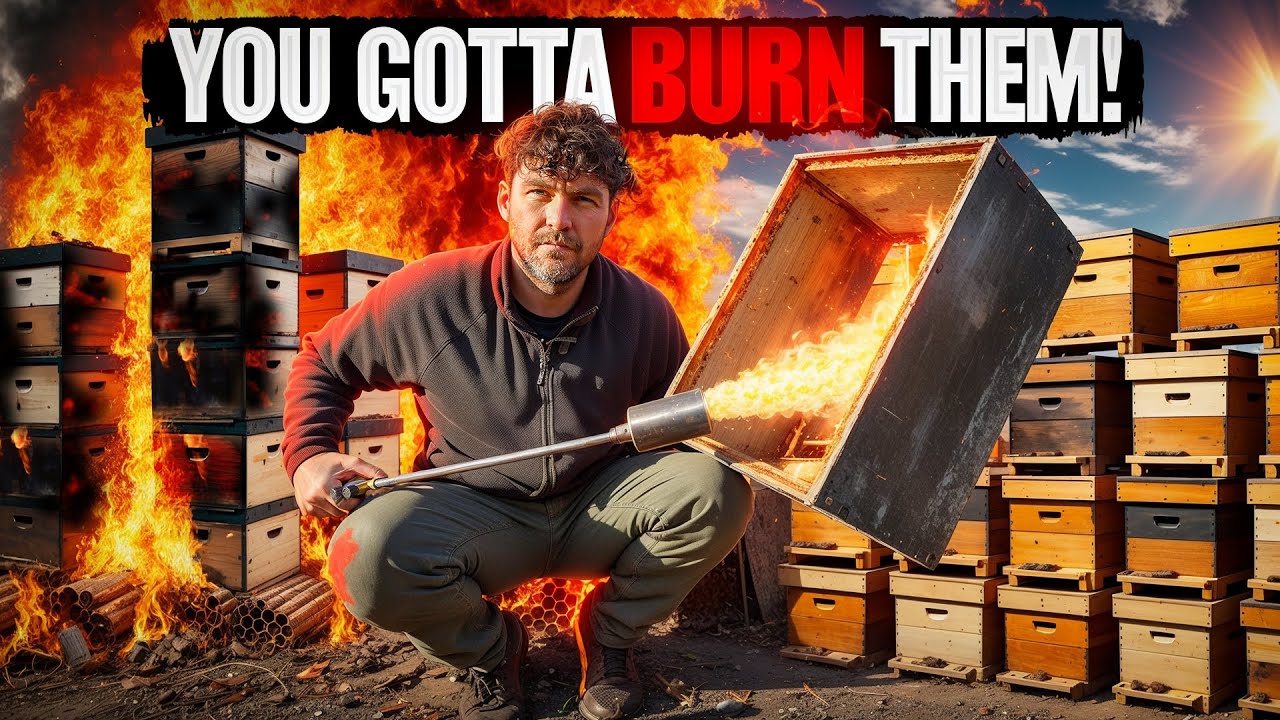
In this instructional video, Laurence Edwards explains why and how to sterilise wooden beehive boxes using fire to prevent the spread of American foulbrood (AFB) and European foulbrood (EFB). He outlines the circumstances that warrant sterilisation—winter colony losses, acquisition of second‑hand equipment, or any suspicion of disease. Edwards demonstrates the full workflow: (1) scraping off all propolis, wax, and debris with a hive tool to expose raw wood; (2) using a propane blowtorch (small chef’s torch for occasional use or a larger roofer’s torch for many boxes) to scorch every internal wooden surface to the point of near‑ignition without actually setting the wood ablaze; (3) re‑scraping any charred, brittle material that falls off after scorching; (4) brushing and giving a final quick torch pass to ensure complete sterilisation. He stresses that the method works only on wood, not on plastic or poly hives, and recommends working with the grain to avoid splinters. Safety tips include having a means to extinguish flames and using a torch with an ignition switch for efficiency. Edwards shares practical advice on tool selection, cost considerations, and time estimates (e.g., ~45 seconds per side with a small torch, longer for many boxes). He concludes by stating that after adopting this routine—scraping and scorching every box annually or after any dead‑out—he has experienced zero cases of AFB or EFB in his apiary, positioning the technique as a cheap, simple, and essential hygiene practice for beekeepers.
Chapters
Are your beehives harboring disease? If so, there's only one thing for it. You've got to burn them. If you've had a colony fail over winter and you don't know why, or you're buying secondhand equipment from a bee farmer that you don't know, you need to make sure that you sterilize your beehives, scrape them down, scorch them in order to stop the spread of disease. We're talking American foulbrood, we're talking European foulbrood, AFB, EFB. If those diseases get into your apiary, you are in a lot of trouble and it could potentially be the end of that apiary and every single bee needs to be killed. In this video, I'm going to show you how to scrape and scorch and sterilize boxes. It's dead simple, it's cheap to do, and there is no excuse for you not doing it at home. So sterilizing your beehive, super, super easy. You need a hive tool for scraping everything down, and then you need a propane burner, either a little one or a big one, to get in there and burn all of that wood and make sure that it is completely sterile. Now it goes without saying, don't do this on poly hives, don't do this on plastic hives. Only works on wood, works on any type of wood—pine, cedar, whatever you've got—and I always say go a little bit over the top, and that way you're definitely going to get that disease. You want to burn the wood as much as you can without setting it on fire. That is my mantra. Let's jump straight into it then, and I'll show you how to do it. So as you can see on these beehives here, it builds up very, very quickly with you know the odd bit of dead bee propolis wax. This is where all of that disease is going to live. You need to take off every last little bit of all of this propolis here, scrape it down, discard of it in a sterile. What I like to do is just kind of do it in an area and then just have a massive fire on top of it, and then that way I know that I'm not spreading it anywhere. I've got loads of pallets and stuff that I need to burn up here anyway, so that's the plan for today. But all we're going to do is we're just going to get in there and start scraping this as best as we possibly can. And you can see just how nicely that comes off there. So you can see what I mean, all in the corners there, gunked up, tons of propolis carrying all of that disease, all the way along the runners, all the way along the top of the beehive there. Even if you go into the beehive, you'll see there's some wild comb on that wall. We need to scrape every last bit of that down, get it away, and then we will burn this beehive to within an inch of its life, and that will ensure that it is completely sterile. So I'm just going through every single side, top, bottom, inside. Don't worry too much about the outside. I take my hive tool, I'm scraping off all of that propolis, all of the wax, anything inside, just trying to get it down to a rough wooden surface. Take your time with this, it makes the burning way, way easier. So once you've scraped down the hive, it should look something like this. You'll still have wax stains, but you've got the majority of that wax off, all of the propolis off. Some of it's smudged in a little bit, but that doesn't matter because when we get the flamethrower in there, it will fix all of that completely. So once you've scraped it all down, all you want to do is take your blowtorch and go over every single internal wooden surface to get it to a point where it's starting to set on fire, but you just want to go back that tiny little bit. You don't want to set it on fire, but you want to get it really, really close to setting it on fire. Now I see loads of videos online with people and I don't think they're doing it enough. What I'm doing here is not detrimental to the wood. You see it in the wild, you'll get like a big massive lightning storm and you'll get a lightning bolt comes into a tree trunk and hollows it out, and then the bees move in. They seem to like hollowed-out scorched wood for some reason. It's good on the outside, gives you good weatherproofing, but I'm not going to do that today on the outside. A method called Shou Sugi Ban— done another video about that, and that was very, very cool. But today I'm going to properly scorch the inside, give the outside a once-over, and then that will ensure that this box is sterile and ready to go back into my production hives. Now, if you want to use a little chef's blowtorch, you can use that. I would recommend minimum upgrading to a big kind of Rothenberger blowtorch like this. This is probably the minimum that I would I don't use this one. I go and use the big boy behind. I'll show you what this one's like first. You can see nice flame coming through, and all I'm going to do is just start burning the inside of that wood, and you will see an immediate change to the color there. So you can see there, I'm taking it to a point where it's just getting really nice and blackened. As soon as those flames pop up, I've gone too far. I move on to the next bit. That's a really, really good guide, and it gets your box into a very nice position for those beehives. Now you can see there I've got halfway through one side of this box using that torch, and that probably took me like 45 seconds, something like that. So if you've got 100 boxes to do, that is not the tool that you want to be using, and you need to up your game a bit and get yourself a proper roofer's blowtorch. Only about £100, something like that. I have to say, the one that I bought, I wish I'd bought the better one. It's not got the ignition on the one that I bought. If I was buying it again, I would definitely buy one with an ignition built in. Double the price, but it saves you lighting it every single time. Let me show you how it works now with the big guns. So get the mega torch and we get that lit like that. So you'll see each time I do it with the big blowtorch, I nearly set it on fire. So you need to kind of like have something on hand to put out the flames if you do do it like that. Or you could just tone it down a notch. But I like to go full on with the blowtorch, make sure that there is no disease present. So then what I like to do at that point is just go over with the hive tool again, scrape off anything that you've missed, any things that have kind of become like a bit brittle and crumbling away. Just get it really, really nice and clean once more. And you can see what I mean there. Look at all that kind of dirt and gunk coming off. That wouldn't scrape off before, but because you've scorched it all down now, that's coming off really, really nicely. Now, where possible, best to work with the grain. Means that you're not going to kind of get any splinters away from it. In some areas, that's just not possible, so you just got to do your very best. Now what I like to do is give it a brush clean like that, go over it again really, really quickly with the blowtorch. And the boxes are ready. So there you go, you can see we've scorched everything down, charred it away, scraped all of those surfaces down, and we have got one very nice clean box ready to go back into circulation. Now if you're thinking about doing this to your beehives, I highly, highly recommend it. Any used beehives that you buy, you should be doing this as an absolute minimum. I do it as well. If I have a dead out and I don't know the reason for that dead out, I will scrape down and scorch every single box every single year. But I just make sure that any dead outs go through this process to limit the spread of any disease within the apiary. And since I've started doing this, I've not had a single case of AFB or EFB, and I don't plan to have another one anytime soon.