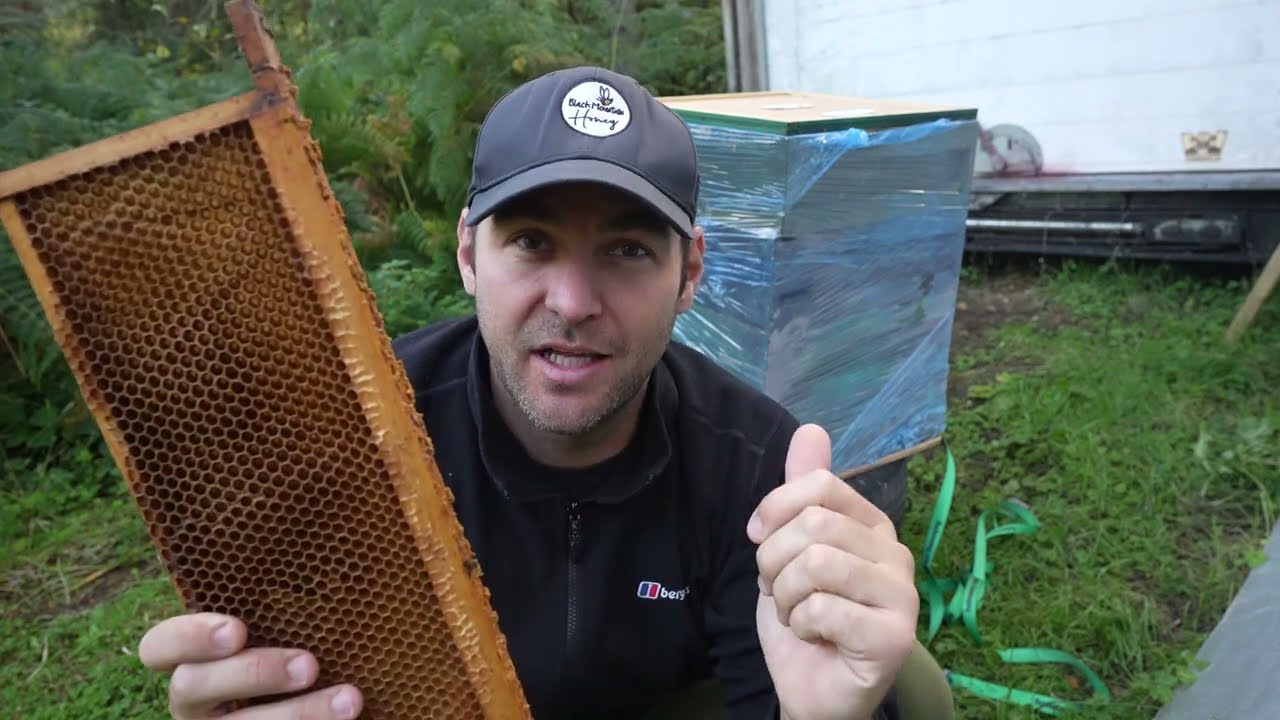
In this instructional video, beekeeper Laurence Edwards explains why drawn wax frames are the most valuable commodity in beekeeping and how they are vulnerable to pests such as wax moths, rats, and mice during winter. He contrasts the two conventional storage approaches – the dry method (capped, extracted, fully dried frames stored dry) and the wet method (extracted frames kept moist). Edwards advocates the wet method, claiming it results in far less wax‑moth damage and makes the frames easier for bees to re‑use in spring because residual honey remains on the comb. He then demonstrates his complete wet‑storage system: two tyres lift the boxes off the ground, a ratchet strap secures a strong roof or plywood panel, and the supers are wrapped tightly in blue food‑grade plastic that both slows moth entry and deters bees. The entire assembly is sealed, ratcheted tight, and stacked in a cold outdoor storage box. In the cold climate of North Wales, winter frosts further kill any moth eggs or larvae that might infiltrate. Edwards emphasizes keeping the system sealed, using off‑site storage to avoid contaminating the apiary, and the simplicity of retrieving the supers for spring use.
Chapters
Drawn-out wax frames is the number one commodity that you want to protect in beekeeping. In this video, I'm going to show you my method for getting those frames through the winter. So the reason that getting your wax frames through the winter can be difficult is that there's lots of pests that like to either make their home in the wax frames or they just like to eat them. You've got wax moths, you've got rats, you've got mice, you've got all sorts of different vermin that will get in and they will destroy those combs. Wax moths can be a real problem, and if you get them in there and don't treat them properly, they can obliterate both honey frames and brood frames within a single winter. There's 2 established There are 2 methods of getting your frames through the winter, the wet method and the dry method. Dry method means you take your honeycombs, you take the cappings off, you extract them, you put them back onto the colony, don't open feed them, the bees will clean them up, you get them to a point where they're completely dry, and then you can go ahead and store them. That's not the method that I use though. I use the wet method, which means you take your honeycombs, take the cappings off, extract them, put them back into a box wet, and then you store them wet over the winter. I find I have much less wax moth damage using the wet method, and I also find that they're Really helps the bees moving up into the supers after the winter if it's got that residue of honey remaining on the frame. Enough of me talking, let's show you how I store my wet supers over winter. So this is what we're trying to protect here. This is actually a dry piece of comb. I don't want to get the wet ones out because I'll create a real robbing frenzy in this apiary. But as you can see, perfectly uncapped out of the uncapping machine. The bees will take to this next year and they will fill it up with honey straight away. I'll get it back into the system behind me and I'll show you how I prepare it to make sure that the wax moths don't ravage it over winter. So what I've got behind me is the wrapping station that I use. I use 2 tyres to lift up the boxes from the floor. I then lay a ratchet strap underneath it, and then on top of the ratchet strap, I either put a poly roof, a wooden roof, or if you run out of those like I have this year, either a crown board if you've sealed up all the holes, or even in its simplest form, you can just cut a couple of pieces of OSB or some wooden plyboard. What you want to do is you just want 2 really nice strong pieces of poly or wood that you can ratchet together and make sure that you're keeping everything nice and tight and sealed. That's the key thing here. If you're keeping it sealed, the wax moth can't get in. Simple as that. And if the wax moth can't get in, then the wax moth can't go and eat that wax, create the larva, and destroy the frames inside. So rule 1, when you're using the wet system, keep everything out. Ratchet it up nice and tight. You'll also notice on here though I've got blue food-grade plastic on here as well. That does 2 things: slows down the wax moth getting in there, but it also makes it very, very difficult for the bees to get in there, and it stops the bees being attracted to it so much more than if you did this without wrapping it up. So as I said, my system: 2 tires, ratchet strap, upturned roof, then I put my supers on there, then I wrap it all up in blue plastic, I seal the blue plastic at the top and the bottom put the roof on or another piece of ply on top, ratchet everything together as tight as you can possibly get it, and then I stack it up in one of my storage boxes and I leave it outside somewhere where it's going to get nice and cold. For us in North Wales, makes it so much easier because we get real cold frost over winter, which means that even if some wax moth do get in there, once you get that cold frost, it completely eliminates everything— eggs, larvae, wax moth. Resets everything, and even if you get like a little minor outbreak of wax moth damage, it's isolated because come November, come December, come January, you get that cold snap and it wipes it all out. So this is the plastic that I use. Get the blue one, it's food grade, it sticks to anything. Keep it nice and tight, nice and taut, and it will stick to your supers no problem. Once you get this final bit at the end, keep it nice and taut, lift up the box, and just tuck it underneath like that. And then the final thing to do, get your ratchet Put your strap on, tighten it up as much as you possibly can, and you have completely eliminated the chance of wax moth getting in and wrecking this honey supers. As you can see, we're in a live apiary here. The bees aren't interested in this 'cause they cannot smell the honey through the plastic. We do this offsite and bring it back for storage here. You don't wanna be doing the honey wrapping in an apiary because the bees will make a right mess and they'll just get trapped in between the plastic. All we do with these now, we take them into our storage facility, stack them up, and they're ready to use in the spring. It's as simple as that.