I Broke My Own Beekeeping Rule. But It Proves The Point!
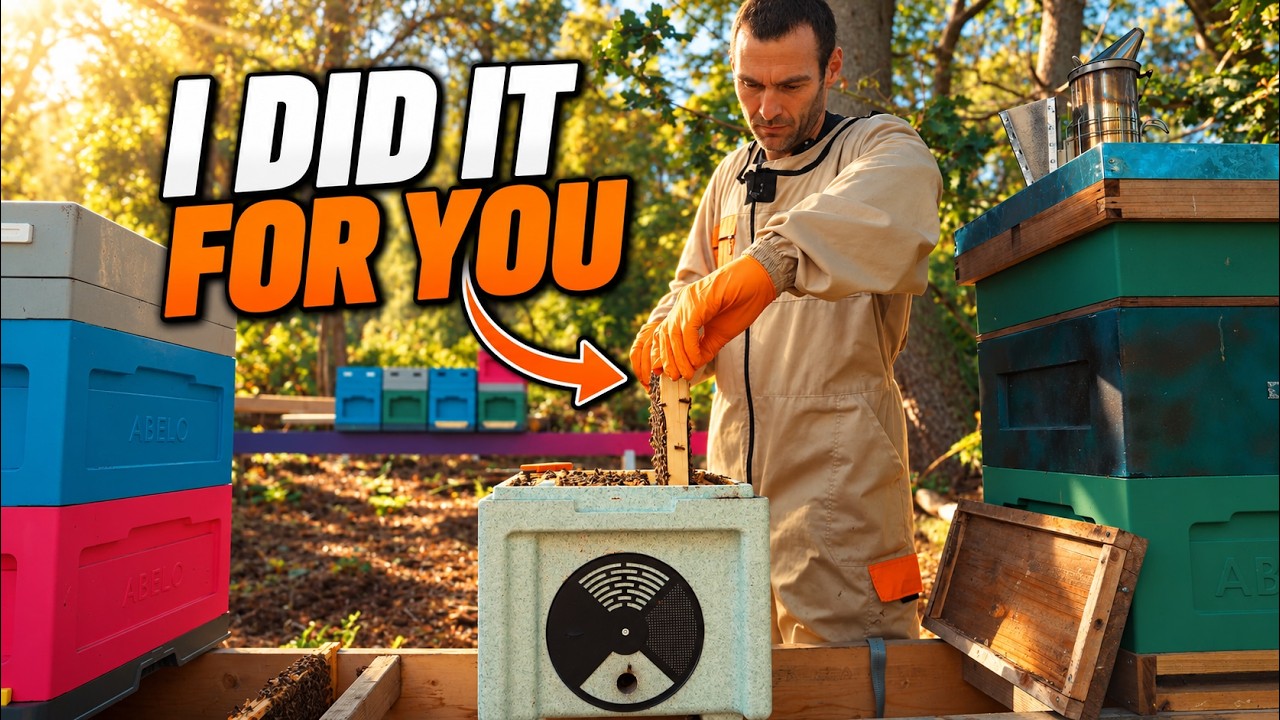
In this on‑site instructional video, beekeeper Laurence Edwards, assisted by Zane, spends a day preparing 35 colonies for winter. He removes the old‑formulation Apivar mite strips, feeds the bees with syrup and invert sugar, installs propolis screens and traps, and weighs each hive to assess winter readiness. Laurence demonstrates a smokerless "Gunsmoker" from the USA, comparing its bee‑response to a traditional smoker. He explains how to size and fit propolis screens without obstructing feeder access, shares his weight targets for colonies (10‑15 kg depending on time of year), and discusses feeding ratios (1:1, 2:1, invert sugar with Hive Alive). The video also captures unexpected field events—a wasp nest, an owl box, and a late‑season swarm that left a colony queenless—illustrating decision‑making under pressure. Throughout, Laurence emphasizes practical tips, safety, and provides a free PDF guide covering his winter‑preparation checklist. The tone is informal, conversational, and enthusiastic, aimed at hobbyist beekeepers seeking actionable advice.
Chapters
It's the one that swarmed. What are the chances of that? That's crazy. Or else I would set fire to the whole of the UK. They're definitely responding to it, aren't they? They didn't like it. We chose the best day, I think, in September to do this video. There's like a common theme. They come after you a little bit. They're not friendly. Look at that massive one there, Zane. Pull the grip up and then you weigh it and see what it is. Today I'm signing off some colonies for winter. I'm doing my final feeds, I'm taking the Apivar strips out, I'm getting my propolis screens in, I've got electronic hive scales, I've got smokerless smokers from the USA, and we have got way too much to do in a single day. So, Zane, let's get to it. A Gazette! Let me read it to you. Yeah, there's a note in here. So you know what it is yet? It's when we went to Narby, so he got in contact. This is— we've been trying to get this over here for so long, and we've got it over, but I was not expecting that. That's really cool. I love this sticker. A blend of smoke and floral aroma compounds. But let's try it out. We've got loads of colonies to go into today. We're taking out the Apivar strips, we're feeding them up, and it's late on in the year, so the bees will be angry. I'm going to light up a regular smoker that will keep me going all day, and we'll keep this one going as well, and we will see Which one comes out on top? They're definitely responding to it, aren't they? They didn't like it. Right, first impressions of that, Zane. I'm really impressed. It's worked, like actually comes out and fires something, which is good. And then when I fire it on the bees, and we will, we'll open up some colonies and really give it a good test. But if you see Like the bees coming in here, a few bees knocking around, and then I smoke them. You hear the roar, like that's what would happen with normal smoke. So it's kind of acting in exactly the same way without the risk of fire.
She good.
So Zane just asked what these are. These are propolis screens. And you can buy these from beekeeping supply shops and they're really expensive, they're like a fiver for each one. But if you buy fly screen then it's super cheap and you just want to cut it to go on the beehive like that. And you'll notice there's like a huge void and a space at the top. It doesn't need to be that big but what it can't be is it can't like go over the whole thing because then it will block the bees going up into the feeder. I'm going to show you exactly how I put these on and then hopefully we catch tons and tons of propolis. But I need about 50 of these, Zane, so— You can be undoing them.
Yeah.
Yeah.
What's my job? Scissors, I guess?
Yeah, scissors. So if I, if I pull it kind of back to there, that's the right size. That's 460.
Just want to get straight through the middle there. Oh, the pressure.
Sweep.
See, you know what my track record's like with scissors. I'm surprised you're trusting me.
Better than mine. It is true. Why did you struggle so much with the scissors before? I don't know. Zane came up to me and said, I can't cut this ratchet strap, and you were giving it a good old go, weren't you? And then—
I feel like I'm quite a handy guy as well.
Way more handy than me. It was embarrassing, Zane.
Yeah, it was.
It made me laugh quite a lot. I don't often get to have the upper hand, that's the thing, isn't it?
Oh, the hand was very much offered, wasn't it? And Laurence made sure I knew.
Yeah, but all right, let's have the opposite view, which was The game that we played, which was trying to get the sticks into the— what was it? The wheelie bin or the wheelbarrow?
Yeah.
Zane did it straight away, although I think I pretty much did it first time before we were playing a formal game, and then I couldn't get it in and was getting frustrated, and then Zane stopped throwing sticks in and went and collected me some pity sticks. Yeah. And then what happened before I used your pity sticks?
Just as I went to pass you the pity stick, you got it in.
It was the pressure.
I love it. I feel like I'm taking your job here, I need to let you pull it.
No, this— oh yeah, I've not been doing any of the work, I've just been lifting it up. Yeah, it's kind of easier for you I think.
I'll let you line it.
So propolis screens are very, very easy, and ideally you want them 460mm by Probably about 400mm, and the reason that you're not doing a full 460 by 460 is that you need to leave a slot there for the bees to go up into your feeder. Now that slot could be in the middle, you could just do a propolis screen and cut a big hole in the middle if you've got a rapid feeder, and you do the same if you had a mille feeder as well, you could have a bit on that side and a bit on this side. I find with the polyashworth feeders though, the easiest way is buying a roll like this, which is a 300mm roll. So So this dimension here is 300mm, and then I've cut it along that dimension to match exactly with the National, which is 460mm. It's as easy as this though. You just place it on and you can see it goes flush all the way up to the edges, and then it leaves this void. So if you zoom in here, Zane, and show this void, really this could probably come up to here with the propolis screen, but you just need to make sure that when you take your polyashworth feeder like this, You line up this gap with your big open void. Can you see, Zane, how if I did the mistake— and it's a really easy mistake to make— you put your propolis screen on and then go and put your feeder on this way, the bees can't access the slot. Even though there is a bee space to get through, they will struggle to find it. So you need to make sure your feeder is like that, and then the bees have got access. And then it's as simple as that. You put the propolis screen on at the top of the stack underneath the feeder, and then the hope is that the bees will work their way up, finish in this top box, and when you come to open it up in the spring, you crack it open and you should see wonderful golden propolis. That is the plan anyway. All right, we didn't need the smoker at all on that one, Zane, and I forgot that I was supposed to be doing my little experiment. So going forward on the rest of the colonies that are here, and there are some jumbo colonies, I'll take both of them. And we'll see which one is best at kind of getting the bees down there. I spoke to the, the people who've been doing it as well, and they said they've had a few leaking issues, like leaking barrel up here, but it doesn't seem to be that bad. I know some people have reported it, and they said they're working on a new design for it. But so got both smokers lit, if you want to call this one lit, but we got lots and lots of work to do. So the plan for the rest of today is going out. I've got about 35 colonies that we need to heft and weigh and feed and take the Apivar strips out, put my propolis traps in. We have got loads to do, Zen, so should we make a move?
Taking no sausage rolls today?
I've not even brought any lunch. Sorry, mate.
Honey for lunch and dinner then.
Yeah, yeah, let's do it. So it's a really important job that I'm doing today. I'm going through every single colony that I've got and I'm taking out the Apivar strips. Now all of the Apivar strips that I'm using are the old formulation, the only formulation that's available within the UK. There is a new formulation that is available in the USA and people are having a few problems with it. So if you're in the USA, I would go with a different formulation, a different product. Still try and stick with Amitraz, but if you can't get a decent Amitraz product, you need to go ahead and use either Formic Pro or oxalic acid or whatever is going to work and whatever is licensed in your area. But for me at the moment in the UK, the original Apivar is still very effective. But one of the most important things that you have to do is you have to go around after 3 brood periods, around 10 weeks, and you have to take them out before winter. People talk about varroa mites becoming resistant to Amitraz, and they will become resistant to Amitraz if you leave them in over winter. So my job today is simple. I'm going around every single colony, I'm opening them up, I'm taking the strips out. I'm not pulling out any frames. I'm having a little bit of a look inside the colony whilst they're open and I've got that opportunity to do so. Definitely not pulling any frames out though. I'm hefting them, I'm feeling what they're like for weight. If I need to, I'm weighing them with a little luggage scale. I'm putting some propolis traps in to harvest some propolis over the winter season, and I'm making sure that's not interfering with the polyash forth feeder. And then finally, I'm going in, giving the bees a feed if they need it. There's a wonderful, wonderful ivy flow on at the moment. You can see it, you can smell it. The sun is here and the bees are working really hard, so they're doing a lot of the feeding for me, which is really, really good for the A lot of work to be done though. I've got to go through every single colony in this apiary, get them fed, get the strips out, and get them ready for winter. Right, first go on the Gunsmoker. Not that many bees in here, but let's see if we can drive them down a little bit. Definitely got like a response, didn't it? You hear the roar? That's that's good. That's what I would expect to hear. I mean, similar, similar sound, similar response. We need to test that on a bigger colony, Zane. I think. So what you have to remember is what you can't do at this point. Do not get caught in the trap of thinking, oh, bees, I've not seen bees for a while, should we have a little look? Because you can see quite a lot just from looking in the top of the box, and I'll talk you through exactly what I'm seeing here at the moment. But you have to resist the urge. It is the easiest way to kill your colony. If you go out now, Zane, and take a frame out and squish the queen, game over.
Yeah.
Like, they'll try and create a new one and fail, and you'll you can't buy a new one.
Mm-hmm.
So every bee will be dead. So I'm not gonna pull the frames out, but I was gonna pull the frames out. I was like, oh, let's have a little look. But no. But if you, if you kind of come over the top and have a look in, you can see like we've got the nest in the middle there, we've got lots of bees in it and they're drawing it out. But towards the edges, we've not got that much. There's some bits where the bees have yet to even draw it out completely. So it gives you a little bit of a problem. It gives me a problem. I kind of think, well, mm, do I wanna stay on double brood? Should I shake the bees down into a single brood box? And that could be a solution here, but I do have a rule now, which is if you're not sure and you're on the fence, then you don't do anything. But I wouldn't actually do nothing with this colony as well, because I've been saying to people all the way through the post-harvest period that you don't want to feed too much. The risk of overfeeding is real. It will make your colony collapse. And then when I look at a colony like this that is probably 50 or 60% full on the top box and then 100% full on the bottom box, which I'll show you in a second, It's very, very difficult to overfeed them, basically impossible. And if you feed a bit more now, it's going to fix that problem, which is some of those frames down there are a bit bare, they've not got stores in them, they've not been completely drawn out. And I've been able to assess that just by looking. I've not opened up any boxes, I've not taken any frames out, I've not done anything. I've just kind of come to this point here because I'm going in to take my strips out anyway. I got a bit of a free look in, and that's the assessment I'm going to make on this one. So I'm going to open it up, I'll take the Apivar strips out, I'll get my propolis trap in, I'll feed them heavily, 2:1 sugar syrup, and I will sign these ones off for winter. We chose the best day, I think, in September to do this video, Zane. They have not been this chilled for ages, have they? No, they seem very relaxed. Super chilled. This is a Lutz Egger 2025 blue-marked queen, really, really old queen. And I just love these bees. They are so, so chilled out. So just another 35 of them to go, Zane. That feels like quite a lot of work, doesn't it?
Just a touch.
We'll be quicker, we'll be quicker, don't worry.
Just quick question.
Yeah.
Why is there a load of wasps picking them out?
It's our wasp nest that we got from that yard with Jono.
I thought you were gonna like destroy it or something.
There's actually loads still left in it.
There was—
when I came back, there was still quite a lot, and I shook them out out there, and then I guess loads more have come out. They come after you a little bit. They're not friendly. Look at that massive one there, Zane.
Jesus.
Yeah, like, watch it come out. Watch it come out. It's huge. So they're building a new nest there. I'm going to kind of creep past them now. She's like super angry, but interesting.
What's the plan now then?
We need to do all the rest of the colonies, but you see the owl box that we put up? Someone very kindly pointed out that we should probably put some bedding in it so the little owlets have got somewhere to chill. So I just want to, I want to get some stuff from the ground, some nice dry stuff, and we're going to fill it up quickly. You seen the stone circle, Zane?
It's looking good, isn't it?
Yeah, yeah. The idea that we'll put the burner on there like we did the other day and then I'm going to put some lawn down so it's quite safe for having a fire, but this stuff up here is, is perfect for this. But this is, this is what we're looking at here. Just, it's like the ground in a woodland.
It's like natural bedding, isn't it?
Yeah, it's quite nice and dry and warm. Look at these bits here. It's just twigs and leaves and moss and, I don't know, everything else. There's like a common theme here, Xane.
What, Lawrence and ladders not working?
He's trying to camera it as well, that's the difficulty. I can't, I can't, I have to turn this off. Take two.
Be careful.
Yeah, and I'm. I do like Zane that he cares about the health and safety.
Good man.
Right, I'll come down. Right, we've done the wasps. We've done the owls. Should we stop procrastinating and do? Some beekeeping. So Zane pointed out there that we started and did one colony, like literally one out of the 35, and then we got distracted by the wasp's nest, and we got distracted by lunch, and we got distracted by Zane's drone video, which is very, very cool, and then we got distracted by an owl box, and then I dropped an owl box on Zane, and then it fell on a beehive, and all the angry bees came out and got him, and now we're on to hive number 2.
Yeah.
I think we need to strip out the interludes and just crack on with it, Zane.
Yeah? Just a bit.
Okay, right, so what are we doing? I've spent 2 months telling people to not go into their beehives, and I think people have been really good. I see people sitting on their hands and not going in and making the mistakes at this time of the year. But the one thing that I really struggle to teach people year after year is how much a colony should weigh. So what I'm going to do is I'm going to go into this colony here, I'm going to heft it, I'm going to kind of think where I would be. And where I am with this one is I'd be thinking Doesn't really need a feed, decent amount of stores in there, but it will need a final feed if they don't get it from the ivy. But how useless is that to people at home? It's like I kind of calibrated my own arms to work that out. Someone could lift that up and say, wow, that's super light, or someone could say it's super heavy and then make the wrong decision. So I'm going to break my own rule. I'm going to weigh this colony and tell you exactly how much it weighs now, how much it should weigh going into winter, and I'm going to break it open and pull out every single frame and show you what's going on on it. There'll be brood, there'll be bees, there'll be stores, there'll be a queen, hopefully a very expensive breeder queen in this one. Do not do this at home, but we're going into the colony for one last time in 2026. I'm going to say like 9.8, maybe. Yeah, 9.8. I'll go less than 10. So these are super cheap. You can get them from Amazon. We'll stick a link in the description, and they're quite easy with little nucs like this to do it yourself. You just feed it around the ratchet strap like that and pull the grip up, and then you weigh it and you see what it is. So that one is— it's like 11 kilograms, just over 11 kilograms. So it's not too bad, I'm happy with that. So this colony here is pretty much where I want them at this point of the year. I was going to say I want them close to around 12 kilograms. I underestimated the weight a little bit. You can see how useful a scale like this is. But for back end of September, early October, before the Ivy Flow is finished, if you've got a Payne's nuc like this and they're anywhere between, say, 10, 11, 12, 13 kilograms, you're in the right spot. Wait until the Ivy Flow has finished, see if they get naturally up to about 15 kilos. That's my target weight for a Payne's nuc. And if they don't and you see the ivy go over, you can switch to feeding invert sugar syrup, maybe with a little bit of Hive Alive as the final feed. And then once all of the feeding is finished, you want to come back in, do a Final check, get them to around 15 kilograms. Now, if it's 14 kilograms, it's fine. If it's 16 kilograms, it's fine. Don't fret and don't try and do things to get it to this magical number. Just don't go into winter on 8 kilograms or 9 kilograms. You're miles away from where you need to be, and you'll be doing tons of emergency feeding. This is brilliant for doing one thing though, and I'll get Zane involved in this in a minute. This is 11 kilograms. As soon as you know something weighs a certain amount, you come in. And you heft. You're just lifting up from the back and you're thinking, okay, right, that's 11 kilograms, I know that now. And that's much easier for people at home to be able to calibrate the way that they heft and the way that they lift up a colony, because you now know, right, that's 11 kilograms. And if I gave you another box next to it, you could say, well, I think this box next to it is a little bit heavier. And you'll say, well, this one was 11, this one's heavier, it must be around 12. And you'll find you'll soon have the ability to be able to judge Pretty accurately once you've done a couple and kind of got yourself in for the day, what's inside a colony without going inside. But I promised you I'm going to go inside this colony and show you what a colony that's on 11 kilograms at the back end of September looks like. I think we're going to be finding 2 or 3 frames of brood, 2 or 3 frames of stores and pollen, decent amount of bees, and I'm going to do my best to not disturb them that much. It's the one that swarmed. You know, I told you that the Lutz Eggert one swarmed.
Yeah.
We picked out the one. What are the chances of that? That's crazy. Right, so there, the queen has swarmed. The breeder queen's gone. Fantastic.
Great.
Yeah, and that's maybe why they're a little bit, a little bit light. I was expecting them to be a little bit more heavy than that, but it's fine. What would I do at this time of the year? I do not know. Let's carry on. Let's see if we can find her first. So what are the chances of that? There was one swarm out of 25 queens that I put in here, and someone called me up and said, There's a swarm here. Your bees are swarming. They didn't say which beehive it was. And the second one along is clearly the colony because there's no queen, there's no eggs, and there's loads of swarm cells. So what would I do with a colony at this time of the year if I saw this? Not much you can do. That's the problem here then. There's not much you can do. There's no queens. I've got queen cells. I've got sunshine. I'm kind of thinking you just have to go for it. You have to let the bees have a go again. Getting those queens out and getting them mated, and we'll check back on this one. I'll leave it exactly as it is. We'll set it up. We'll try and overwinter it, and we'll just cross our fingers. It doesn't need any feeding. There's plenty of bees in here. They've got more than enough food, not enough brood. So I'm more worried now about the queen not being mated. I've taken the apivar strips out. I'll come back. I'll do a final heft and a check in terms of the weight, but I'm not going to go back in, and we'll come back in the spring and see if the virgins that are emerging now actually can go out and get mated. This late in North Wales. It'd be around the middle of October that they would be going out for mating, which is very late. We need the weather. I'll cross my fingers. I'm not holding out that much hope, but I definitely wouldn't try and do anything different. You just got to let the bees get on with it. So I've been going around adding these propolis traps on pretty much everything. I'm going to put it under the plastic as well, but it's kind of a freebie. You just take this insect screen like that and place it over the top, and then you could leave it like that. I like to put the cellophane on the top, put some more insulation on the top, and then leave the bees to it. But the bees will fill that up with tons and tons and tons of And we'll be back in the spring. Hopefully we get some propolis. Hopefully the queens go out and get mated. I was not expecting this to happen, but you know, beekeeping doesn't always go to plan. It's how you react and it's how you bounce back. So fingers crossed these bees will get through the winter.
So which one's the winner?
I got a mouthful of smoke on that one there. I'm always reluctant to give a verdict after one day. All I will say is, you know how dry it was this year, Zane? It was bone dry. I couldn't use this or else I would set fire to the whole of the UK, and I think a lot of places in the world are like that now. So I really like the idea of this working. I want it to work. I've not managed to get it to leak yet, which is very promising. And you can see the effect on the bees, isn't it? It did, it kind of did a thing. The bees roared, they moved. So I'm going to continue using this. Very, very excited. And the thing that I'm probably most excited about is the propolis traps. I've never gone to the extent of putting all of those in, and they work so well with the polyash forth feeder because the bees can only really go up a slot anyway. So I think we're going to open them up in the spring and they will be Full to the brim with propolis. So hopefully that was useful for people at home. There's quite a lot to do at this time of the year in terms of final checks, and you want to be going out and taking your Apivar strips out, making sure the colony is fed up to weight, switch over from 1:1 up to invert to get the bees to pack that weight on late on in the year. So if you're watching this and you're thinking, do I need to be doing stuff with my bees? I've produced a free PDF guide showing you everything that I do to get my bees ready for winter, and I'll stick that in the comment below.










