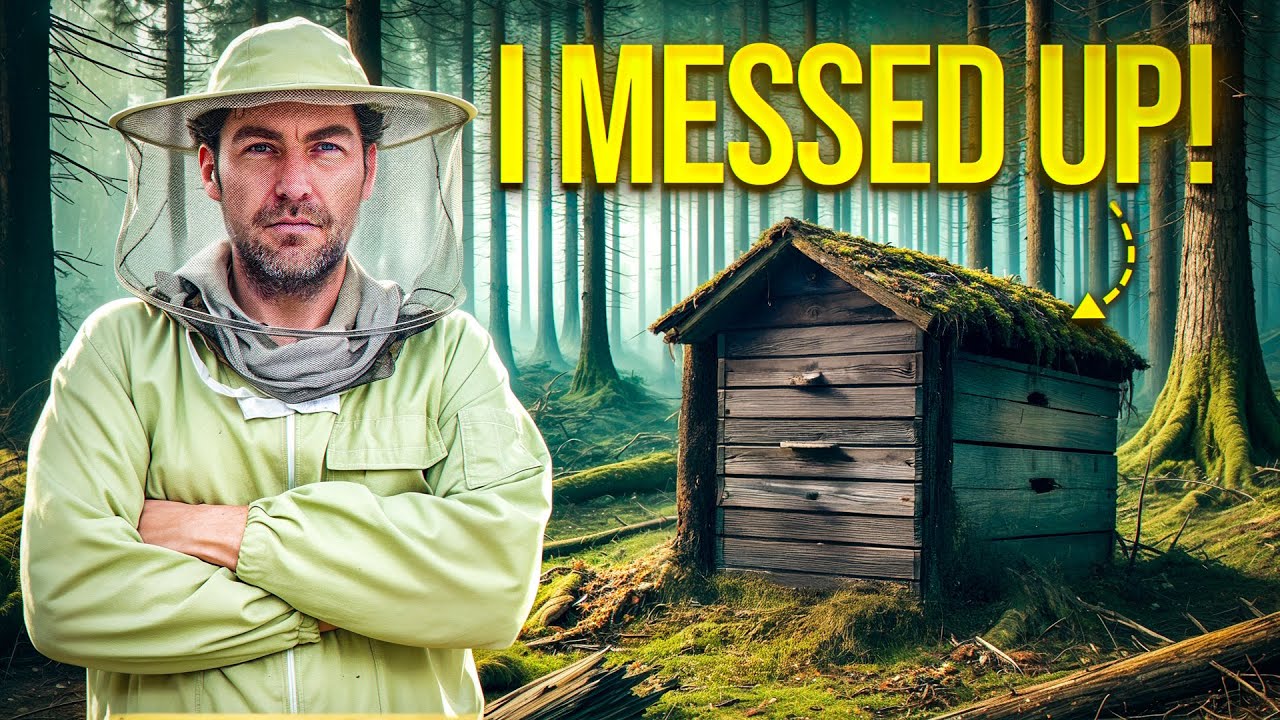
In this solo beekeeping video, Laurence Edwards returns to a hive he unintentionally abandoned five years earlier after a landowner reminded him of its existence. He narrates the entire inspection, beginning with the physical state of the hive: a crown board covered in condensation, extensive slug infestation, damp and rotting frames, and general decay from years of neglect. Edwards pulls out multiple frames, documenting abundant honey stores—some fermenting—and noting the lack of feeding, which suggests the colony has survived on its own. He identifies a supersedure cell, indicating a recent queen replacement, and eventually locates a dark, unmarked queen, which he marks with a pink oil‑based pen for future identification. He finds limited capped worker brood, observes mouse damage, wax moth presence, and continues to assess the colony’s health despite numerous stings. Throughout, he discusses his protective gear (thin blue nitrile gloves) and the challenges of working with cameras in a defensive hive. Concluding, Edwards straps the hive back together, plans to leave it through the winter, and intends to perform a shook‑swarm in spring to relocate the colony, reflecting on the lessons learned from leaving a hive unattended for so long.
Chapters
5 years ago I abandoned this beehive. I'm back here today to see what is inside. They might be thinking, why did you abandon a beehive? What was the point in that? I did not mean to abandon it. I completely forgot about this beehive. I condensed everything down on this apiary, took my bees away. I left one colony to gather all of those stragglers 5 years ago, and I forgot to come back and get it. And it was only when the landowner said, you still want that beehive that's down there? And I thought, oh my God, I've completely forgotten about that one. But we are back here today, 5 years ago. They've not been treated. I've not been managing the bees. They probably swarmed loads of times. I don't even know if there's any bees in there. But let's jump straight in now, open it up and see what is inside. Right, gloves on, suit on. I am really, really excited. Let's get inside and see what we've got. So you can just see from the roof there the amount of rubbish that's underneath that strap like that is just. Completely natural mud that has stored for 5 years underneath that ratchet strap that I had on there. So it just goes to show how long that hive has actually been there. Take a look at that. Right. And then when we look on the top of the board there, you can see lots of condensation. This here is like an old Correx crown board that I used. To be fair, that is without a doubt the most disgusting thing that I've ever seen. So let's just take that round the other way. If you have a fear of slugs, you do not want to be looking at this. Extreme slug warning there. That is minging, absolutely disgusting, and probably the most gross thing I have ever seen in my entire life. A family of slugs. But eagle-eyed people there, you will see we've got a couple of bees on there as well. So all hopefully is not lost. Right, so let's go and put the slugs off to one side. That is like The most disgusting thing ever. And let's take a look at this colony here. So all of the slugs that are still there, you can see we've got a lot of brace comb as well. That's just where the bees are bracing everything up. But what we definitely have inside here is a colony of bees. So that's really, really nice to think that there's still a colony of bees in there. I highly doubt it's the same colony of bees that was in there previously. Probably got a swarm that's come in here. But just looking at that now, covering maybe like 6 or 7 of those 14 by 12 frames, Actually looks half decent. Right, so let's pull a few of the frames out and see what we got. So first frame, lots and lots of stores by the looks of things. Yeah, nice frame of stores there. Looks like it could be fermenting a little bit actually, that stores. That side looks all right though. So bees aren't completely going wild, which is nice. They do look like very dark bees though, so not the bees That I left in there. If you're wondering why did I abandon this location here, why did I abandon the hive, is that it's just way too close to the road. We were getting issues with vandalism as well. So I had 4 colonies here, I took 3 of those colonies away, I left one here to gather up all the stragglers, and that's when I forgot about it. So I didn't mean to abandon them, but you can hear from the road, it's very, very close to the road, not the best place for bees. So another frame of stores. Interesting. If you've got an eagle eye, there is something going on. on this frame here. Let me turn it round, give you a better picture. So what do you think's going on here? I'll give you a clue. It's over in this corner. There is something happening. That looks like a supersedure cell. So when people tell you supersedure cells are only here, that's a supersedure cell. It's a single cell. A queen bee will have emerged from that, would've gone out and mated, and that's probably what's happening with this colony here. Hoping we don't find a drone-laying queen. But seeing that means we might find a drone laying queen. I'll keep an eye out for the queen as we go through. So you can see what I mean here. Look, the frame kind of falling apart. This is what happens when you don't look after your beehives very well. They get damp, they get moist, and bits just start falling apart. But we've got a nice frame of honey there, nice frame of stores. These bees have not been fed, so that's going to be lovely wild natural honey, probably delicious. Again, you can see What a mix of frames though. That is not the right size frame, is it? And we got another, whoa, geez. They're just so rotten, the frames. Like they're just falling apart on me. Look, look at that there. Just completely falling apart. So I need to be careful with that. Right, so lots and lots and lots of stores. Not found anything that indicates that we've got a laying colony of bees in here just yet. That is just stores after stores after stores. But you can see, like, the box is pretty much full of bees. And I've looked downstairs down here and there's bees down there as well. So this is a big, strong colony of bees and they've not been looked at. I've not gone into this colony for over 5 years and the temperament's not too bad. Like, I've got a few, few stings to the fingers so far, but could be a lot worse. So another frame of stores and a slug. So definitely not going to be taking any of that honey. I wouldn't have taken the honey anyway, but not with slugs living all over it. That is absolutely disgusting. And again, another frame of stores. Bees on the lens. Wow, bees all over the GoPro. Look at that. They are not fans of the GoPro. 9 frames of stores so far. Not a single egg, not a single queen, no brood, no nothing. So hopefully that'll all be downstairs in the bottom box. So you'll see there we've got a bit of that comb that was wild underneath that shallow frame, and they just naturally built that one down. Ow, I'm getting, I'm getting a bit stung now. I'm not gonna lie, getting a bit stung and it hurts. You can see though, just completely wild natural comb. Very, very nice. Gonna resist the urge to taste it and get battered by these bees, but I'll just rest that down there. So do you think we're going to find that queen? Do you think we're going to find some brood? Stick it in the comments and then see if you're right at the end. I'm going to go with yes, we're going to find a queen, but it's probably going to take me a little while. Oh, getting very, very badly stung on the hands. It is painful. I use nitrile gloves. People ask me often, what gloves do you use? I use thin blue nitrile gloves, and the bees can sting through these gloves, but they're just like one-time disposable gloves. I'd prefer to take the odd sting than trying to kind of spread disease around from apiary to apiary. Right, so these are much bigger, these frames, much darker. 14 by 12 frames. You can see we've got slug damage, bad, bad slug damage. Aha, found the queen. That's good news. And she is very dark. Wow. See if you can see the queen on that frame there. She is super, super black. Definitely not the queen that I left in here. No way. And she's unmarked, which is what you would expect. You wouldn't expect to find a super, super old queen here. There's my queen there. And all I'm going to do, you can see her, you're nice close up there. I'll get you a close up on that one as well. So she is here. That is my queen. Hopefully a mated queen. I will quickly mark her though, just so it's easy for me to find her when doing inspections on this colony. So we're going for pink. I like pink. And all we're going to do— almost impossible to get this on camera— just going to pin that queen down, little dot on her back, and then we'll let her go. And then that's the queen marked. Always use an oil-based pen when marking your queens. And there we go, you can see her there settling right back into it. Turn that camera as well. So I'm just going to pop that frame there with the queen back in there nice and safe, and we'll continue looking through to see if we can find any brood. Oh, they are getting really quite angry now. So next frame along, no eggs, no brood, no nothing. Ah, so we've got a little bit of brood, and the brood doesn't look Too bad. Seen worse brood. Got some crystallized stores in there as well, but a tiny little pocket of open brood, capped worker brood. So it looks like that is a successfully mated queen. So again, next frame, tiny little bit of brood on there, and again in that corner there. So 2, like, less than half the fist-sized clumps of brood, but that's kind of— could be normal at this time of year. There we go, another frame, the broken frame. Lots of bees on it, no brood on that one though. So I think that is it in terms of brood. So yeah, there we go, dark bees, not that much brood at all, but we found the queen. Ow! Just trying to tidy everything up before I put it back together and they are really stinging me quite a lot now. So Let's take this bit of comb out here. Trying to not get too sticky as I do it. Lovely bit of honeycomb there. Look at that. Super sticky. Ow! Ah! They're getting me loads. Right, let's finish this off. So just look on that frame there. We've got mouse damage, we've got slug damage, we've got a bit of wax moth. That frame there has got absolutely everything. Mm-hmm. These bees do not like the DJI action cam. They are smothering it. Whoa! So probably best clear off all these slugs off the crown board. Never seen a hive with that many slugs. Obviously nice and damp inside. Get the crown board back on best we can. And then same with the roof. Right, so the bees are nicely strapped up now. I'll leave them here until the spring. I'll be back though. These aren't going to stay abandoned for long. I'll come back, I'll shook swarm them, I'll get them somewhere safe, and I will know better for next time not to leave a colony abandoned for this long.