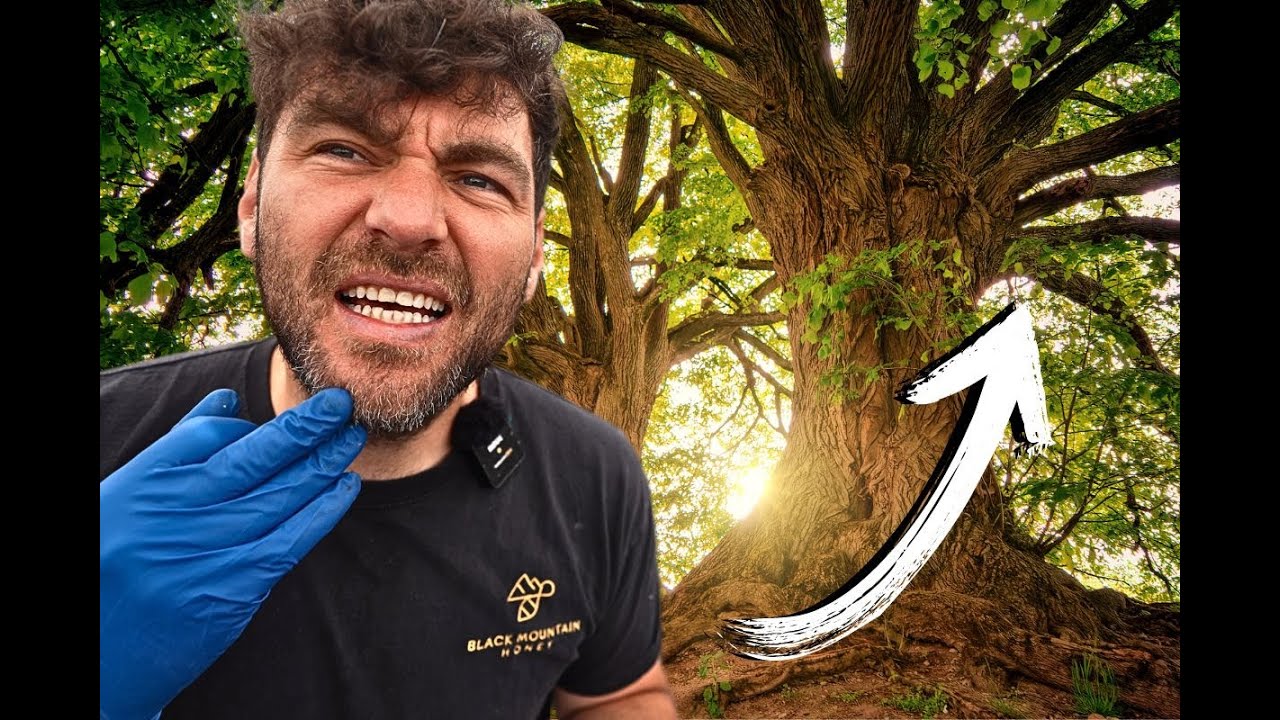
Laurence Edwards finds a wild bee colony in a rotten fallen tree, heavily exposed and aggressive. The bees, possibly a dark Apis mellifera mellifera strain, have built about two combs deep in the cavity. Edwards gets stung repeatedly in the face while documenting the colony's poor conditions and defensive behavior.
Chapters
Fuck's sake. See what we can find. Ah, bit of a false start there. Today I've been called out to a wild colony of bees in a collapsed tree. Right, so the access here is really, really poor, and I know I'm tempting fate by doing this, but I just want to get in, take a look, see what this colony is looking like, see what we can find. Ah. Right, not doing that again. That's the second time I've got in there, the second time they've stung me in the face. You can see that it's very different to kind of semi-domesticated bees that you keep in a beehive that have been bred for temperament. These are wild bees, and that's not to say that all wild bees are horrible, but these are definitely horrible bees. That's like the 6th or 7th sting that I've taken to the face. Happy Christmas, there you go. You've got to see me get stung in the face again a number of times. I'm not going close to that again. I'm going to get the zoom camera out and I'm going to show you the bees I'll zoom in a little bit just so you can see them. Right, so this is the tree that's fallen down. That's the stump. That's at least 3 meters tall, maybe 2.5 meters tall, that stump. And then you can see, look how big this stump of this tree is here. Following it down, you can see that it started to rot as well. The bees are over there in that cavity, and you can see the cavity's opened right up. But then take a look down here. This is what's really interesting, is if you look a little bit further down, you look At the quality of the wood, you look at how rotten it is, see all that rotten wood down there, and then you can see all the mushrooms growing on that. That's really rotten. This only came down the other day. And then you look in here and you look at that cavity. Could you get a better spot for bees? I really don't think you could. The bees actually are over there in that little crack. You can see them. I'll zoom in a bit there. It's a good, decent-sized colony of bees. And they're very, very exposed. So we're going to have to somehow try and fix how exposed that beehive is. So we're on the other side of the tree now, and you can see that's where it's fractured. And when you look inside, you can see where the bees are getting in. So the bees are through that hole there, and they're using this hole here as a bit of an entrance. That's probably where the entrance was originally before the hive fractured and broke and fell down. Absolutely perfect place for a beehive. Nice big high entrance. You can see it would've been all that way, that high up. So a good, I'm gonna re-estimate it, maybe 4 or 5 meters above the ground, and then a really good size hole. And then they've built that colony over to the corner, right out of the way. Right, so here's the bit you've all been waiting for. Let's take a look and see what this colony of bees is looking like. For some reason they're not too fussed about stinging me on this side. Seems it's only when I go down that they see that I'm a threat. Really strange because I did think that I'd be kind of at risk of getting stung over here as well, but not so much. They're letting me in and you can see that colony there goes all the way down. Nice big strong colony of bees. So just had to jump out the way there as well because I got attacked again. These are really not very nice bees at all. But it's understandable. They're very threatened because their home is pretty much in tatters. They're exposed to the wild. They've probably got foxes and badgers and all sorts coming and getting them. They're in easy reach of all of the predators that they've tried to get away from by going so high up in a tree. So their temperament and their trigger to be so defensive is, is very natural, I'd say. What's really interesting about this colony though is how dark they are. And you hear about it, like we've had the discussions before. You look how dark that colony of bees is. That is a really, really dark colony of bees. Is it AMM? Is it close to AMM? I don't know. I'm not an expert on that. All I can say here is that is a very, very dark colony of bees. So if you look up here, you can see lots of damage over here, lots of damaged combs. You can see there was an old nest that was built in there as well. Maybe it was a squirrel, maybe it was a bird's nest, I'm not really sure, but there was something else going on in this tree. And in terms of the size of the colony, it's very, very difficult to see how big that colony is. You can see how far it— ah, you can see how far it goes down in this direction here, and it's probably about 2 combs deep. No more than that. And you can see that the combs are broken up as well, so they're just clustering up as best as they possibly can. But there's nothing to say that that doesn't go really, really deep down here. You look how deep that trunk is, can go down another 2 feet almost. So it could be a big, big strong colony of bees, and they might just go further down. Just impossible to see at the moment. So I hope you enjoyed that video. As always, please hit the subscribe button, please hit the bell so you're notified of every video, and I'll see you next time.