I Have Never Seen Destruction Like This !
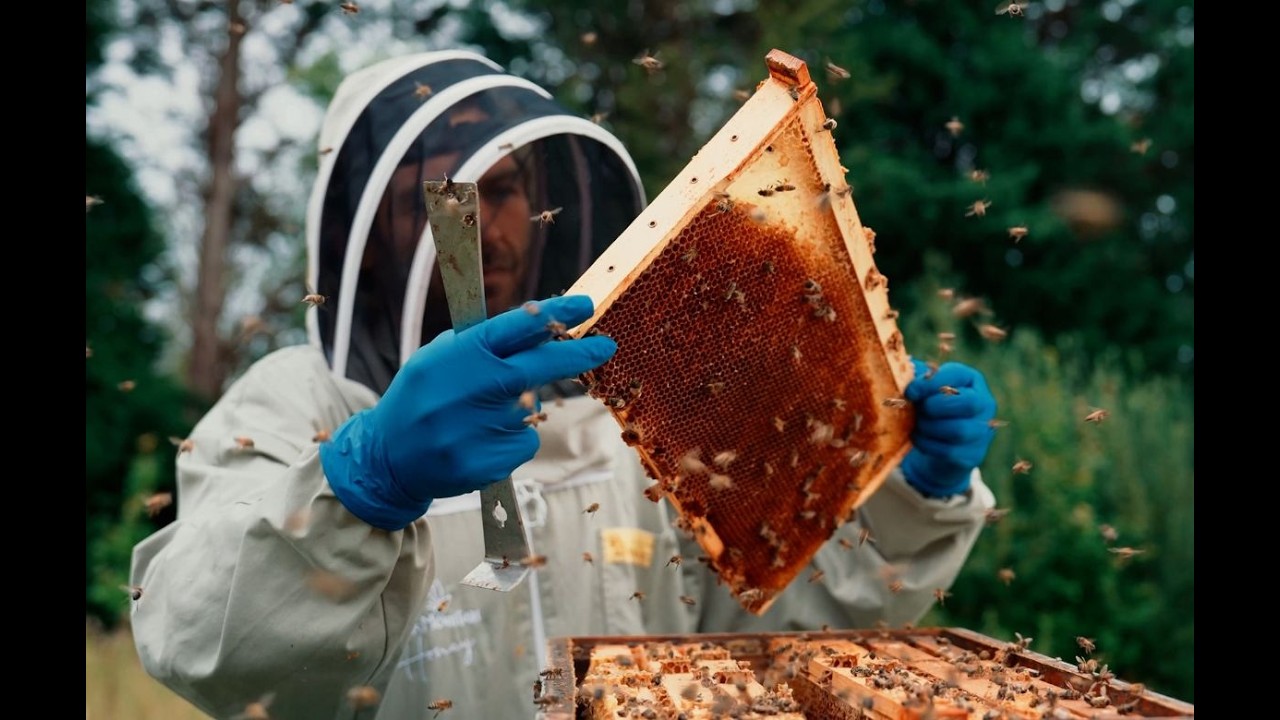
In this instructional beekeeping video, the presenter discovers a hive that has been devastated by robbing bees. He walks viewers through the visual cues that signal a robbery—excessive and frantic entrance activity, mixed‑color bees, fights at the entrance, dead bees, torn wax cappings, and debris on the floor. He explains why robbing is most likely in late summer when natural nectar flow has ceased, and how practices such as open feeding, late‑season inspections, and weak or queen‑less colonies increase vulnerability. The presenter diagnoses the specific cause in the affected hive: a gap between the brood box and the queen excluder that allowed foreign bees to enter, and a merged colony situation evident in the Flow Hive super. He then demonstrates a step‑by‑step remediation plan: relocate the hive, shake out and condense the boxes into a single brood box, reduce the entrance size, quarantine the compromised hive, and sterilize or destroy contaminated equipment. Finally, he offers long‑term prevention tips—maintain strong colonies, limit entrances, avoid external feeding, minimize late‑season inspections, and properly seal and store compromised equipment over winter. The video ends with a call to an online beekeeping course.
Chapters
The bees have absolutely ravaged this colony, and that floor there is full of dead bees. So I came into the apiary this morning looking to take off my honey, put my Apivar strips in, and start feeding. All of the rest of the beehives in this apiary are completely silent and chilled, and no activity at the entrance apart from this one here. And it looks like an unusually active entrance. But it's not just activity at the entrance, it's activity at the sides, at the back, everywhere. The robbing bees have found this beehive, and these are all the things that you need to look for if you think that your colony is being robbed by bees. So the very first thing that you're going to notice is excessive activity at the entrance like this. Maybe lots of different colored bees, definitely lots of arguments going on at the entrance, potentially dead bees as well. This one here is the biggest giveaway, but if you're only seeing at the entrance, it could be swarming, it could be orientation, It's when you look further up and you see the activity elsewhere on the beehive that I really start to think that it's gonna be robbing. So these are all the signs of robbing that you should be looking for. Unusually frantic activity around the entrance or at any other point around the hive. Bees fighting on the entrance or the landing board, or even dead bees underneath where the entrance is. Inside the hive, you'll find torn wax cappings and lots of detritus on the floor, potentially dead bees in there as well. The bees are darting in and darting out quickly. There is chaos when generally there is order. You're going to have bees hovering around cracks or gaps trying to find new entry points. There's potentially a sudden change of temperament, but as you can see, active robbing situation here, and the bees don't even mind that I'm sitting here. If you're seeing any or a combination of those things, think that the bees are robbing and move on to trying to manage the situation. So what you can see at the entrance here is lots of different color bees. Generally with the bees that I keep, they're all a similar color. When you're seeing orange bees and black bees and gray bees all coming in and all going out like this, it's almost certainly robbing. Also, a few places here you can see bees not getting on with one another. This one here having a little bit of a ruckus, trying to fly away, and then someone else comes in and it's all kicking off. Massive fight going on over there. If you're seeing fights and arguments in addition to entrance activity like this, you know it's going to be robbing. But for me, this is the biggest giveaway, and this is probably the problem in the first place. There is a gap in between the brood box and the queen excluder and the super where the bees are getting in. Not bees from this colony, other bees that are coming in and robbing the colony out, going back to their respective beehives, telling the bees that there is a free meal over there, just come along and help yourself. And then all of the bees' sisters come back and completely destroy the hive. So there's a few high-risk times of the year when you're much more likely to see robbing. And if you can keep your eye out during these periods, it's much easier to identify. So the first one is late on in the season. It's the middle of August at the moment. The natural flow has subsided. All of the bees are sitting on lots of honey for the harvest. And because there's no natural flow, the bees have got lots of time on their hands and they will just sniff around other hives and try and find some easy pickings. If you do any sort of open or external feeding, you're just inviting this pressure on. I do not recommend that. But if you drip or drop any syrup, even a tiny little amount, you can trigger robbing like this. So be very, very careful when you are feeding your bees. Bees are generally quite good at defending themselves, but if there's a weak colony inside or a failing queen and the colony's dwindling down, then they become much less able to defend themselves. And then all of a sudden, a robber bee goes in and thinks, wow, that was pretty easy. And before you know it, you end up with something like this. Also, late on in the year, you shouldn't really be going in and doing inspections because there's no benefit to doing it. All you're doing is exposing the hive to the open air and inviting this kind of pressure. All I do for my late season inspections is just check upstairs, make sure there's enough space in the super, and add additional supers as necessary. So in terms of the rest of the apiary, this is pretty much standard for what we're expecting for entrance activity. Some of the ones back there are a little bit busier, and you can see the bees over there traveling to that beehive and robbing it out. But it's so easy to spot the one that's really in trouble. And then if I jump to the 2 colonies at the end, it's quite clear that the bees inside these 2 beehives are going over, robbing the honey, and bringing it back to these 2 hives here. Still, the activity on the entrance of both of these hives where the bees are bringing the robbed honey back to is nowhere near as intense as the one on the robbing hive. Let's get back over, open it up, and see what the bees are up to. So lots of bees emanating up from the top as soon as you open it. That is not the The natural behavior of bees within this beehive. Everything that you see coming up there is a robbing bee, pretty much every single one. And you can see that exodus now is continuing. I can smell honey. I don't think we're going to find a huge amount of honey. I think we're going to find destruction. So from the first frame that I've pulled out, I can see what has gone wrong here. Look at this frame and tell me what you think is going wrong here, because there is a lot going wrong with this frame. This is a Flow Hive super. There should be no brood up here, but there definitely shouldn't be any dark black bees up here either. This was a really nice calm orange F1 Buckfast queen in here, and her offspring were orange. So what has almost certainly happened is a huge swarm has moved in and taken over the super up here, because maybe the bees had just left it open and left a nice little entry hole for them. This is why we're seeing the 2 different colors of bees. because 2 colonies have merged together naturally and now they are fighting it out. So you can see the bees breaking open the stores there. And although there is a little tiny bit of honey left, the bees have already started breaking it all down. So where you see these tiny little holes here, that's where the bees are chewing the wax off, discarding it, and trying to get down to the honey underneath. So it's quite clear from opening up this box here, it's a really severe robbing situation. We need to take action and get this fixed as soon as possible. So this is the plan. I'm going to close everything up. I'm going to lift up the entire beehive, and I'm going to go and place it in between the 2 hives that I identified earlier that were robbing this beehive. I'm then going to go through, shake out all of the top boxes, condense down to a single brood box, reduce the entrance down, and hopefully that should trick all of those bees to go back to their beehive. They're going to come back here and think it's vanished, and then it gives all of the bees in here a chance to recover. I have to say, when you see robbing this bad, there's a very, very low chance of recovery. I will take a look downstairs in the brood box to see if we've got a queen. We've got a brood nest upstairs above the queen excluder in the Flow Super as well, which is an absolute mess. I'm going to shake all of those bees out. It is time to clear this one up. So I've moved this beehive over to the new spot here, and as soon as you look down into the queen Looking at the queen excluder, you can see this path of destruction. All of these dead bees, all of these dead wasps. This is still a battleground. Another thing I spotted on this beehive here is where the boxes have shifted a little bit like that. It's opened up a new entrance at the bottom of the beehive. The bees have tried to propolize it shut. They've left themselves a little gap, but all of these additional entry points makes it much more difficult for the bees to defend the hive. So it's not looking much better downstairs in the brood box. You know what? I don't even think there's a colony here worth saving. I'm going to go through the frames one by one. I'll show you every single frame, see if you agree with me. So that is all the frames from the first box, and if I look down into the second box, it is completely empty. There's literally nothing in the frames. They're all just like this, robbed out, shredded up. I want to get downstairs and look at the floor. I'm suspecting there's going to be carnage on the floor of this beehive. So here are all the clues that you need: lots and lots of dead bees. Big, thick wax cappings where the bees are shredding down those honey frames. Sadly for this colony, there is no way back. We need to protect the rest of the bees in this apiary from any further spread of disease. So what I'm going to do is I'm going to quarantine this beehive, shake off all of the bees, let the bees go back to their beehives, and take away all of the frames and boxes and everything that is attracting those robber bees. So I've got Solid roof at the bottom that I'm going to ratchet strap together. It effectively gives me a completely sealed unit so I can chuck stuff in here that's going to be a biohazard risk and it's not going to go anywhere apart from in the top of that lid that I put at the bottom there. You clean it all out at the end, clean it all out over winter. This is the best practice and this is what you should do. So definitely not taking my veil down for this bit. You will see now that we've taken away the entire beehive, All of the honeycombs, all of the brood frames, everything, the floor, the roof, the lock, all of those bees are gonna think, well, that was the one that we're going for, and they're just all gonna go in and try and attack this one here. So make sure if you've got a weak one there, you move it away. If you've got a strong one there, definitely reduce the entrance down. This one is on pretty much a single bee space entrance anyway. So all of this robbing should disperse as long as you make sure you've only got strong colonies left behind and you're reducing those entrances right down. So you can see, even after 5 minutes, the bees really have calmed down. They've gone back to their hives, deposited any honey that they've robbed. Come back and then realize that that same beehive isn't here. They're trying to get in everywhere, but what you'll see over the next few hours is this activity will subside. The best way to stop this happening is to ensure that your colonies remain strong. I let slip here; colony went to drone layer. The box slipped open. Too many entrances. There was honey exposed, and the bees took advantage and robbed out every last bit. That beehive I'm going to take back is now in quarantine, completely sealed. I'll melt down all the frames, scorch the boxes. sterilize everything and start again next year. If you want to learn more about beekeeping, check out our online course, 14-Day Beekeeper. So you can see when I open the door there, all of the bees, the robbing bees that were in that beehive, they've come out from where they're hiding and they're just desperate to escape. So they go up to the glass and then as soon as I open the door, all the bees just go and fly off. All I have to do now is take whatever is left from the beehive here, take it into storage. I'm going to strap it all up and I'm going to leave it there for winter. I never do any processing at this point in the year because it's just going to attract more robbing bees in. I'm going to seal it up properly, get it into storage, leave it until winter, and I can do a much better job then.










