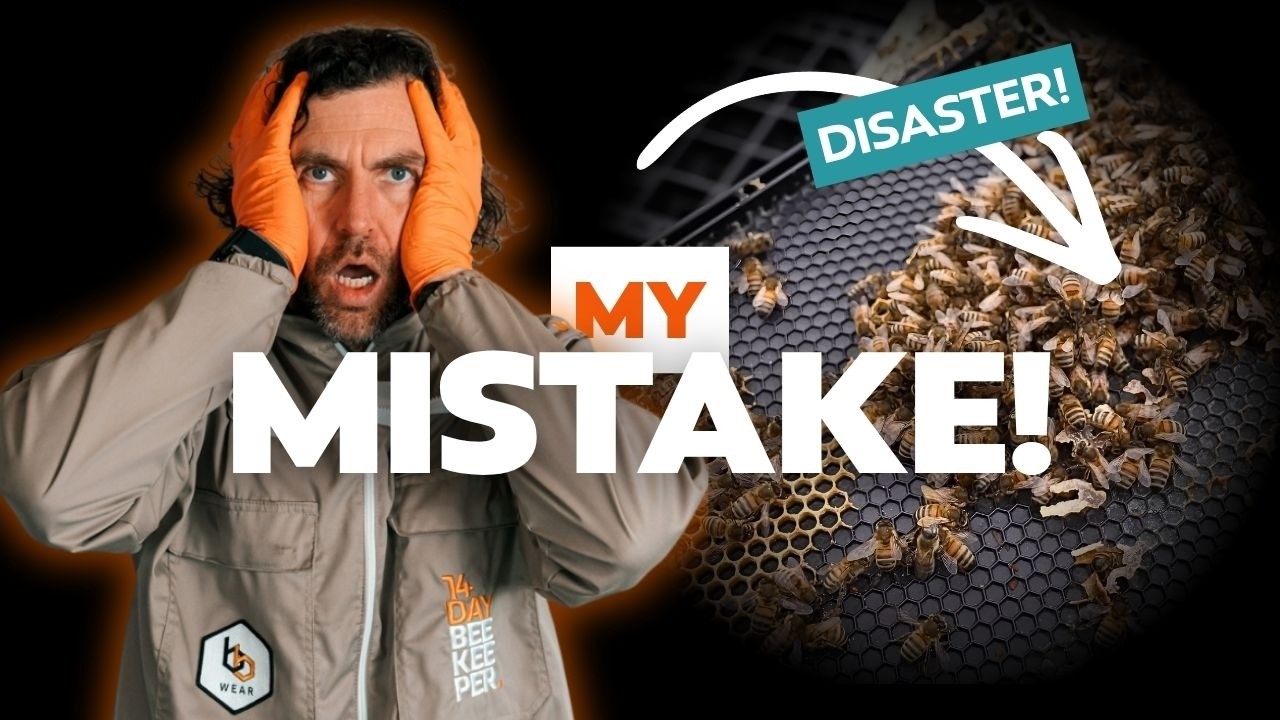
In this candid, first‑person video, beekeeper Laurence Edwards opens a spring‑time nucleus (nuc) hive and discovers that the colony has catastrophically starved due to his own failure to provide supplemental feed. He walks the viewer through the visual evidence—dead and dying bees, condensation, empty cells, and extensive brood cannibalisation—explaining how each symptom signals a lack of carbohydrate stores. Edwards admits that his decision to wait a week before feeding, based on an optimistic assessment of hive weight, was a grave mistake, especially for a high‑quality Buckfast breeder queen colony. He details the hopelessness of rescuing the majority of the bees, but describes a rescue plan for the queen: extracting her, placing her in a fondant‑filled cage with a small amount of syrup, and later introducing the cage into the strongest colony in the apiary so that emerging workers can nurse her. Throughout, he expresses deep guilt and uses the episode as a cautionary tale, urging beekeepers to regularly check hive weight, feed proactively in early spring, and avoid the complacency that led to this loss. The video serves both as a personal apology and an instructional warning to prevent similar starvation events.
Chapters
The bees inside this colony here are dying as a result of my negligence. This video should serve as a stark reminder that bees will starve in the spring if you do not give them enough food. I am gutted, I'm devastated. I stand to gain nothing from this video, but I do hope by me showing you what's going on in this colony, the dead bees, the negligence, it will maybe stop some other colonies dying because this is a really, really hard watch. So as soon as I opened up this colony, I was very, very concerned. You'll see we've got dead bees over in one corner, condensation forming in the other corner, some bees that are clustering up gasping for life, and lots and lots of lifeless bees. This is not what I expect to see when I'm opening them up for spring. I expect to see them really thriving, moving a lot, lots of action. Like, it is a relatively warm day here today, it's about 10 or 11 degrees. This is not right. So when you start to take the frames out, it just becomes immediately apparent what's happened here. The bees have starved. And in this video, I'm going to show you every single little detail, what to watch out for, but more importantly, to show you the aftereffects of what's happening with these bees. And I just absolutely hate to say it, but there is nothing that can be done in this instance here. I'm not rushing to try and save the bees because these have just gone way, way too far. I could try and put some fondant on and maybe save 10% of the bees. But as soon as you get further into this colony and you see the amount of brood that has been reared and has been cannibalized by the bees because they've not got enough carbohydrates, they've reverted and resorted back to their own protein in the form of cannibalization. Like, I just feel gutted. I should know better. And I looked at that colony about a week ago and I hefted it and I said, you know what, it's feeling a bit light. But I think it's okay, it's not that bad. I'll wait until next week, and if it needs a little bit more next week, I'll give it some more feed. This is a disaster, but this can happen within a matter of hours, and if not hours, definitely days. Err on the side of caution and make sure you give your bees sufficient feed to get them through the spring. So although you can still see a little bit of movement there, these bees really do not have much longer to live. If I zoom in there for you, you can see you've got lots of bees with their heads deep down and Every single cell that we've got here is completely empty. There's no stores left, there's no brood, there is just dead and dying bees. This frame here just says it all. It's always the very, very best colonies that fail in the spring. And the reason they fail, there is only one simple reason that this colony has failed, through my own negligence. And that's what hurts, that's what feels bad, because I've made a decision based upon probabilities that these bees would have enough gas to get them through to the next stage the season, and within 7 days they have failed. And this was by far and away the best nuc that I had in this apiary. It was a pure Buckfast breeder queen, and there is about 4 frames of brood in here. Really nice capped brood. The queen was in perfect condition, and there was loads of brood, and they have just motored through their stores to the point where the colony has collapsed. So you can see it on this frame here again, lots of heads deep down in the cells, lots of empty cells, but here we go, we've got a Significant amount of capped brood. And what the bees have done here is they've capped the brood over, they're waiting for those bees to emerge to boost the colony, to hope that they can go out and get some more nectar, and the nectar's just not come in. I should have supplemented that with additional feed, and that is what I'm going around and doing now on all of my colonies, regardless of whether I think they need it or not. This spring is going to catch a lot of people out, and it definitely caught me out with this colony here. So again, another frame almost full of capped brood. And like I'm going to show you down at the bottom of the beehive in a bit, there were so, so many bees in this colony. Like, this is a plea— don't make the mistake that I made here. It's hard doing this video, it's a bit embarrassing, and it's not easy to admit that like this is my problem, this is my mistake that's caused this suffering for these bees, and there's absolutely nothing that I can do about it. The only thing I can do about it is try and educate other people to not make the same mistake and to not make the same poor judgment calls that I made. So even with half those frames out there, you can see there was a lot of bees in this colony. But what's interesting in this frame here is the fact that the bees haven't even drawn that one completely out. So although I've definitely been negligent in the spring, I'll probably add to that negligent list that I've been a bit negligent in the autumn for this one as well. Like, they've not drawn out the frames properly, and although that I've tried to feed them, they've not been able to convert that into stores. Take a look down at the bottom though, piles and piles of dead bees. This is not what you want to see in the spring. Now that frame there really has annoyed me quite a bit because I should have been on top of that late on in the season, making sure that they were turning that syrup into stores. I don't know what they've done with it, I don't know where they've put it, I don't know whether they've been robbed, but that is not right. That's the only colony in this apiary here where they've got frames that are completely undrawn out. Very, very strange indeed. Now I'd love to be able to say that all is not lost here, and I'm not sure how viable this queen's going to be, but I have found the queen. And as I said, she's an artificially inseminated Buckfast breeder queen. See if I can just pluck her out here now. So there we go, look, I've managed to get the queen. And what we're going to do with this queen here is we're going to go pop her into a cage, and we are going to do our best to try and get this queen through. I know this sounds really, really bad, but what is important about this colony here for me is the queen. I feel awful that I've caused this suffering, but you know what, if I can get this queen through, this clipped queen, then maybe, just maybe, we can keep this line going and it will make this whole escapade a little bit easier to swallow. So she's still moving around. She looks pretty good, to be honest, like considering the state of the colony. I've got some food for her in this cage, and what I'm going to do is I'm just going to take her on her own, put her in a cage with some fondant. I'll put a tiny little bit of sugar syrup in there to see if I can get her just to feed on the syrup to get her through for the next few hours. And then what I'm going to do is I'm going to find the biggest, strongest colony in this apiary here, and I'm going to place this cage into that colony with the hope that the young bees that are being born will feed this queen and get her through. I'll then make a split later on in the season, and fingers crossed we can get this queen through the year. This colony of bees is nearly dead. Go out to your apiaries now, heft your hives, make sure they've got enough weight to get them through winter. Do not make this mistake.