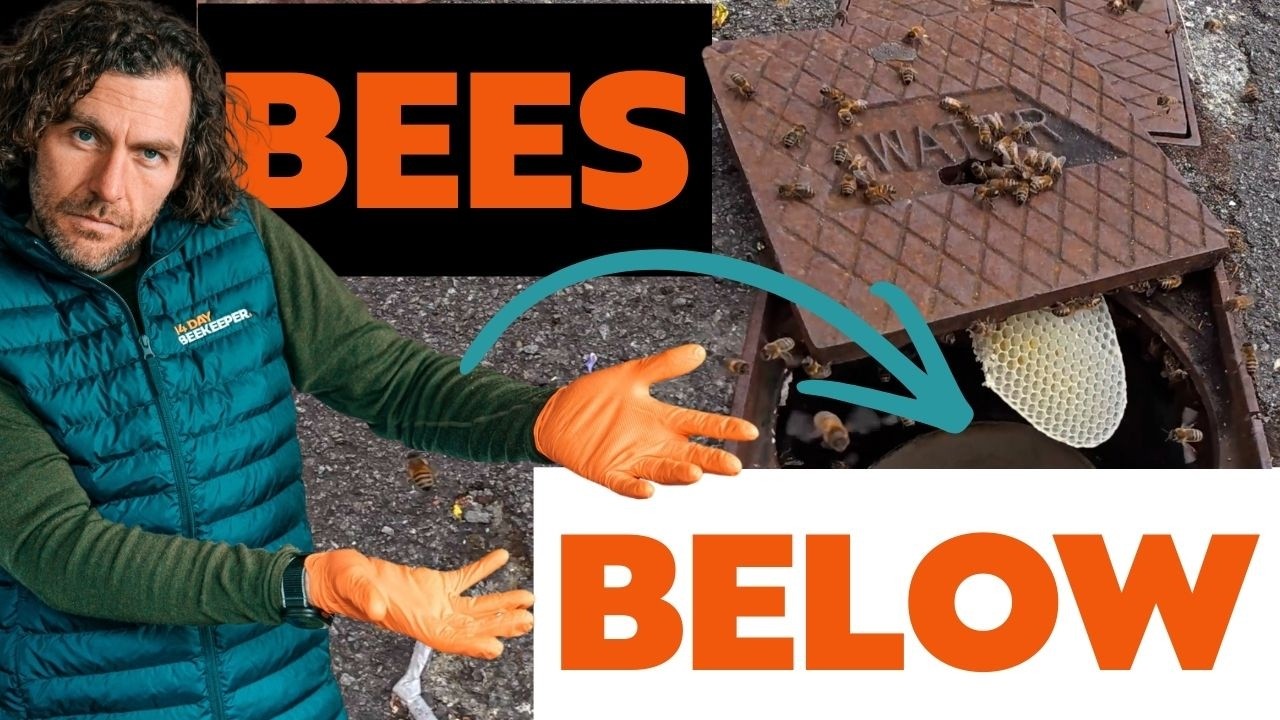
In this vlog-style beekeeping video, the presenter discovers a honeybee swarm nesting beneath a water‑meter/manhole cover. He documents the entire rescue process: lifting the cover, locating and marking the queen with a Zaya pen, extracting the bees into a bucket, and transferring them into a mini mating nuc. He explains why he discards the original brood (disease risk) and feeds the small swarm. The video then follows the nuc’s placement in a quarantine apiary, the use of a queen excluder to prevent the queen from escaping, and later wing‑clipping the queen to stop future swarming. Over several days he monitors comb building, egg‑laying, and larval development, showing close‑up footage of frames, brood patterns, and wax drawing. Mid‑way, a family medical emergency forces the relocation of the quarantine apiary to a new site, which he documents. The presenter concludes with observations of a healthy, expanding colony and a call to share the video. The tone is informal, instructional, and enthusiastic, with moments of caution when discussing disease risk and emergency relocation.
Chapters
Underneath this water meter here, we had a colony of honeybees. A swarm moved in a few weeks ago, and it is now my job to get them out from underneath this cover here into a nuc and to try and take them away. This is going to be fun, right? So you can see the pest controller came here yesterday and he sent me a picture and he said, what do you think, honeybees? I said, 100%. Smoker just in case. So the only option that I've got is just to try and pull it out. Mind out. Jesus. So give that another go. You have to come in like that and then you have to twist. So you can see first little sneak of the bees, but you can see capped brood in there as well, which means you've got a queen. So that was impossible. There was no way I was actually going to be able to do that. And as you can see, it has just all fallen down into the hole. But now it is Operation Tidy Up. Just got to try and go through everything that comes out now, see if we can actually find a queen anywhere. And there we go, one queen bee. So I'm going to take my Zaya pen, just going to make sure that there's no mega drops on it. Really important, that makes it so much easier to find her now if I need to see her. And then I'm just going to leave her underneath this cage with a few bees inside. So what I'm going to do, which is probably the sensible thing to do anyway, is just abandon all of the brood. I don't want that brood, it's a risk of disease, and it's a tiny, tiny swarm, so it's not going to do very well without it. So what I'm going to do is I'm just going to collect all of the bees that are here. I'll be able to attract them into a bucket because I've got the queen. So I just put the queen in, all of the bees will go in. So let's get everything tidied up and let's get these bees into the bucket. Then all I'm going to do is just put everything back in position. I'm going to take the queen, I'm going to place it over the hole, and I'm just going to place that over, but making sure that there is enough space for the bees to go in under the bucket. Already you can see what is going on. Look at this. So I just had to go back home and get one of these little mini mating nucs because it is perfect for a little tiny cast swarm like this. Normally I do recommend not feeding swarms, but I've taken away their brood. There's not that many bees at all, and if I didn't feed them, I think they would die. I suspect they're just going to be clustering around that queen. That is generally what happens. But let's take a look. You never know with bees. And there we go. That literally couldn't have worked any better. What I'm gonna have to do now is just try and tap the bees down and get as many in as I possibly can. Now I've got my queen from before, so if I take this off, the queen will be underneath. And all I need to do is take my queen, gonna pick her up by her wing, one queen from her wing, and I'm just gonna drop her in like that. Everything's covered up still. I've got my queen inside. She cannot get out of the entrance because of that. And all I'm gonna do now for the final time is just Leave this nuc here and let all of those bees go in. I'm going to take this nuc back now to my quarantine apiary. I'm going to place it somewhere. I'm going to let them fly straight away. There is a risk they will abscond because it is a very small mating nuc with not that much ventilation. I just need to get them back as soon as I possibly can, get it open, and we'll cross our fingers and hope it all goes well. So this is the apiary I'm going to use as my quarantine apiary. Just got a couple of queens mating here. That is the box that I just went and collected there. So let's take a look inside and see how the bees are getting on. Now, what you cannot do with mini mating boxes like this is just open the roof and let the bees fly. What you can do though is use a crown board like that. You can see there we have got pretty much every single bee. So I've got my little queen excluder insert here, and I'm going to place that on the entrance to ensure that the queen cannot come out. So very dark here now. I'm just going to place that queen excluder over the front there, close this back down to hold it in place, and then when the weather's good, the bees will come out there, but the queen cannot get out. Very important. when you're doing that with mini mating nucs, but also with swarms. Keep that queen trapped in, and then that means that the bees hopefully will not have absconded. So that's it. The entrance is open, full of bees. We've got our mated queen in there. Let's give them a couple of weeks and see what they do. So 24 hours later, I put them into the quarantine apiary, which is coincidentally in my garden, and we're going to go inside and take a look. So you can see, not a huge amount of activity. Just got the odd bee flying around there. I've still got my queen excluder on, which is stopping that queen coming out. But just looking at that, not many bees coming out at all. I'll just run the risk and remove that and see what is going on. So let's open up the crown board and see what the bees are doing inside. So no queen on there. And look at that. It's not even been 24 hours. It's been about 16 hours, I think, since I caught this swarm and put them in there. So you can see on that camera there, they're drawing out that wax that's on that plastic foundation and making themselves some nice comb for that queen to lay some eggs into. Same on that side there as well. A really, really good looking frame, especially after such a short amount of time. So they've not started drawing this frame out yet, but they will. They'll get around to that pretty quick. Actually a few too many bees for this tiny little nuc, but I didn't want to put them in the big one. I'd prefer to get them to draw these out first and then we can actually do something with them. What I'm going to do instead of putting that queen excluder function back on and restricting any of the movement in and out of the nuc, I'm just going to clip the queen's wing. I always clip my queen's wings. It stops them swarming. It stops them getting into these awkward situations in the first place. Always good practice just to nip that wing off. The queen can't feel it at all and she will not be able to fly into anybody's chimney. So there we go, my queen is tucked down in there. She is fully clipped, so she cannot leave this nuc now. So now that my queen is in that position, really, really easy. I'm just going to put them back in, leave them for a couple of days, let them go out and forage, let them build out all of these combs, let that queen get back to her laying, allow all those eggs to turn into larva and then to be capped over and to emerge as young worker bees. And it's only at that point that we'll finish this video. We've still got a long, long way to go. So I'm going to go and get the queen and the queen cells. So the nuc's been here about 4 days now, and excuse me, I'm losing my voice. A few days ago, my wife had a major anaphylactic shock, and we had to rush her into hospital, and she needed 2 shots of adrenaline. Needless to say, no more beehives allowed in the garden. So my little mini mating/quarantine apiary here is going to have to move. Luckily, we've got loads of places we can take it, so I'm going to wait for dark, Close the entrance, transport the bees there, and then a few days after that, we'll take a look inside and see how that colony is expanding. But for now, it's time to close this entrance here and take these bees off to their new home. So just like that, we're at a brand new quarantine apiary. Still not got a good voice. Open up the nuc here now, leave the bees to orientate. We'll give them a few more days and then we'll go in and see how they're getting on. Let's have a tiny little snapshot inside though. I'll open up the roof, we'll have a look through the crown board, see how those bees are doing. So you can see it's late at night here, even though the camera makes it look like it's quite light. These are reluctant to come out. So you can see there a really good close-up inside. You can see the eggs, you can see the larva growing inside, various different stages of larval growth there. So we're back at the quarantine site. Let's get inside and see how this little mini swarm is getting on. But you can see there the bees have fully drawn out all of that plastic frame, brought back some nectar, drawn out the wax, put it into the frames. So I've seen some eggs dotted around in there. The queen's in there brooding all stages. Brilliant brood pattern like this. I'm going to upgrade this colony, but we're going to do that in a separate video. I hope you enjoyed this one. I really enjoy going out and catching swarms. If you enjoyed it, the biggest compliment you can pay is sharing it on social media.