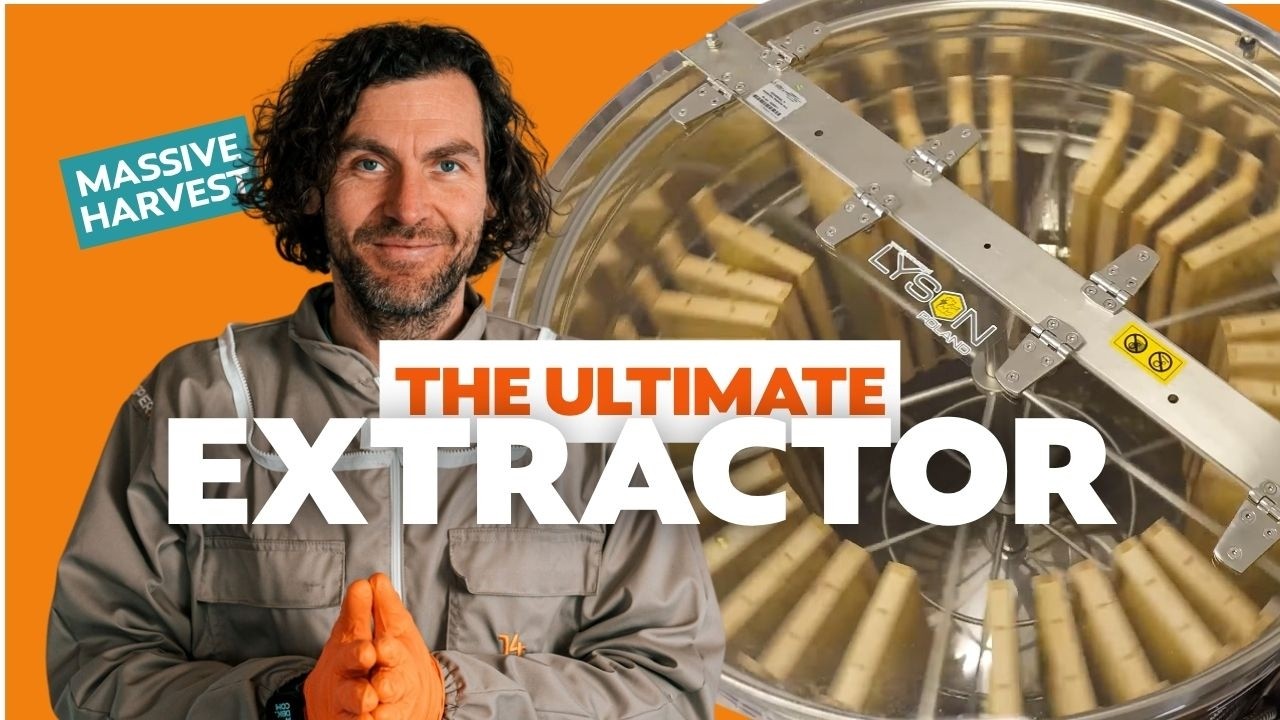
In this video, the presenter demonstrates the Lyson 30-frame premium heated radial honey extractor from Abelo, walking through the full extraction workflow from uncapping a capped frame to collecting filtered honey. The extractor’s radial design positions frames like spokes, allowing honey to be spun out of both sides simultaneously, preserving comb integrity. Key features highlighted include a 30-frame capacity, transparent lid, digital variable speed control with multiple automatic presets, and a water‑jacketed base that can be gently heated without damaging enzymes. The presenter explains how to start the machine slowly, ramp speed as frames lighten, and use automatic cycles, noting the stability provided by the water jacket. Honey exits through a honey gate into a food‑grade bucket, then is filtered and settled for 48 hours, with wax particles rising to the top. The comb emerges intact, ready for reuse, saving bees energy. The video concludes with a strong recommendation for large‑scale honey producers, emphasizing the extractor’s power, stability, efficiency, and build quality, and provides a link for purchase and pointers to related honey‑processing videos.
Chapters
Today I'm reviewing the Lyson 30-frame premium heated radial extractor from Abelo. I'm going to give you a full demonstration of how it works, and we'll run some honey through it so you can see it in action. We start with a fully capped frame of honey, and obviously the first thing we need to do is take that wax cappings off, which we do with a really sharp knife. Once the wax cappings have been removed, the cells are open and primed for extraction. The Lyson 30-frame premium extractor has a radial design, which means the frames are positioned like spokes on a wheel. This setup allows the honey to be spun out of both sides of the frame at the same time, which saves a huge amount of time and also protects the comb. I'll load this frame here, along with the rest of them, into the drum. One of the things I love about this extractor is its capacity. It handles 30 frames at once, which is ideal when you're working through big harvests. With the frames in place, I close the transparent lid and set the speed using the digital variable speed control. I always start it off slowly to gently release the honey, and then gradually increase the speed as the frames get lighter. What I love about this extractor— a lot of extractors are like this nowadays— is that they are fully automatic. So on older designs, you might get a speed knob where you can make it slower or you can make it quicker, but if you walk away, it can't do anything on its own. These newer extractors are fully autonomous and they have various different settings. So you can do that, you can put it on 10%, 20%, 30%, and manually do it yourself. Or if you're like me, you're a bit lazy, you just choose the automatic setting that you want. And on some of the premium ones like this, you can even start to adjust what those automatic settings look like. Maybe you want a slower wind-down at the end or a faster build-up. You can get in there and play around with the settings. I never bother doing that. The presets on these are very good, and there's quite a lot of presets on there as well. So the preset that I use, I literally press the button once, it starts off one way going slowly, then it goes the other way going slowly, and then it goes back the other way a little bit quicker. Just keeps on going through all these different cycles, and at the end it just goes beep beep beep beep beep and it's done. Everything is automatic, and that really does help me in the extraction mode. When it comes to ramping the speed up though, I always like to keep it as low as possible, but this extractor here has a water-jacketed base that keeps the extractor incredibly stable, even when spinning at full speed. Plus, if I need to, I can gently warm the base to encourage the honey to flow, without ever overheating or damaging its natural enzymes. I have to say, with this one here, I don't even put the heater on. I want that water jacketing down there to bring the overall centre of gravity down and to stop it going out of balance. As the extractor spins, centrifugal force pulls the honey out of the comb and down the walls of the drum. From there, it flows through the honey gate bottom and straight into a food-grade bucket ready for filtering and settling. I take it straight over to my premium settling tank that has a sieve in place, put it all there through the filter, and leave it for at least 48 hours to settle. All of the little bits of particles of wax float up to the top. But let's jump back to the extractor. After just a few minutes of extraction, the frame comes out completely empty with perfectly preserved comb, ready to go straight back into the hive or into storage. That's the beauty of radial extraction. It saves the bees energy because they don't have to rebuild everything from scratch. The frames are nearly perfectly preserved every single time. For me, the Lyson 30-frame heated radial extractor is an absolute game changer. It's powerful, stable, and efficient, with the build quality to handle big harvests season after season. If you're serious about producing honey at scale and you want a reliable, well-engineered extractor, I can't recommend this one highly enough. There's a link in the description if you'd like to check it out further, and if you want to see more videos about uncapping techniques, honey processing tips, and storage, I'll stick my best ones up here.