Inspection of Beehives - How to Keep Bees Without Gloves - Inspecting Bees Without a Veil
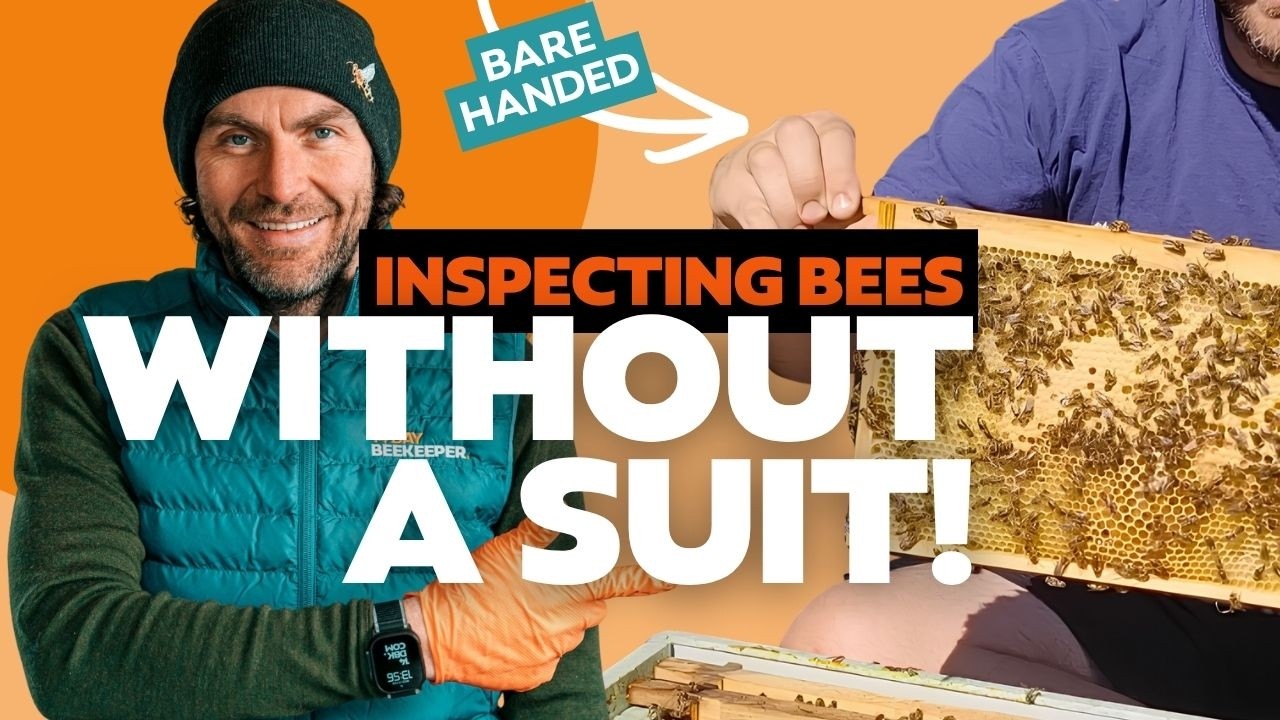
In this episode of No Nonsense Beekeeping, Laurence Edwards inspects a recently captured, exceptionally gentle Buckfast‑like swarm without a veil, gloves, or a bee suit. He explains that the swarm has been in a quarantine apiary for 2‑3 weeks, has expanded to fill all six frames, and shows healthy brood and a strong queen. Throughout the walkthrough he demonstrates slow, deliberate handling, points out brood patterns, capped brood, eggs, and stores, and locates the dark queen. He records only two stings (one to the cheek, one to a finger) and emphasizes that this minimal‑gear approach is only safe with a calm colony and should not be taken as a recommendation for general beekeeping practice. Laurence discusses how rapid, gear‑heavy work can foster bad habits such as crushing frames, and he advocates occasional “back‑to‑basics” inspections to retain core handling skills. He also mentions moving the colony to his new Abello‑brand apiary (pink hives) and outlines feeding plans for winter. The video ends with a reminder to wear full protective equipment for most colonies and a call to subscribe.
Chapters
Today I'm going to do my beehive inspection without a veil or a bee suit. Hi, I'm Laurence Edwards from Black Mountain Honey. Welcome to another episode of No Nonsense Beekeeping. If you watch my videos regularly, you may remember this swarm that I caught. They're the most gentle bees that I've ever come across, and generally it's the Buckfast bees. You buy them in, F1, really, really nice and gentle. But every now and again you come across a swarm that is just the kindest, most gentlest swarm ever. So in this video I'm just going to give you an update on this swarm because it's coming on really nicely and I'm taking them away from the quarantine apiary today because there's no signs of disease. I'm going and taking them to a new apiary that I'm setting up, so I thought just while they're in situ here I'll do a final inspection. I'll show you just how nice and gentle they are and how well they've come on in the 2 to 3 weeks they've been in the quarantine apiary. So I'll jump straight in now. No gloves, no veil, no bee suit, just got my sandals on. I'm gonna be really, really gentle, not going to use any smoke. See if we can find that queen, show you some of the brood, just show you how nice they are, how far they've come on. So this is what the colony is looking like. You can see they have significantly grown since last time, covering all 6 frames now, and it's very different from when I inspected them last time. They're only about 2 Or 3 frames. So it might go horribly wrong, this video, and I'm going to take a lot of stings to the face, but you live and learn. I think they're relatively gentle, these bees, so hopefully I won't take too many stings here today. But as you can see, completely full up on that box now. They're ready to be rehomed, or else they're just going to go and swarm again. So it's quite nice doing something like this because normally when I'm doing my beekeeping, trying to get like 30 or 40 colonies in In an afternoon, or if I'm doing a whole day, I'm trying to get like 100 colonies in and I'm being like really quick. And it breeds really bad habits in terms of squishing frames and just being a little bit too aggressive with the bees. Like, my Ultra Bee Suit is fantastic. It is such a good bee suit, but you do become a little bit lazy and you take for granted the fact that the bees can't sting you. And it probably does. Yeah, it breeds bad behavior, definitely in my beekeeping. So doing something like this every now and again, it really takes you back to the basics of how you should handle bees, how you should be able to feel them. So using either very thin gloves or no gloves at all. But I don't think there's anything wrong with wearing gloves. You see all of my videos, I wear gloves because it keeps your fingers nice and clean, um, you don't get propolis on them, and it saves you getting stung on the fingers as well. So I've not got anything against people who wear gloves. I, I would advise people to wear gloves. But doing something like this occasionally and I'll just get this out of the way. I'm not encouraging people to go and inspect their colonies without a veil on just to get stung. That's definitely not what this video is about. But for me, knowing how gentle this colony is, it's just quite nice to get back to basics, to understand how slow you should move through a colony and how you should move the frames around to protect the bees, protect the queen, and to minimize the stings that you're going to take. So I'm going to get straight in there now. I'm a little bit apprehensive. That's why I've just been rambling on. I'm going to go straight in there now, see Let's see if we can find that queen. Hopefully I won't get stung too much. So here's the first frame straight out of the middle. Really nice brood. I've got a few buzzing around my face and a couple tapping me, but no stings yet, which is really nice. And bees will be a little bit defensive. You will get the odd tap from the occasional bee. But you can see, as soon as I stopped doing anything with the hive, the bees stopped going for me, stopped getting those taps to the face. You can see here though, nothing on the fingers. On an aggressive hive, you'd be getting stung loads on the fingers here. Really good to see that the genetics in terms of their calmness wasn't just a fluke, and it wasn't just down to the fact that it was a really small swarm. They are generally a pretty calm bee. Not quite as calm as originally, but fine to be doing it without a veil, without gloves, and without a suit on. Obviously, I wouldn't recommend this normally. I'd just say put a veil on. Why not? What's it going to harm you putting a veil on? But I just wanted to demonstrate how calm this So here's that first frame. As I said, nice brood pattern, not amazing but pretty decent. Hopefully we'll find a couple more that are better than that. Healthy looking brood though, nothing at all wrong with the brood, and nice calm bees. So there we go, next frame. Really nice looking brood on this frame here. The bottom of the frame's a little bit mangled because I gave them really mangled foundation, but they've fully repaired that. Really nice big full frame of bees there. Lots of capped brood. These are a week or so overdue, I reckon, on a new home. So I'm going to get these up to the new apiary today. If you follow my channel, I'm doing a video on my new apiary. It's my sponsored Abello apiary, and these are going to go into the pink hive. So if you're interested in following the progress of this colony, they're going to go into my pink Abello hive at my new apiary. So this is the second frame of brood. Really nice frame of capped brood, little bit emerging as well. Lots of bees. This is going to absolutely expand at a crazy rate. Good to see though. Love catching a swarm. Even better when you get nice healthy brood like that. So I'm just going to— so I was just going to say there, I'm going to leave that bit in to show you how Slowly I'm handling those frames and it's reacting really, really well in terms of the bees not stinging me. And just as I did, it got stung in the cheek. So I've taken one sting to the face. You know, this is no-nonsense beekeeping. I don't edit out getting stung in the face, so you will get to see that. So total count so far is one sting to the face, none to the fingers. 2 frames in, so there's probably going to be a few more stings. Another really, really nice frame of brood here. Pretty much capped from end to end. Both sides are like that as well. Really top quality frame of brood. Surprising how much brood is in here. Like, I think it's brood side to side, probably going to be 6 frames of brood. Do need to be careful when you have colonies in nucs like this. They expand so quickly, especially with the good weather. They can swarm so quickly. So I've got this one just in time. So this is the 3rd frame of brood here. Really nice looking frame of brood. I'm quite amazed actually and surprised at how much this swarm has come on. I knew it was a decent-sized swarm, but I didn't think they were going to have expanded this much. So good colony, definitely one to keep an eye on. And one just tried to go up my nose there as well, so I'm probably regretting not wearing a veil a little bit, but I'm still only on one sting to the cheek and I think I can take that. So 4th frame that I'm looking at, this is the frame right up to the side of the wall. And it's quite rare to have brood up to the side of the wall like that on both sides of the colony, so it'd be interesting to see what it's like on the other side as well. But it is jam-packed full of brood. They've not got much in the way of stores, so a colony like this, if you were to get a bit of a lean spell in terms of the weather, wouldn't be the best. They could die very, very quickly. But give them a little bit of feed now. Once we upgrade them to a hive, we'll put the feeder on just to boost them and get them good and strong. Going into winter. So I was just about to take a final video of that frame there, and my camera said it's too hot for use. Just goes to show, like, what an incredibly warm day it is here today. It's about 27, 28 degrees. It is really, really warm here. So my camera has pretty much given up, but you've seen enough of the brood frames now, so you don't really need to see any more. I'll let it cool down a little bit, and I'll continue with the video, see if we can find that queen. Just go through the rest of the frames, see what the makeup is, see if there's any stores in there, or see if it is back-to-back brood. And then we'll close them up and see if I can get away with just one sting to the face. So you may notice I've got a different cap on and a different t-shirt on now, and the camera just completely died on me. Said it was too hot. It's just, it is so, so hot here today. So I've already done the first 4 frames. Going to take a look at those last 2 frames, See what the frames are like. See if there's any stores. See if there's any brood. See if we can find the queen, and then we'll close the colony back up. So on the second to last frame, we just got a frame of eggs, and then it stores on the other side. And my dog's over there; he's having great old fun in the garden. But yeah, that's pretty much where the brood nest is going to end here. Eggs on one side, stores on the other side. If I had to guess, I'd say the next frame along is just going to be completely stores or not drawn out at all. And there is our queen. She's a really magnificent looking queen, this one. Very, very black. And I, I'm not one for saying whether black bees are better or blonde bees are better or ginger bees or whatever, but I do tend to find the darker the bee, the not so friendly they are. And this colony just completely blows that out of the water because it's a really, really dark colony, really, really dark queen, and they are incredibly friendly and gentle. So then the last frame is not even drawn out. They started to draw it out, but it's not actually in straight at the moment, so I'm gonna have to fix that one when I take it to the new apiary. But the colony is really strong, it's expanding really, really well. Over 5 frames now, and they're just gonna get bigger and bigger. So I'm really happy with this colony. They're over 5 frames, they're expanding really, really well, and I just wanted to do this video without the veil, without the bee suit, without the gloves, to prove to myself that I can handle a colony again without rushing. Because as a semi-commercial bee farmer, you do tend to do things as quick as you possibly can, and you crush bees between frames, and everything comes down to doing things as quickly as possible. And you do breed quite bad habits when you do that. So I just wanted to get this colony here, which I know is a gentle colony, do it without the veil, do it without gloves, Do it as gentle and as slowly as possible, just to kind of practice those real core beekeeping skills of colony management and to prove that I can still continue to do it. So please don't take this as an advertisement for you to manage your bees without a veil or to manage it without gloves or a bee suit. Definitely think that everyone should be wearing full beekeeping attire when you're checking out your bees. Some colonies really, really friendly. Other colonies that I've got, you Definitely would not be able to manage them like this. No chance whatsoever. So in total on this video, I took one sting to the chin, um, and one sting on the finger when I crushed the bees. So the finger one, that was completely my fault. So when I was putting the frame back in, just crushed the bee and it came around and stung me on the finger. And then obviously I've got one sting to the cheek as well, which would have just been a guard bee, one of these ones that's bashing around my face now. Probably got tangled up in my beard and just gave me a little bit of a little bit of a sting. But if you're interested in following the progress of this colony, I'm setting up a brand new apiary, my Abello apiary, and this colony here is going to go into the pink Abello hives. So if you see any manipulations the rest of this year or next year in the pink Abello hive, it's going to be this colony here with this queen. So I hope you enjoyed that video, I hope you found it useful. As always, please hit the subscribe button, please hit the bell so you're notified of every video. I'll see you next time.










