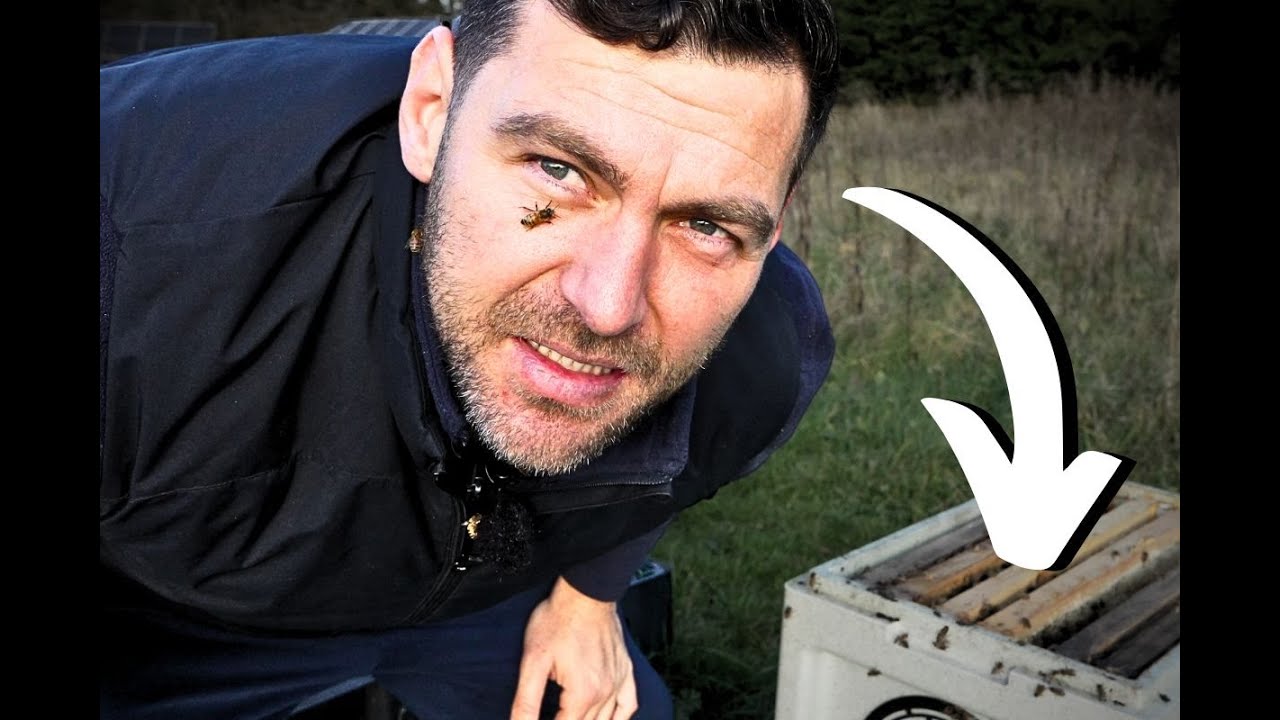
In this YouTube video, Laurence Edwards inspects a Langstroth hive on 25 November 2023 to determine whether the colony is broodless—a key condition for effective oxalic‑acid varroa treatment. He explains that colonies can be broodless at various times, but late November is often a reliable period. Edwards warns strongly against routine winter inspections because they can damage the queen or the colony, yet he proceeds carefully to demonstrate the process: removing the feeder, locating and removing an Apivar strip, finding the F1 Buckfast queen, and checking each frame for brood. Across six frames he finds no eggs, larvae, or capped brood, confirming a broodless state. He uses this observation to argue that a single oxalic‑acid sublimation at this time maximizes mite knock‑down, while emphasizing that most beekeepers should avoid such invasive checks. The video also showcases practical handling tips to minimize queen injury and discusses the importance of timing and multiple‑treatment intervals if the colony is not fully broodless.
Chapters
I think I've got quite a lot of bees on my face, and maybe today I should have wore a veil. Is there a period in winter where your colony of bees is broodless? In this video, we're going to find out. Now, I say we're going to find out, we're going to find out on this specific colony here. So I'm going to go inside this colony today. It's Saturday the 25th of November, 2023, a time where I would expect the colony to be broodless or to be close to being broodless. But that does not mean that they are broodless. They can be broodless at any point throughout the year. And they can also not be broodless at any point throughout the year. They can continue to maintain brood all the way throughout the year. However, when you're supplementing oxalic acid and you want to use it to give them a single blast in a broodless period, it's nice to know that they're broodless, isn't it? But I do not recommend people going in and checking their colonies to see if they're broodless or not. There is far too much damage to be done and really nothing to be gained. If they're not entirely broodless, the treatment just won't be as effective as it would be if they were 100% broodless. If needs be, you can track the varroa that are being dropped and you can do multiple treatments at 5-day intervals, which means that as the mites emerge from the capped cells, you're taking them down before they can go and lay again. But I know people are curious to see, are the bees actually brooders at this point of the year? So within this colony here, very, very carefully, I am going to go through and I'm going to check every single frame and I'm going to show you just how much brood is inside this colony. Right, so let's get inside this colony then, see if there's any brood, see how friendly the bees are as well. Let's take a look and see how the bees are getting on in this apiary. So the bees are definitely moving to cluster up now. It's quite a warm day today, it's about 11 or 12 degrees. You've got a few bees flying there, doesn't look like there's that many bees in there, but when you start to look down the frames, you can actually see there is a huge amount of bees in here. See, got my Apivar strip in situ there, single Apivar strip, and we've got some very, very confused bees who are thinking, what is this guy doing? So whenever you're dealing with your bees late on in the season or going into winter, obviously be as careful as you possibly can. I will say it again, I do not recommend you going into your bees at any point, say, after like the middle of September. There just is no need other than to take your treatments out, That's what I'm doing here today on a couple of late splits that I needed to put the Apivar strips in late. But just be so careful. Like, the worst case scenario here is going in, killing the queen, and that's it. The colony is wiped out. You've got no chance whatsoever. The beauty of this Langstroth design though is that I can take the feeder out and give myself a huge amount of space to work, which means that I'm not kind of like levering frames out and I really don't stand much of a risk of squishing that queen. I'll try and find the queen in here today as well. Show you the queen that I've got. And then obviously when we put it all back together again, I'll be super, super careful to not squish that queen. That really would be a disaster. So first thing I'm doing here, just really, really carefully removing that feeder. Got a few bees flying up. You can see they're still really active at this point in the year. And then all I'm going to do is just quickly check that feeder to see if the queen is on there. Going to be really careful to do that because this is the only piece of the hive that I'm actually taking out at the moment. The rest of it's going to remain in there. So can't see any queen on that feeder. Bees are still really nice and active, which I'm guessing— I'm going to say, if I had to take a punt, I think there's still going to be a little bit of brood in here. Bees are active, it's not been that cold yet. The chances are we're going to see some brood, which means that the varroa treatment might not be 100% effective. So I'm not going to shake these bees off, which is what I would normally do. I'm just going to place them down at the front there. I don't want to disturb the bees, I don't want to get them flying, but I am going to get in there now and take a look and see if we can see any brood. So first frame that we've got, we've not got a single bit of brood on it. Really nice frame of stores. Good to see that they've got a nice outer frame that's so heavy at this point in the year. Like, it should be heavy at this point in the year. I'd be a little bit devastated if I hadn't given them enough feed and it's only kind of back end of November. Nice frame of stores though, not a single bit of So you can see what I mean here in terms of the actual space that I've got. I've got like space for an additional 2 frames in here because I've taken that feeder out, which means that doing these inspections just becomes so easy and the risk of squishing the queen is negligible. Like, it's just not going to happen. I know, famous last words. Remember, I'm doing this so you do not have to. Do not recommend going into your colonies in the winter. Right, next frame out. This is the reason I'm really going in here today, get that Apivar strip out. Right, second frame out, and there we go, we found the queen. You can see her there just wandering around in the middle of the frame, red spot on there. So really good to have seen her. She's in really good condition. She is one of our F1 Buckfast queens, and as you can see, got a really super gentle colony even when the bees are flying. So no brood on this frame either. Can take this one now. I can put it off to one side, and we know that the queen is going to be nice and Safe. But just to show you this whole frame again, good amount of stores in there, nothing under those bees, just a little bit of open stores where they're starting to work it. Another frame with no brood. So you can see here, 3rd frame, another frame with no brood on it, but it looks like there was some brood not that long ago. But I'm not going to shake the bees off because it's a bit too disruptive at this point of the year, but there's definitely no brood on there. I've just moved them away a little bit with my finger. We've got no brood there on either side of the frame. So we're 3 frames in now and we've still not found so much as a single egg or any patches of capped brood. No brood whatsoever. So we're onto the 4th frame here and still no brood. And I have to say, I don't think we're going to find any now. I'll be very, very surprised to find it on like frames 5 and 6. If you're going to find it, likely going to find it in the middle. Although sometimes with polyhives they do rear brood right up at the edge. So I will go in, continue looking, but I think this is pretty much perfect timing. And it goes to show a lot of the advice that you see nowadays is kind of go in around Christmas time, maybe early in the new year, and that's your broodless period. And it's only through actually like going through my colonies like this and doing these checks very occasionally just to kind of verify what my thoughts are. And I do think back end of November is the time you want to be going in doing your single blast of oxalic acid, because a single blast of oxalic acid on a colony Some oxalic acid on the colony. Hey, you know the rules, you know the rules. Any stings to the face do get published on YouTube. That one was very, very close to my eye. But what I was saying, yes, single blast of oxalic acid at this point in the year when they are genuinely broodless like this, that is the time you want to do it, and that is when you're going to get the best knockdown for your mites. Right, so there's the 5th frame there, and as you can see Definitely no brood on that one either. And then I'll just give you a little zoom inside there so I can show you the sixth frame without picking it out. These bees are definitely broodless. It's the back end of November 2023. I've gone into these bees today to show you and prove to you the back end of November for me is a good time to get in there and do that oxalic acid. I'll chuck it in for the final time. Do not go and do this with your bees. There's no need. It's disruptive. It will set them back. But get there, do your oxalic acid sublimation, and it— got scared there, didn't get stung that time, but I thought I was gonna. But get in at this point of the year, do your oxalic acid sublimation, and your bees will thank you for it come the spring.