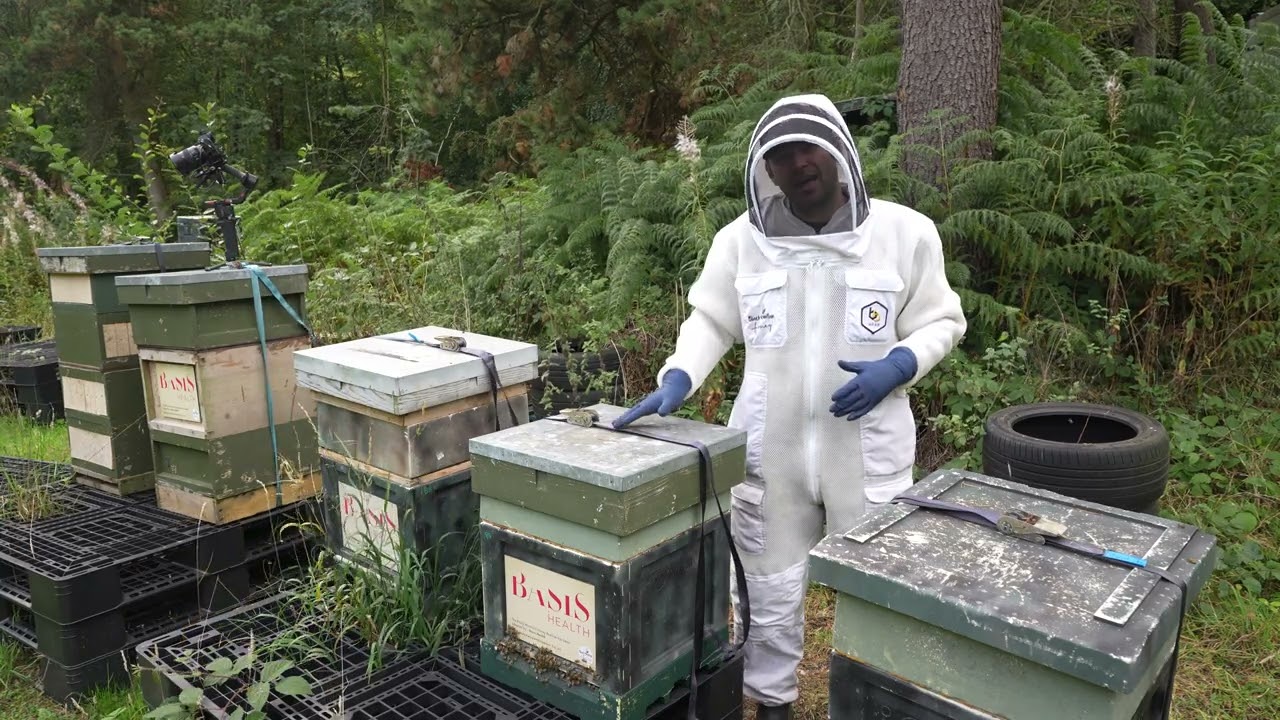
In this instructional video Laurence Edwards walks viewers through his late‑season feeding regimen for honeybee colonies in North Wales and illustrates how two adjacent hives, treated identically, can diverge dramatically because of genetics and colony condition. He begins by describing his standard autumn protocol: removing all honey supers in mid‑August, consolidating the bees into a single brood box, applying Apivar strips, and providing a small initial trickle of 1–2 L of 2:1 invert syrup to familiarize the bees with the feeder. He stresses that feeding labels (summer, autumn, winter) are less important than recognizing when a colony actually needs feed, which he determines by hefting the hive, inspecting brood, and observing bee activity. He then shows two colonies side‑by‑side: one that became honey‑bound with abundant stores and another that nearly starved, losing all brood and stores. The starving colony required an emergency feed of 14 L of 2:1 invert syrup, while the honey‑bound hive received no feed. Edwards explains how to reactively adjust feeding volumes, when to remove honey‑filled frames, replace them with foundation, and how this dual approach can both reduce honey‑bound issues and stimulate brood rearing. He also discusses requeening choices—using a breeder queen versus an artificially inseminated queen—and how queen type may affect colony dynamics. Finally, he offers regional timing guidance: in North Wales he makes a final heavy feed in the last week of September, provided temperatures stay above 12–13 °C, and outlines a simple winter fondant feeding method using an inverted poly feeder. Throughout, he emphasizes the need for continual assessment, flexibility, and the goal of cleansing the apiary of undesirable genetics.
Chapters
In this video, I'm going to talk to you about my late season feeding schedule, talk to you about some of the colonies that definitely don't need it, and talk to you about a near miss where a colony very nearly starved. So people who watch this channel regularly, you'll know my process. Middle of August, I take off all the honey supers, condense down to a single brood box, generally have quite a good amount of stores in there, put my Apivar strips in, and then I just leave the bees to get themselves ready for winter. They get the end of the summer flow and they get all of the autumn ivy flow in order to produce themselves a decent amount of stores going into winter. And I supplement that at different times throughout the autumn season. Now you can call it summer feeding, call it autumn feeding, call it winter feeding. All you're doing is feeding your bees to make sure that they get through to the next season. Doesn't really matter when you do it, and I wouldn't worry too much about the different labels that people give it. What's really important is understanding when bees need to be fed and when bees don't need to be fed. And there's no way that I can tell you that your bees need feeding in July Or September or November. The only way to understand it is to go out, look for yourself, to heft your colonies and see what the bees need. I've done a previous video on hefting. Ratchet straps really help with that. You can lift the colony up, get a good understanding of what the colony should feel like at different times of the year, and then you just need to make sure that you're feeding an appropriate amount of feed, an appropriate feed for the time of year, in order to give the colony everything it needs going through the year. So in this video, I'm gonna give you 2 examples, and I'm gonna give you 2 examples and go into the bees and actually show you these examples. as well. 2 colonies that are basically next to each other on the stand that had the exact same process given to them, but due to their genetics, they responded very, very differently. So as I said, my process: take all the supers away, they've gone, bees condensed down to a single box, they get a little trickle feed on that first takeaway when I put the strips in, but I'm talking only maybe like 1 or 2 liters of syrup just so the bees know where the feeder is and just so there's no emergency shock of taking away all that honey. And at that point, these 2 colonies were relatively even, strong colonies bubbling out the box, Lots of bees, lots of brood, reasonable amount of food. I came back here 3 weeks later after doing that. One colony was barely shaking off the frames. They were completely starving, bone dry. All of the brood had disappeared. I had some really untended brood in there as well. Not a single drop of stores left. And then the colony next to it didn't have a single cell of brood and they were completely honey bound. So it just goes to show, at this point of the year, you can't say, well, I'm going to do my feeding in the last week of October. I'm going to do my feeding in the first week of September. It just doesn't work like that. Every single colony is different. Now I go out to set my colonies up and say, right, I'm going to go into this apiary, I'm going to feed and treat all of the colonies. But if a colony is super heavy and honey bound, I'm not going to give it any food whatsoever. And if a colony is starving, like the colony here was starving the other day, I'm going to give it 16 litres of syrup as opposed to maybe the 8 litres of syrup that I had scheduled to give it. It's all about being reactive. It's all about assessing the situation as you come across it and making sure what you're doing at that moment time is best for the bees in order to get them through the year. So let's go and get my bee suit on. I'll show you 2 colonies, one that was honey-bound a week ago and one that was barely alive a week ago. So these are the 2 colonies that I was talking about. This one here, the queen had no room to lay, jam-packed full of bees, but they were honey-bound. They needed a little bit of a fix. This colony here was literally trembling on the frames. It's so obvious when you go into a colony and they're starving, even before you go in and heft them and think, wow, they're really light, they need a feed. As soon as you pull them up, they're almost lifeless on the frame. When you shake the frame like that, they cling onto it for some reason. Really difficult to shake them off. You kind of get used to it. You kind of know as soon as you go into a colony and they're starving, there's not as much sound. The bees don't fly up, they won't shake off the frame. Obviously they're hefting really light. So I gave these ones here an emergency feed, 14 liters. I gave them a full 14-liter tank of 2:1 invert syrup. This one here I didn't feed. In previous years, what I would have done is I would have taken some of the stored honey from here, put it into the one over there, but I'm just not doing that anymore. I have to manage things a little bit differently. I'm giving these ones a little bit longer to see if they can manage it themselves, but if they remain honey-bound, what I'll have to do is take out some of the frames of honey, store them securely for next year, and just replace it with some frames of foundation. Easily manageable at this point of the year. They'll turn those frames of foundation when the ivy flow comes in They'll draw that out, she'll lay it up. Gives you really 2 big benefits there. One, in that it's gonna reduce the honeybound nature because they're gonna use some of the stores within the hive in order to draw out the frames of foundation, and then it boosts the amount of brood at the same time. So you're kind of getting that double effect. Let's go into this one here first. This is the one that's got a ridiculous amount of stores going into winter. Right, so I'm just going through the frames in here and I've realized I've got this completely wrong. This is the colony that was starving and this is the colony that wasn't starving over there. Got it the wrong way round. Been going through the frames, looking at them all and thinking there's no capped stores in here at all. It's just full of open nectar, open stores. And then I look up into the feeder and I think, yeah, this is the one that I fed. This one here is the one that 2 weeks ago was completely starving. I topped up the feeder and they've taken down the entire 14 liters. I'll show you some of the frames now because they've stored it really, really quickly. So you can see there, really heavy frame, but none of it's capped over. They have just filled that with invert sugar syrup. And this frame here, this is the one that threw me. I pulled this frame out first and I thought, oh my God, they've eaten all their stores. But no, this is what the majority of the frames looked like. In fact, they were considerably worse than this. There was no stores in them whatsoever. I'm gonna shake off the bees, give you a close-up, and show you what their empty frames looked like. So you can see, you've got the dark ring of brood where the brood used to be, and then round the edges of the comb, completely empty, and the bees will go back through that now and fill that up. 2 weeks ago, every single cell that was here in the whole of that hive was completely empty. They did not have one cell left. They were hours, probably about a day away from completely starving. In fact, I already found a few with their bottoms sticking out because they were starving, trying to scrape out the bottom from the cells. So there's my new breeder queen that I've got in there. You can see she's a lot lighter than the bees in the colony. All of the bees will be a lot lighter come spring. And this frame here as well, really nice and heavy. So I'm going to get this colony put back together again, really being careful with that queen. They don't need to top off a feed now. They've taken down those 40 litres of syrup. They're really happy for it, really nice, calm. Not aggressive bees. Oh my God, I can't wait for 2023 to get rid of the nasty, nasty bees that I should have got rid of a long time ago. Let's get inside the colony next door and take a look at a colony that's prepared well for winter and didn't need any feeding up until this date. So this colony here has maybe prepared for winter a little better. I have to say though, it's not necessarily what I want my bees to do. You can look at this as a negative, or you can look at this as a positive. I like the bees to put the honey in the supers and keep the downstairs for brood. This colony here Packed out the downstairs with honey. They put some honey upstairs as well. It limits the size of the colony, and it means that they can potentially become honey-bound in spring. I prefer to deal with the colonies that need a little bit more feeding, but you know you're going to come into spring and they're not going to have any excess stores left over. Again, this colony here has been requeened with a pure artificially inseminated queen, not a breeder queen this time, untested. Let's get inside and show you some of these frames. So I have to say, it's amazing what the bees will do in a couple of weeks. Last time I came here, all of this was capped over. 8 out of the 10 frames in there were fully capped, 14 by 12. And I've come back in today and they've broken a lot of that over, and they found obviously another source of nectar coming in. Shows how reactive you need to be with your bees, because even in the space of 2 weeks, they've got rid of that honeybound status and they've managed to find some I'll have a look through, pull out a couple of the other frames, see if we can find some brood in this one as well. So there's my queen, artificially inseminated queen. This frame is a bit dark as well, that's going to get cycled out next year. Going to burn all my old frames, recollect that wax. Nice pattern of brood on both sides though, and there you can see the artificially inseminated queen. And then final frame, we've got some drone comb in this one as well, good amount of capped stores. This one here is pretty much the perfect example of where I would like my colony to be at this point of the year. I'm really happy with this colony even though they're quite aggressive because it gives a real good lesson in terms of the status of both of these colonies 2 weeks ago and the status of the colonies now. One got fed, one didn't get fed, and they're now very, very similar in terms of where they are in the season. Good mixture of stores, good mixture of brood, good mixture of open space, and I can top up that open space with invert sugar syrup later on in the season. Ballpark figure for me, last round of feeds, big heavy feeds, 2:1 or invert syrup. For us in North Wales, I go around last week of September. As long as it's above 12 or 13 degrees in an insulated poly feeder, they'll take that down in about a week or 2 weeks. And for me, it's just a case of lifting up the colony, doing a heft, topping it up with as much as I think. And then if I need to feed fondant throughout the winter, it's a really simple method. Flip the boards over, feed it in an upturned polyashphal feeder. Say goodbye to the angry bees, they are not going to be here next year. We are going on a true cleansing mission to get rid of all bad genetics from our apiaries.