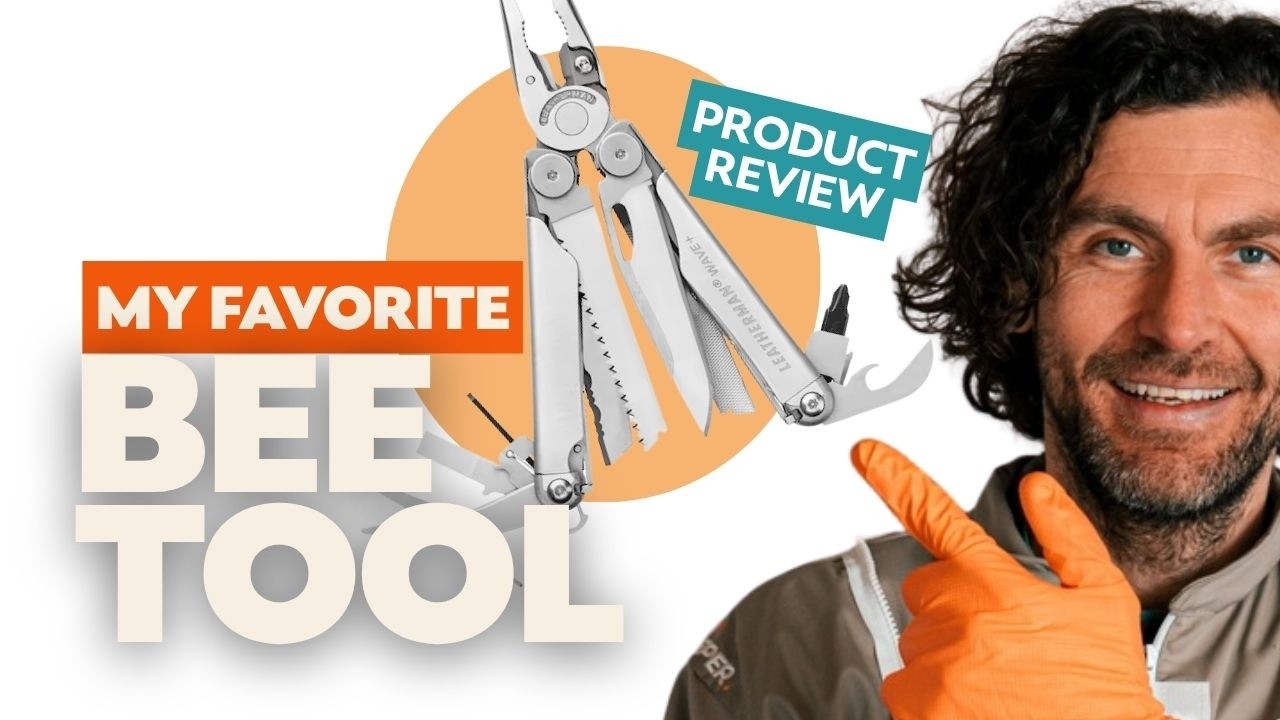
In this episode of No Nonsense Beekeeping, Laurence Edwards reviews the Leatherman Wave multi‑tool, explaining why it has become his go‑to piece of equipment that lives permanently in his bee‑suit pocket. He describes the tool’s construction (stainless‑steel, lifetime warranty) and maintenance (cleaning, oiling). Edwards walks through each of the Wave’s functions—pliers, wire cutters, 3.5‑inch locking blade, serrated blade, saw, flat‑head and Phillips screwdrivers, scissors, and bottle opener—highlighting the specific beekeeping tasks each supports, such as cutting queen cells, trimming frame wire, pruning branches, and prying hive boxes. He stresses the legal restriction on carrying a locking blade in public and advises keeping it in the bee suit or vehicle. Edwards also positions the Wave as an ideal gift for beekeepers, noting its versatility for camping, hiking, and fishing, and argues that its frequent use more than pays for its cost. The review concludes with a personal endorsement, a disclaimer that he received the tool for free but paid full price, and a call to subscribe.
Chapters
Hi, I'm Laurence Edwards from Black Mountain Honey. Welcome to another episode of No Nonsense Beekeeping. Today we're going to look at the Leatherman Wave. Now this is my personal favorite piece of equipment that lives in my bee suit, and when I say it lives in my bee suit, it literally lives there. I never take it out, it's always in my top pocket. Because I use it so often. Now, these normally cost, I think, about £120, so it seems kind of a bit of a frivolous purchase. And when I first purchased it, it was a bit of a, a boy's toy, and I kind of thought, well, you know, I might use it occasionally. There's certain tasks within the apiary that I'll definitely need it for, but I'll maybe use it kind of maybe once or twice a month, something like that. I use this absolutely every single inspection that I go on. It's so versatile. It's such a, such a good tool to have kind of in your arsenal within your apiary. So in this video, I'm just going to do a bit of a review of the Leatherman Wave and tell you about some of the specific reasons that I use it within beekeeping and then give you my recommendations for it. I often get asked, what's a good gift to get a beekeeper? And I go kind of through it in my head loads of times and I think, well, if I What would I like? And I kind of have most things that I want in terms of beekeeping because I need them for the kind of nature of the role that I'm in. But if you're looking to give someone a gift, I think that's such a good beekeeping gift because it kind of doubles up as a lot of other things as well. So you can take it out kind of camping and hiking and all of those things and fishing, but it's such a useful tool within the apiary. So as soon as you give this to someone and say that, keep that in your bee jacket, Um, you'll need it soon. They will absolutely love you for it. Like, it's such a good gift. So we'll talk you through some of the features. The first thing I'll say about it though, like I say, it's called the Leatherman Wave. Um, it comes with a lifetime warranty. So when I read that at first, I thought it's going to be really, really good. And it's such a quality piece of kit. Like, it's built so well. The fact that they're willing to offer a lifetime warranty on it. You know it's going to stand up to some abuse, and I really, really do abuse it. So you just kind of keep it clean and keep it oiled just to stop it from rusting. But I mean, this gets, this gets abused on a daily basis pretty much with an RA parry. All right, so enough of me waffling. I'll go straight into the kind of technical details of it. So it is fully stainless steel, really, really easy to keep clean, doesn't rust. It's about 4 inches long and about an inch and a half wide like that. So the main functions are it's a set of pliers. Now that's probably the one tool that I don't use that much in the beekeeping world. Um, I guess if you really wanted to, you could use that to kind of pick out larvae. So if you were like removing, say, some chalk brood or something like that, I find they just drop out. But if you kind of wanted to get in and use that, that would be really good. The section below the pliers though, they They actually have wire cutters on here, and I use these all the time. So if you've got a frame like this, um, and they've kind of messed it up or something's gone wrong and you want to cut the wires, all you do, straight through, and the wire is then cut. So I won't continue to do that one because I'll reuse this frame. That's really, really handy to have that, to have that kind of functional functionality within the apiary. Is such a helpful thing to have. Like, the amount of times I've kind of found a frame and just want to cut a bit of wire, um, or there's a bit of thread coming off one of my foundationless frames and I just want to cut it off, it's getting in the way, um, I can cut it off. I've got the tool to do that. So that's a really, really good use for that. Apart from that though, that's pretty much the functionality there. Now, the number one tool that I use on this is Is the blade. So it's got a 3.5-inch blade and that is razor sharp. It's a full locking blade, so be careful. You can't actually carry these around. If you get caught carrying one of these around, you will get— it's a criminal offence. So we keep these, make sure they're in the back of the pickup truck if you're using it, and I keep it in the bee suit. So we use it for our work, we're allowed to carry it around, but you can't just kind of walk around with these in your pocket. So like I say, it's a full locking blade, and when it locks, it's really solid. There's absolutely no wiggle in it whatsoever. Now, as you can see, it's really sharp. Yeah, really, really sharp. So what do I use the knife for? Um, I use the knife predominantly for a couple of things, but the really, really handy one that I use it I do quite a lot of cutting out of queen cells. So say you've got a colony and you open it up and there's 10 queen cells on a single frame and you want to make 5 nucs, you can't do it because they're all on the same frame. So what I do is I cut them out. So all I do is I get the knife, and you need a really good sharp knife to do this, I just go in. And I'll just cut it out. And then all I do is I take another frame, I cut the same size hole out into some honey, and I just wedge that in. And there'll be a queen cell on there, making sure not to damage the queen cell. Wedge that in, and then you can split it as many times as you want. So I'll do a video on that separately. That's a really, really handy way of turning kind of a, a frame with lots of queen cells into lots of different nucs. So I use that knife loads. Also has a serrated knife. The serrated knife is actually really, really good for cutting those cells out as well, but I kind of use that for other little activities around the apiary. Another one that I use loads is the saw. Now you look at that, you might think that's probably not a very good saw. It's an incredible saw. So, do you mean, say you come to find kind of a site, or you come to an apiary and things are starting to grow in front of the hives, or you want a couple of sticks, you can just kind of go— You just cut straight through like that. I mean, I've cut kind of 3-inch branches with that saw. Takes a little bit of going, getting through, but they're really, really sharp, the teeth, and they're really, really good at clearing themselves as well. Um, and again, that's on a lock like that, so it's completely locked out. There's no wobble in it whatsoever. Really, really handy tool. Um, other things that it's got then, so it's got like a little flathead screwdriver like that. And again, completely locked like that. If you forget your hive tool, that's really, really good for kind of getting in and just unjamming boxes. A little bit, a little bit, um, thin. It's not perfect for that, but I mean, if you forget your hive tool, that's kind of something that you could use that for. I've used that a number of times to kind of pry open boxes just to get them to break the seal, and then it works fine. But the fact that that locks makes it really, really strong. Then we've got a tiny little flathead screwdriver as well, and you can take that out and change it around, and you've got a Phillips on the other side. Then looks a bit weird, that one. I, I didn't know what that was for ages. It's a pair of scissors, and the mechanism on these scissors— Get that one back first. The mechanism on these scissors is, is really, really good. So as you can see, it kind of flicks back like that, um, and then there's like really good pressure there. So I use that for loads of things, kind of like trimming little bits of thread, um, or little bits of wire as well. You can trim with that. Don't use that a huge amount in the bee— in the beekeeping world, but I mean, really, really handy to have a good pair of scissors. So I like that one. So then the next one, I don't use it ever for beekeeping, but you've got like a, uh, a Phillips screwdriver there, and it's kind of like a bit of a thin one, but that works on so many things. So if you get like kids' Christmas toys and stuff and they need a little screwdriver head, that works really, really well for that. Got me out of trouble loads, that one. And then I can't get this one out. There's a bottle opener on there as well, which obviously while you're beekeeping, if you want to have a beer You can use that, but I wouldn't recommend it. So that's about it. Like, it's not got a million and one tools on it. It's not like a Swiss Army knife that's got kind of like 50,000 accessories on it. What it has got though is 5 or 6 really, really critical, good quality tools that will help you with your beekeeping. The ones that I use the most are the knife, both the normal knife and the serrated knife. Use those all the time just for cutting things, and the saw. The saw is really, really handy. The amount of times I've needed just to kind of cut off a branch—you don't think that you need it at the time, but I mean once it's grown in front of it and you want to cut that down, it works really, really well. So that's about it. I just wanted to give you a quick update on one of the really, really important tools that I use. You might see it as a bit of a frivolous purchase, and for some it could be, but I find having one of these around has saved me a trip on so. many occasions. Do you know what I mean? If I have to— if I come to an apiary and I need to chop down a branch, I'll have to go home, get a saw, and come back, and it's probably going to cost me about an hour's time. Now, I don't have that amount of time, so to have something on hand that might not be perfect but can do the job saves me lots of time in those instances. And I turn to this tool so much and so often, it's kind of paid for itself many times over. But I think for recommendations for kind of beekeepers for birthdays, you can't look kind of— you can't look past a Leatherman. I think they're a really, really good tool, perfect addition to any beekeeper's arsenal. So that's about it. I hope you've enjoyed the video. Get out and get yourself a Leatherman. I'll just say, I mean, I haven't been paid for this, not kind of promoting this because I've been given it for free. I paid for that full price out of my own money because I thought it was a cool gadget, and then I've kind of adopted it into my beekeeping accessories and I use it all the time. So I'm just sharing that knowledge with you. If you know anyone out there who needs a present, or you're just a beekeeper who likes your gadgets, get your hold of one of these. It's a really, really good buy. So thanks for watching. Please hit the subscribe button, please hit the bell so you're notified of every video, and I'll see you next time.