Live Apiary Inspection - Episode 3
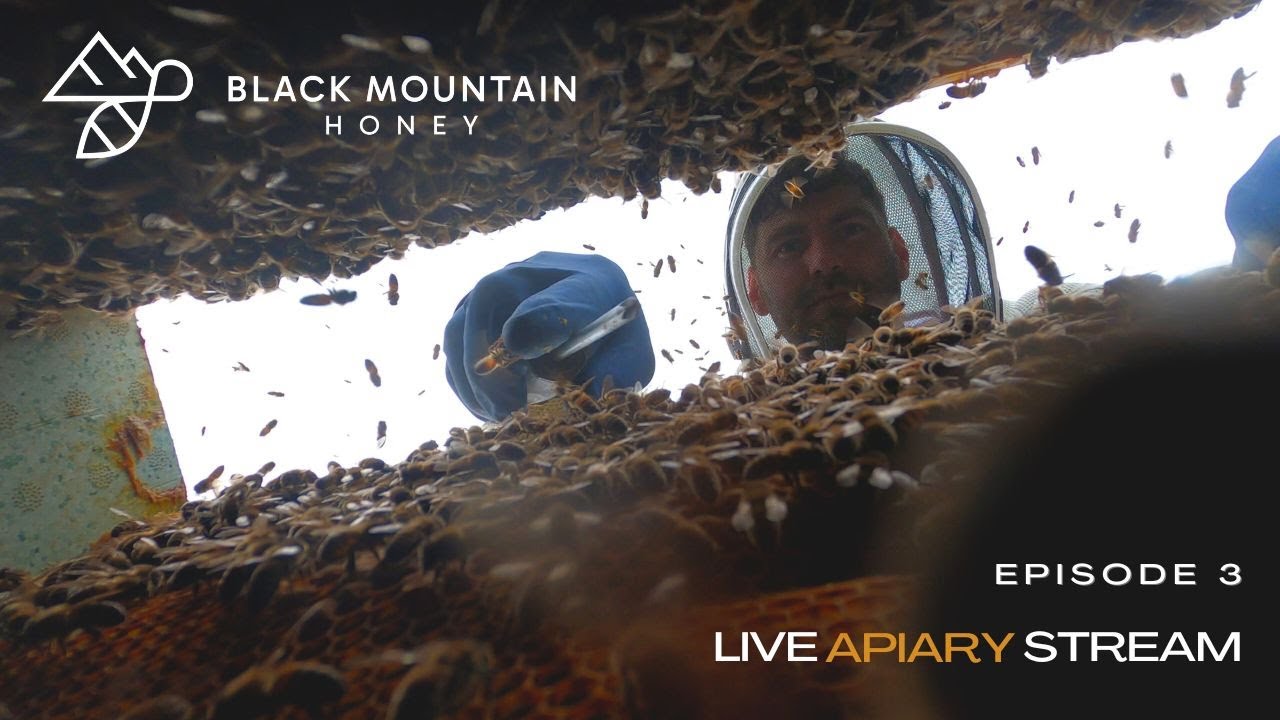
Laurence Edwards inspects hives in rural Wales while streaming live, checking queens, brood patterns, and food stores. He battles technical glitches with camera and audio while feeding colonies syrup ahead of poor weather and re-queuing queens based on what he finds in the brood.
Chapters
Right, so we're live again. I'm finding it really difficult with these settings. I'm switching it up each time, and I'm just going to do a really quick live stream today to hopefully make all of these settings work. I want to check these colonies again, make sure they've got queens in them, hopefully not get stung in the face. I'm not announcing these at the moment because I just have to quickly nip out of the house as and when I can get out of here. But I need someone to give me a thumbs up and to say that they can hear me. Having real audio issues, so please do bear with me. There's no way of practicing a live stream on YouTube or Facebook for that matter. Can't do a practice, so I just have to come in here and do a live stream. So a new one that I'm doing today is I've got the camera flipped around the other way, and also I've upgraded my StreamYard subscription to 1080p, so I'm hoping that doesn't mean I'm all juddering and all over the place. And you're getting a better quality stream. We might have to downgrade it again to 1080p— or sorry, to 720p— if this isn't working. Problem I've got at the moment though is when I come in here, I can't see the comments. I've got to go around the back. So I'm going to quickly go around the back. Hopefully someone's giving me a thumbs up to say the quality is okay and that they can hear me, and then I'll jump in and we'll do some inspections. Excellent, you can hear me, right? So I hope the signal is pretty good. I shouldn't clap with my veil kind of up like that. I will shout just at the same time just to make sure that people can hear. For anybody who didn't watch the last live stream, I went through all of them. I'm not going to do that today. I am doing my full proper live stream tomorrow, live stream Q&A with a special new brand new twist that I'm really, really excited about, but I will not give that away. 8:30 PM Saturday night, tomorrow night. So let's get into this colony here. This colony here was rescued by a young man called Aidan last week because when I was doing my live stream, I was going through and I was showing you all the cells and taking lots of care and paying attention. And as I showed you one of the cells that I took out, the elongated one, to show why that was such a poor quality cell, I've missed 3 cells in there. And Aidan commented on the video later on and said, you missed some cells. I looked back and said, yeah, you're right, I did. So I came back up And fix them. Hopefully they've accepted the queen. We will go in today and we will find out. And this is definitely not fixed. I don't know whether she's even out of the cage yet. So fingers crossed we are all good. I'm just going to jump back here for a second and everything is good, right? So this is, this is good. This is working well. I can't wait to see this when I get home and see what the quality is like, if there is any difference in quality at all. I was not happy with the quality of the last one, but we're in Wales, so we do have to put up with the mobile Signal that we have got here. Right, first things first. Looks like the queen is out of the cage. So let me just get that queen cage out. There we go. No queen in there. So I'll just open that out. Empty queen cage. I just need to be aware that I have to kind of come and touch that every now and again to make sure that the screen doesn't go off. So we'll either find the queen walking round thanks to Aiden, or we'll find her dead thanks to me. I reckon we're going to find her alive. Even though the weather forecast today was pretty shocking, it's, um, the bees are doing well. There's a really nice strong flow on today, fresh nectar in the frames there. This was the problem that I was having last week in that the quality of me holding that like that just wasn't good enough. So what I can come and do now is— let's have a look. Is that any better? Sun's not in the best place for this one. We're looking pretty good. Nice frames of stores there. Right, let's see if we can find this queen. Hopefully we find the queen. Even better, we'll find eggs. See what we've got. So just stores again on that frame. I love going in and finding eggs straight away because then you know you definitely got a good successful, successful queen introduction. But nothing's still on that frame there. Oh, there's a bit of action downstairs. What's going on down there? Oh, they're the old queen cells that still on the floor. They were well and truly squished though. Oh, I was just about to say I'm going to be really, really embarrassed here, and that's that introduction is not going to have gone well. But here we go, and this is how I'm going to do this. I'm going to come around this side and show you because there I can see it. We've got one F1 Buckfast queen, and I'm you probably can't see in there, but we do have a little patch of eggs in the middle. So from four or five days ago, um oh someone's just mentioned that the sound is much better. The video is a bit jumpy. But it's watchable. Okay, I'm sorry about that. Streaming quality here is always going to be a little bit suspect because it is rural Wales, but maybe I can set one up at home in the garden and, uh, that would be the best way of doing it. But the audio should be pretty good here with me talking directly into it. But there we go, first queen! So that one is a success. Very, very happy with that. Every time I come back, I think I've lost the queen. I'm pretty sure my eyesight's getting worse and worse. Massive thank you to Aiden, you saved that queen there. You got that colony successfully introduced. You were the only one paying attention last week when I missed those queen cells, so congratulations to you. And what I am going to do with this colony here, I'm going to put the feeder back and I'm going to run and get some syrup, and I'm going to start feeding these syrup because the weather— if you remember last week, the weather was really, really nice. It was 25, 26 degrees. Bees working really well, and although they're working well at the moment, it's very rainy. Kind of today was rainy, it was cold, it was freezing cold this morning. So the length of time that the bees are going to be able to work at the moment significantly reduced, and I want them to get upstairs and start working those boxes. So I want to give them something to do on the downtime, and I'm going to do that by giving them some syrup, which I kind of have over here. Now this would be interesting. This is like a test for me. If I pour Way over here, and you can still hear me, and I know that that headset's working. And if you didn't hear any of that, what I said was, if if you can hear me over there, then the headset's working. So I'll definitely know one way or another now whether that headset is working. I have some invert B here. Invert B straight two to one invert B, and let's see if we can get him out spilling it. I'm not going to go wild putting this in. Just gonna go probably about a third, maybe a half a feeder full. Good few glugs though. There we go, no drips anywhere, textbook. And the feeder float has come up to the top, so very, very happy with that. That's one nuc sorted. Now we'll leave the cage on the top so I know what queen I've got in there, which is F1 Bufffast queen. So success! I'm hoping that the video is holding up. I'm going to come back around and have a look now, see what we see, see if there's any comments. Ah, there we go. It was so quiet when you walked away and not sure it is working. There we go. Oh man, I honestly, I just don't know what to do with this headset. You've got my headset in there and it's just not working, and it works on every single other device that I've got. But there's no way of really testing it here, which is just very, very peculiar. So I'll shout. There we go. I'll shout. That'll be the way to do it. And I'll have to just keep on testing that until I get that going. I can change it up. I can go into the settings and I can change the audio. Let's go for— and let's see if that works. Ah! So, can you hear me? Yes, no. Oh, can you hear me? I'll change it back if not. Can you hear me now? Can everyone hear me now? That'd be good. Hello, hello, hello. Okay, all right, we'll try, we'll try this one. Sorry for you to be guinea pigs. You have to be guinea pigs because they just come on like a random stream. But like I said, there's no way for me to work out if that's working or not. So let me just double-check what one that's on. Right, so that is on headset earpiece, headset earpiece. No, we're gonna have a look in a sec. Right, let's have a look in this one, see if the bees have moved up. Oh, very nice. Right, so we've got bees up in the top box in this one now. Take out a couple of the emptiest frames. So believe it or not, I got stung there. Bee just took me right by surprise and got me, which is annoying. I hate getting stung so early along a big line of bees because they all sense it then. But there we go, you can see good frame of bees working upstairs. Someone's saying it's quite low now, should be able to hear it. That's using the clip-on mic. Yeah, it should be. Let me just double-check. I'll let you watch the bees while I check. All right, so that is the headset earpiece, and I will stop with the audio now. We'll just do bees going forward. Someone's saying it's quite low now. I don't know, I'm just gonna shout. We'll talk about bees, I'll do half an hour of inspections, and then I'll go back and I'll do a little bit of a kind of recap when I get home to make sure it's all right. Luckily, tomorrow's— tomorrow night's stream, the No Nonsense Beekeeping live stream, is at home. Good internet connection, gonna be nice and crisp. I've got my mic at home, I'm gonna answer loads of questions, and as I said, we've got something brand new to show you. which probably isn't that exciting. It's exciting for me though. Let's see, what I want to see in this top box is I want to see if the queen has come up here yet and started to lay some eggs. So we've got like 2 eggs in that one, so I'm going to pretend that she's not laid eggs in that one because that's a bit of a feeble effort, but that's pretty good. So 4 out of the 5 frames in that top box there are drawn out. Could do a little bit of checkerboarding in there, but I'm not going to bother. I'm just going to run through, go down to the bottom box quickly. My job up here today is I want to requeen the 2 colonies up there, or check on the 2 colonies that I requeened up there. One that just had nothing and one that had a frame of— sorry, one that had a queen and one that had nothing. And put a frame of eggs in at the end, and I want to see how they're getting on. And then I want to check on the one that had eggs in, and I don't know whether it's worker brood or not, so we're gonna have a look at that because I think that might be drone brood. So I'll get some of these frames out in here, and then we'll put a bit of feed in that one as well, I think. Love this frame. So I wanted to show you this frame last week. I think I might have even showed you this frame last week, but It might not have looked as good as that. It's annoying that the way in this apiary, it's definitely a morning apiary to come and do it up here because the sun is kind of like right up there, so it's behind me. But look at that, isn't that a nice frame of pollen? Beautiful frame of pollen. That is what you want to see, big frames of pollen like that in your colonies, and you need that as part of a kind of special mix to get good growth. Well, I'm just going to flash through this one. It'd be nice to see Wow, talking— look, that's the next frame along and it is absolutely identical. Look at that, really, really nice. So I'm just testing out the new camera there, seeing what it's looking like, but lots and lots of nice colours. Oh, definitely gonna have to get this camera turned the other way around somehow. Can't do that today. Maybe I'll come up here first thing in the morning and we'll do a live stream so we get the nice early morning sun and it'll look beautiful. Right, that's just a frame full to the brim with eggs, looking really nice. And another frame of eggs on that side, and then we've got some nice brood as well. So let me show you some of this nice brood. Not found the queen, but I'm not particularly looking for the queen. Nice frame of capped brood in the middle, eggs around there, and then a ring of stores as well. So we'll close this one up. I, uh, I'm not going to feed this one because this is the one that's got all of the wax in the feeder, so it'll take me a while just to kind of get that sorted. Chilled out bees as always, nicely chilled. See what I mean about the wax in the feeder though? Like it's a sign of a big strong colony, but it's really annoying. And if you put the syrup in there, then the float doesn't come all the way up to the top, and then if the float doesn't come to the top, we get loads of drowned bees. So I'm not going to fix that now, but I'll fix that next time I come. I'll do this full line here. And then we'll go over to the ones that were a little bit troublesome, and then I'm going to go home and see how this has all gone. I kind of let you half into the secret of the new features of StreamYard. So not only does it give you full 1080p streaming, but it also gives you the ability to have an extra camera. And that's what I'm really, really excited about at the moment, is the ability to have that extra camera. And If I can get it set up here, we might have to do a little bit of playing, we might have to do a little bit of trial and error and kind of connect it somehow to the main camera and have it here. And then you'll see both me talking jibber jabber and all that, and, and they actually inside the hive as well. So I'm not coming up there and talking to you like that. I think that would be cool. Hopefully the bandwidth can cope with it here. But we will see. Right, let's have a look at this colony. 2 roofs, always confuses me that. Bees moving up on this one as well, which is nice to see. Oh yep, lots of drawn-out comb. Just syrup up there, but nicely drawn out. How many have we got? 1, 2, 3, 4. 4 and a bit, I'd say. Oh, that's annoying. Look, so that's the feeder again, so we're gonna have to sort that out. So what I'm not going to do is I'm not going to do that today. I'm just going to put that feeder back in. Oh, oh no, there we go, we fixed it. Look, it's on that bottom frame there. It's annoying they do that. It's the space in the feeder. So what you can do With these Langstroth ones, which is really, really nice, is you can obviously just remove the feeder and stick an extra couple of frames in, but then you need to store the feeders somewhere. You need to make sure they're going back to the exact same one. And you can see, like, I've just ripped some of that comb. There's a little bit ripped, which is a bit frustrating. But I'm gonna just quickly shake the bees off, get that bit of wax off. We have to deal with that bit of wax. Where am I going to put that? I'm gonna have to store that in the feeder for the time being until I come back and clean all of these out. Don't get into bad habits and just chuck that down because even for a second, you know, another bee could come and rob some of the honey out of that, and if there is contamination then you're in trouble and you've just spread it around. So be really, really cautious. Shake that one off again. So I can't feed this colony because of that. Let's just have a quick look here and see if that Carniolan queen— oh, she's definitely laying eggs! Full to the brim with eggs, that one. I'll tell you what we're going to do, I'll tell you what we're going to do. We are going to switch this up a bit. We're going to bring this round here, and I'm going to inspect from the front, which you wouldn't normally do. Because you're going to block in loads of bees. But what's nice is that it means that I can enjoy some of that sunshine. Hopefully that will improve the stream quality as well. What I know it will do is it will improve when I come and show you the frames. It will make the frames look loads better. Right, so this one here is still eggs. This one was a bit slow to get going, I think, but I'll show you what I can see in this one now, and let me do it from behind. Try not to drop anything. And that is just like you couldn't be more sod's law. I'm behind the shade. Look, there's the sun over there. Right, let me move that. I need to move that and show you, don't I? Well, this is this is a change from all those perfect YouTube videos. I call them perfect, but you know, heavily edited. YouTube videos where everything goes right all the time, but this is, this is real life. Right, so I'm hoping you'll be able to see me there. Yeah, you should be able to. Right, let me grab that frame again. Still, still a little bit in shade. I just— I've picked the wrong tree there and I've gone right behind it. Hopefully you can see there, that looks like better quality if you can see it, but not a huge amount to see in that, in that colony, to be honest. Eggs, eggs all the way throughout this one here though, which is really good. And I'm not seeing the queen, but I'm sure the queen is around. And they're working upwards, so definitely by this time next week they're They'll be, they'll be well up there. That's all good. What I always do whenever I put a box down like that, you got to just check, check, make sure the queen's not there, because if she's there and you don't put her back in, you're in trouble. Right, strap that one back up. Bee from behind for the time being, so for that Right, so we're going to go over and have a look at this one over here, and this is well out of the sun, this one, anyway, so no good fun with the sun. See all the syrup bottles behind? Obviously no spilt syrup, and they are all closed. But this is the one that I'm really, really interested in here. Because this is the one where I think it was just a virgin that had killed my introduction queen, and then she started laying eggs. So I don't know whether those eggs are good eggs or bad eggs. And I'm trying to think when we did the last one. We did the last one 6 days ago, and there was eggs. It might still just be a touch too early if they've capped over, but we'll get in and we'll take a look. And you never know, we might actually see the queen in here. Let's get in. The bees are so slow on these plastic frames. Like, I've had another one in another apiary where I put the really fat drawn-out version next to a not drawn-out version, and they just double extended the fat one. Very, very frustrating. So now they've wasted all that effort, and I'm gonna have to like take it back because It's kind of like an unusable frame as it is. Okay, little bit confusing. They've drawn it out and they're filling it, and there are eggs and there are larvae in there, but nothing's closed over yet, so you can't really understand what's going on. Hopefully you may be able to see it. Can you see in there? We've got eggs, we've got larvae. So Definitely next week I'll know with that one whether it's been capped over, or— well, it will be capped over, whether it's drone brood or capped worker brood. You can see a couple of play cups there. They had those play cups there last week, but one there, one there, and there was nothing in them. One up there as well. I always get a little bit worried whenever you see colonies where you're unsure whether the queen is mated in there and you see kind of queen cells Always get a bit concerned because it may be maybe me thinking the queen isn't any good, and they're just preparing to. So I'll show you this one here. So so this is what is leading me to think there's this is no good this queen. So I've just opened up one of those play cups on a colony this size, and I'm not sure whether you'll be able to see it or you won't because that bee's in the way. Here we go. Hopefully you can see it there. Pretty good that it will go that close in. There's an egg. So an egg in a play cup on a colony that's not got any capped brood, for me, that's a drone-laying queen. They're going to attempt to sort her out by superseding her, but if she's a drone-laying queen, then they're not going to be able to do that anyway. So that's a bit of a bummer, but I've been proven wrong many times. Many, many times in the past. That's just my hunch. Good, good amount of eggs, good amount of larva, not particularly good pattern, which again indicative of a drone-laying queen. And the fact that I've still not found this queen, like, it could, could be laying workers. Also, another interesting thing in here, there's a few double-laid Which you would get with an early queen anyway. But let me just see where they are, the double laid. You can see double larva right in the center there. You see that one there? That's double laid. There's a few double laid. Nothing wrong with the larva, nothing wrong with a couple being double laid, but to see that many being double laid is a bit of a concern. But you can see, like, see at the bottom there, loads of eggs. So she's laying well. And again, that is what you would get on a newly mated queen. You would get her firing, firing some blanks and firing kind of like twos or threes down to the bottom of the cell. Nothing to worry about, but definitely something to kind of monitor and keep an eye on, which I will with this one. I'm not thinking laying workers. Laying workers will be multiple legs kind of sitting on the side of the cells. But it is, it is a strange one that I've still not found or seen the queen. So that frame there's got loads of, loads of the same thing, loads of eggs, loads of brood, nothing capped as of yet. So that's a monitor, we'll leave that one to it. Let's go and take a look at the one where they killed a queen first time round, and then I introduced another queen without doing a test frame of eggs. That's like the riskiest thing that you can basically do, but we will see. Sometimes you do have to take a gamble. Sometimes the gambles pay off. So it's a 50/50, this one, I think, for me over here. But we will take a look. Hopefully stream's going well. Stick my hand in front of it there. I'm hoping, hoping the audio is good. I'm hoping picture's a little bit better. I was gutted with the picture last time, I'm not going to lie. Even like anything below 4K for me is a bit rubbish. 720p was not, not ideal. But as I said, we are in deepest, darkest rural Wales. The fact that we've got like 4G, pretty good, right? So let me double check to see if this is actually the one I put the Queen in, then we're like a fish. Yes, okay, well, there is a queen in here and they've not, they've not got through the fondant yet. Brilliant. It's annoying. All right, so let's get that cage out. So that's a, that's a long time for them to get through the fondant. They're not a million miles away from it, but what I really don't like when they take that long to get through the fondant, you kind of think, well, is, is there really any urgency for you to get get through that. Like, the bees are eating out that way, bees are eating in that way, and then you've just got this little kind of puck in the middle that's stopping them. But she's perfectly healthy. It's interesting when you put them in, they can plump up in the cage as well because they're just being constantly fed. They have no choice other than to plump up. What I'll always do in this scenario though, where it is a bit of a gamble, is I'll go through the colony again. Now, if I go through the colony and I see eggs of any sort, I'm gonna I'm going to remove that queen. Looking out for virgins again at this point. This was the colony that very kindly stung me in the face at the end of the last video. Nice of them, right on the ear, which, which is the sign of a queenless colony. They do tend to get a little bit grumpy. Right, lots of drones on that one. Just want to flash through just to see if there's any eggs. I'm not going to look too much for a virgin here. It was a weird colony, this one, though. Like, they had a queen, a naturally mated queen, who was laid— who laid up a brilliant round of brood. And then, because she was laying up in there, I took the queen excluder setting and closed it because I thought, well, I don't want to— I don't want to go back out. She's definitely in there now. And then when I went to open it again, I saw this little dot come flying out. And then I never found her again, and it was definitely the queen that had just legged it during that period, but left no no cells, no supercedure cells, nothing. So there's no there's no eggs. Having a little play with some play cups, but that's about it. Just gonna have a look at a couple more frames, and then if there's no eggs, we'll just we'll continue with this. Introduction here, see how the bees get on. Colony still seems in a pretty decent state, but they are, they are trying to— I'll show you on this frame what I mean, because play cups normally happen when a colony is— oh, Busy Beekeeper saying very bad picture quality. Sorry about that. Right, I'm gonna— this is the problem with 1080p. I'm really sorry. Maybe maybe I'm getting blocked by a tree or something. But this this up here, the fact that they're kind of like creating those cells, like when they've got no eggs or anything in there, that they're desperate and they're saying that something is wrong. And what they're saying is wrong is they don't they don't have a queen. Hopefully, or all the queen that they've got is failing, one or the other. So hopefully that new queen will fix it. I'm going to move the camera back over to where it was over there. I think I'm getting a better signal over there. And the fact that the sound's up and down as well, I don't think the headpiece is working. So we will continue with this trial. I do want to get this working because it's— I think it'd be good fun. Let's close this one back up. Right, I'm not going to take my veil back down. I'm going to go back over there though. That was good. So probably best to connect to the phone. That's, that's gone really well. Brilliant. Uh, but we are, we are still live, so I'm gonna say goodbye there. That was— it kind of went hiccup-free all the way until the end when I dropped the phone on the floor because I didn't connect it. But I did. I just wanted to do that little experiment again, and I'll iteratively improve the quality of these streams one way or another. We'll do it somewhere else, or we'll set up some random connection here. But I hope you enjoyed that. I hope it wasn't too blurry. I hope the audio was okay. And I'll see you next time.










