Making Splits With Swarm Cells - Simple Method For New Beekeepers
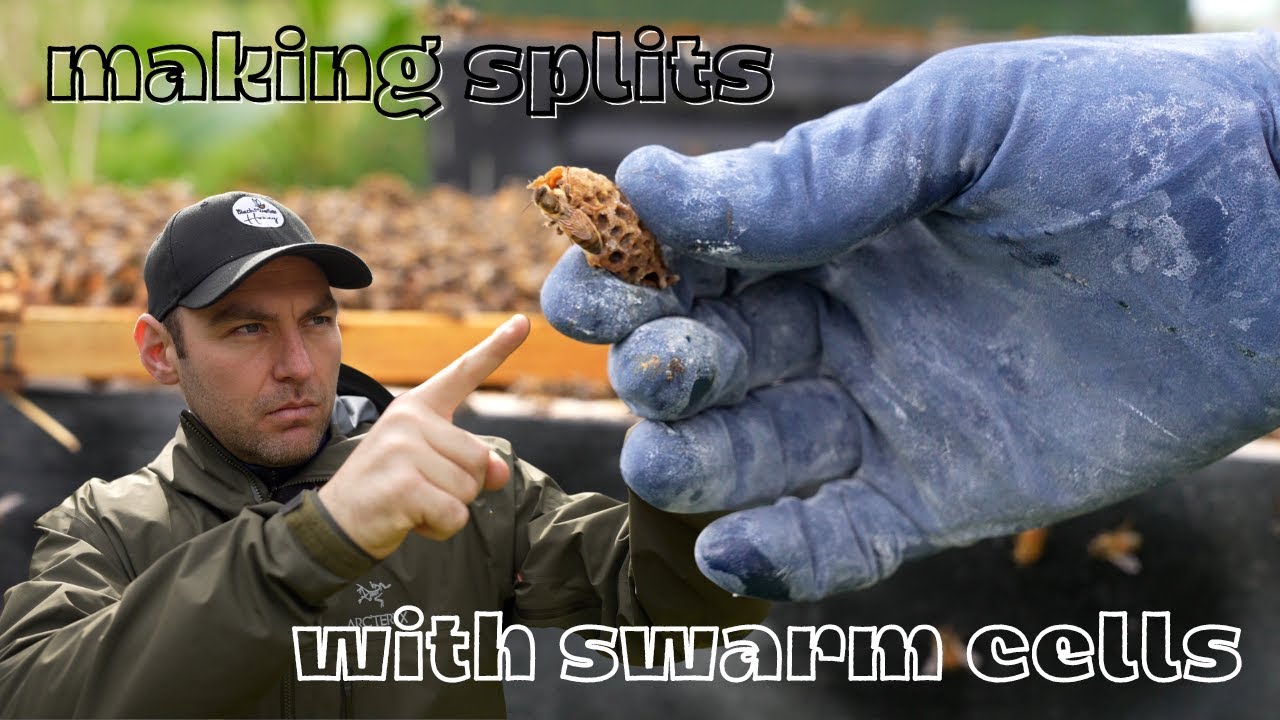
Laurence Edwards shows how to split a congested hive using swarm cells. He keeps the queen in the original hive with one open swarm cell in the queenless half, positions them side by side within a few feet so foragers return to the original, and removes excess swarm cells to prevent damage and disease risk.
Chapters
I'm just going through this colony here. It's jam-packed full of bees on a double brood configuration. In one box I found the queen, in the other box I found swarm cells. What I'm gonna show you today is the easiest way to do an artificial swarm if you're on a double brood configuration. So there's my queen, she's walking around on the frame. Always nice to find open charged swarm cells and also find the queen. Means you can do this split. So in case you didn't see the queen there, here she is on that frame around the center at the moment. She's not marked, but I'm gonna leave this queen in the original spot, and then I'm gonna make the split with the other half of the box. So I'll take my frame with the queen in, and I'm gonna put it back down into the original brood box. So at this point here, this is the original brood box in the original position, and then over here I've got a second brood box, and as you can see, jam-packed full of bees as well. Gonna be the easiest split in the world, this one. In this box over here, this is where we've got the swarm cells. In this box over here, this is where we've got the queen. So what I'm going to do is I'm going to go through both sets of boxes now, and I'm just going to inspect and see how many swarm cells we've got. What we want to do is we want to leave one single open charged swarm cell in the box that hasn't got the queen in it. Simple as that. We're going to put the boxes next to each other. We're going to load one of them up with the majority of the brood. We're going to load the other one up with the majority of the flying bees and the queen. Then we're just going to leave the colony that hasn't got the queen in it to finish off making that swarm cell. The virgin queen can then go out and mate. She'll come back, and then we've made a really simple. So I think you'll agree the queen there has mated really, really nicely. Both sides of the frame there, very good. I'm just going to shake through, see if we can find some more frames of brood. So no frames of brood just yet, but what I have found is a brood frame here that's completely jam-packed full of stores. You can see the bees there doing the waggle dance as well. I love it when they do that. But that means, A, there's a heavy flow on, but B, this colony doesn't have enough stores. Space. That is the reason that these bees are trying to swarm. You'll also notice in there I've got an Apivar strip. Shouldn't have that in there still. Missed one because there was 3 in that because it was a 14 by 12 box. Take that one out now, dispose of it properly. So I've been through this half of the colony now and all I've got is about 3 frames of brood, no queen cells, 1 queen, but lots and lots of congestion, lots of nectar. So I can't just leave this colony as it is. I need to add my supers at the same time. Don't think by doing the split the bees won't continue to try and swarm due to congestion. They definitely will, and these bees here are way, way too congested. So I'm going to get a queen excluder on this half now and add a couple of supers on. What that will do is that will give the bees some space to store the nectar, but it will also mean that they can bring the nectar up from that brood chamber, giving the queen loads more space to lay. So there we go, got my queen excluder. I'm going to place that back on the original hive now. And as it's spring, I've always got a good supply of drawn-out supers in the truck for situations just like this. I'm doubling up those supers there because I need the space. The flow's on. You'll be amazed how quickly the bees will come up there. And also the fact that this colony is so cramped, the bees need space just to come up to relieve that congestion in the brood nest. So there we go, nicely drawn-out supers. The bees are going to get in there, clean all of that up, any pollen mites in there, any dust. They'll clean it up and they will work that very, very quickly indeed. These frames here, they've been stored dry, so no remnants of honey on them. Get a little bit more damage like this way, they're very, very fragile, but the bees still work them really good. Excited to see how quickly the bees are going to fill those up. So the original half of the split is now fixed. I'm going to get the feeder back on there. I use my feeder as a crown board, and then I'm going to get my roof on there as well. So what we have now is the original brood nest, with the queen and some brood, queen excluder, 2 supers, empty feeder as a crown board, and the roof. All of the flying bees will return there 'cause that is the original hive location. So what we're gonna do now is even simpler. We're gonna create a new hive just next door, and we're gonna use those swarm cells to give the colony the ability to requeen itself. So take a new floor. I've got an underfloor entrance here. Put that either right next to it or about a meter away from it. It really doesn't matter here. You can do this at any position in the apiary. I do find it works a little bit better the closer it is to the original hive. Try and get it right, right next to it. Then we're gonna take the incredibly heavy brood box on this double brood configuration, and we're gonna put that on the newly sited underfloor entrance. Now we need to go through this colony here, this half of the split, and make sure that there is only one open charged swarm cell. If you leave more than one, they will almost certainly swarm. And leave you with half the bees that are in there. And what you need to remember at this point is that all of these bees that are here are gonna go out, they're gonna fly, they're gonna come back to the hive over there. They're not gonna go to this one because you're using the 3 feet or 3-mile rule. This is why I like to keep them within that 3 feet, because then when the bees come back, they have to make a decision. And generally they go for the one with the queen in it, but you do get a few that still come back to that. So I do find you get better success keeping these 2 hives as close as you possibly can. Literally 6 inches apart is ideal. So you can see there, that's the original hive, and then I've just brought that next one right up next to it, really nice and close. Now we're going to go through, see if we can find any swarm cells. So you just need to go through every single frame in here. I've already gone through and taken these down. I wasn't going to do this video, so all I've done is I've left a single open charged swarm cell in here. There was about 20 at one point, and I immediately started doing this and I thought, you know what, I'll do a video showing the process. I'll double down on that though. Do not leave any more than one single swarm cell. If you do, you still risk losing them as a swarm. So you can see the congestion in this hive as well. As I said before, you've got your ring of worker brood, and then in the middle, what you would expect to see there is eggs. Definitely at this time of year, you're not expecting in the middle of the day to see nectar there. That indicates to me that the bees do not have enough space. So this half of the split will get a super as well. But because a lot of the bees will go back to the original one, I'm just going to give this half of the split a single super. Though a word of warning here, don't go blindly shaking all of the frames and especially don't go shaking the frame where your larva that you're going to use in your swarm cell is going to be. Really easy way to dislodge that larva. You can see it here. I will try and get the bees off without shaking it, but it's around this corner up here. One single larva charged in a swarm cell. I've chosen this frame here because I like to choose a swarm cell on a frame that doesn't have any other swarm cells on it. Because then that way I don't have to shake that frame and I can shake all of the others off and I can make sure that I get every single one. So this one here definitely only got one cell on it. I'm not going to shake it off, but I'll give you a little zoom in now, close up, see if we can see that swarm cell. There it is. You can see at the top just above it, that is a queen cup and that's got nothing in it. And then below there, that is a swarm cell. If there's only one or two, that might be a supersedure cell. But in this case, I don't think it is because there's absolutely loads of them. My rule is if there's more than 2, I'm treating it as a swarm. Just having a look down here at the bottom as well. I hadn't noticed those before, but they're just cups. There's nothing in them as of yet. Oh, actually, I tell a lie. There we go. We've got something in that one as well. So I do need to fix that one. That's actually a really nice one to get a close-up of right there. I can show you inside a swarm cell before I take it down. So as I said before, bees are sneaky. They put these cells in really, really awkward places. And this just confirms to me that they're definitely trying to swarm and not supersede. You can see in that there, that is a larva, and that is a larva in a swarm cell. Can't resist just having a look over here at the moment. Look at those drones trying to come out there. That is beautiful. Desperate to come out. It's really funny, drones seem to emerge all at the same time, and you do tend to get this. You get loads of drones all emerging at once, whereas workers, you just find like one or two emerging. Very, very strange. So that's gonna be the cell that I'm gonna keep. I'm just gonna make sure that all of these ones down here are squished as well. Especially that one there, that's a really ripe one. Look at the amount of royal jelly in that cell. Perfect demonstration there of how much royal jelly really does go in to create these swarm cells. So there we go, shows that I can't count either. There was actually a frame in there with some more cells on there. So you can see hopefully on this frame here, got a cell up in that corner there, got another cell there. I'm going to go through and take down all of these cells now. So taking them down, really simple but impossible to show you on camera. All I'm doing, just going in, just trying to create not that much damage and just taking the whole cell out like that. You can see it there, single cell in my hand, and I'm just going to pop that into a feeder back on this colony because that is a biosecurity risk. Don't just go chucking that in the grass. So as I said, going through, shaking off every single frame, taking down anything that looks like a swarm cell. Now I've just gone back to the van and I've run out of queen excluders. Really annoying. So what I'm going to do is I'm going to double brood this colony again. Need to make sure you give a colony like that space. They're swarming because there's not enough space in the colony. Worst thing you want to do is just further restrict them like this. Definitely need to get some additional space in the brood nest. Can do that by either supering up and clearing all that nectar upwards, or just by adding more fresh foundation into the brood nest. Now you might not have seen these frames before. Got a few of these that I'm using this season, only about 100, but they are beehive bits from Plastic frames with wax foundation. We'll see how good they are. We'll cover them in a separate video. Right, so here's our second split. This is the new colony. This one over here is the original colony. This new one has got lots of brood, one single open charged swarm cell, and we put an additional box on top to act as additional space within the brood nest. I'll get a cover on that, close it all up, and within a few weeks that queen would have been out, hopefully mated if the weather's good. And we would have come back and we'll have a nice new colony on the left-hand side. The original hive's still there, the queen's in there, they're going to clear all of that nectar upstairs now onto those new supers, and we've effectively turned one colony into 2. So I hope you enjoyed that video, really simple method, artificial swarm, what to do if you find swarm cells in your colonies.










