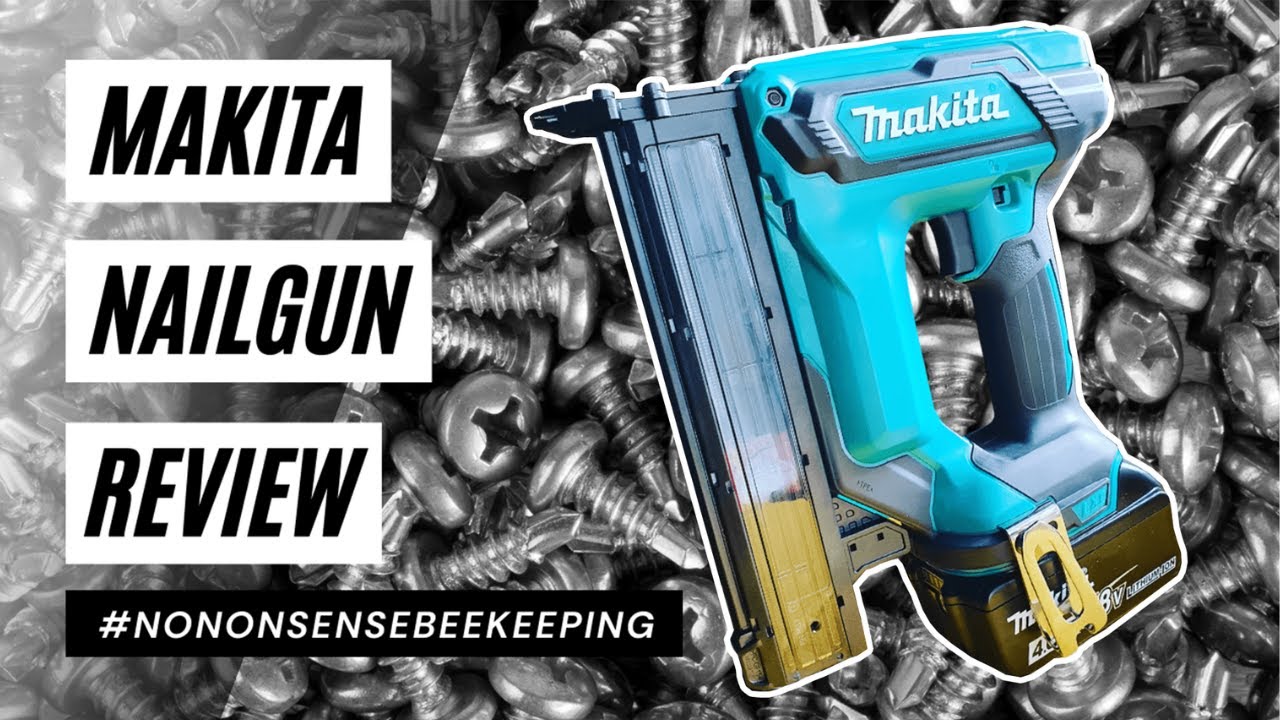
In this episode of No Nonsense Beekeeping, Laurence Edwards of Black Mountain Honey reviews nail guns for constructing beehive frames, explaining why traditional gimp‑pin methods are slow and cumbersome. He first evaluates the Makita DPT353 23‑gauge pin nailer, noting its lightweight design, compatibility with his existing Makita LXT batteries, and suitability for small tasks, but points out its need for multiple shots per joint due to the thin, headless pins. Edwards then introduces the newer Makita DFN350 18‑gauge brad nailer, highlighting its larger, headed brads that allow a single, strong shot per joint, faster assembly, and similar battery compatibility. He discusses the portability advantages of cordless tools versus air‑compressor units, the broader applications of the brad nailer for building boxes, supers, and reinforcing glued joints, and praises Makita’s three‑year warranty and quick repair service. Concluding, he recommends the DFN350 as his go‑to nailer for frame construction, provides Amazon affiliate purchase links, and invites viewers to ask questions.
Chapters
Hi, I'm Laurence Edwards from Black Mountain Honey. Welcome to another episode of No Nonsense Beekeeping. Today I'm going to talk to you about nail guns and pin nailers. So making frames is probably the most boring thing in, in beekeeping. Horribly boring, um, and really, really time-consuming. So much so that I'm looking at ready-assembled frames potentially going forward because it takes up so much of my time over the winter. Um, now when you normally make up frames, you use gimp pins and a hammer. So you have a little pot of nails, a hammer, probably a little pin hammer, something a bit smaller than this. Um, but it's fiddly stuff, especially like for me, I've got quite big hands. And little piddly kind of pin, gimp pins like this, they're just not very good in terms of being able to use them. They're fine, the end product's absolutely fine. I don't think this is that much superior in terms of the actual fixing, although I do think this probably has a little bit of an edge over a gimp pin. But yeah, normally, you know what I mean, you take, you take your frame, um, and you stick however many pins you want to stick in there. Normally the standard is one in that end, One in there, one in that end, one in there, and then on your bottom bars, 1, 2, 3, 4, and then 3 across your wedge as well. Some people like to put them in the top there as well. I don't think there's much need to put them in the top there, but for the sake of an extra couple, it's not going to break the bank. So that's normally what you do with gimp pins. I soon grow out of gimp pins. I just couldn't handle them. They were driving me mad. I kept on breaking them, I kept on dropping them, so I wanted to go on to something different. Now there's so many different options for nailers out there. I see people using air compressor ones, and to be honest, if I had a dedicated place where I did my frames, like in a kind of cabin or like a shed or something like that, and I had a compressor already, I'd go with an air compressed version of this, um, because they're considerably cheaper if you've already got the air compressor, if you've got a good air compressor, um, and they're really, really powerful and they're quick. So the air compressor units do work very, very well. Because I am basically a hobbyist with quite a lot of colonies, I do it in my front room. So I didn't want to have a big air compressor sitting in the front room making loads of noise, taking up loads of space, and I didn't want the additional cost of buying the air compressor. So I originally went down this route, which is a pin nailer. So this is the Makita DPT353. You may have seen this on separate videos. It's got a little kind of slide container there that goes up. You put your pins in there. So I've got a 35mm pin in there at the moment because I was pinning baton onto some Suyenti poly feeders. Really, really good for that. But it's a 23-gauge pin, so it's a bit thin and it's a headless pin as well. So I did— I've done so many frames with this little pin gun and it's really, really good. Um, but what you can't do with this pin gun is you can't kind of go like 1— just realized I've shot a 35mm directly into the table there, so I'll have to get that out. And what you, what you can't do is you can't kind of go 1, 2, 3, 4. It needs— you need to fire a few in because they're so small, um, and they haven't got the head. In order to get the strength, you just need to fire in a few from a few different angles. So it was quick, So really, really quick, this one, and was very happy with this. But the reason that I bought this one, so the DPT353 Makita pin nailer, was because they didn't have an 18-gauge variant that took the LXT battery. So all of my DIY kit is Makita LXT. I've got tons of these batteries, loads of 5 amp-hour. I've got some 6 amp-hour ones now. They're a really good set of batteries and they get long life out of them. Means I can work anywhere. I don't need power. Um, I can kind of go and do it outside, but more importantly is I can take it out into the field with me. So this stays in the back of the truck. If I come across a broken frame, I just go straight in and fix it and we're done. So this is why I wanted something portable that was compatible with my existing batteries. Keeps the cost down as well. However, Makita have recently brought out the DFN350 and They look very similar, like the body. I think, I think it is the same body. The only real difference is the, the nozzle is a little bit bigger, and then where you put in the brads in this case is a bit longer as well. But the big difference on this one is that it takes 18-gauge brads with heads as opposed to pins. So I'll snap onto a little shot and you can see the difference. And what that means is really good is that you can just do a single shot in all the locations. So you can just kind of chuck in one single shot. And it's so quick. Like this, it's got so much power in it. Like, uh, there's loads of 18-gauge nailers on the market, but you want something that's small, you want something that doesn't weigh that much. That's why the air compressor units are really good, because okay, the compressor unit's bulky, but the actual handheld is very, very small and light, and it means that you won't get tired if you're doing a lot of frames. This one, okay, it is a little bit heavy like standing up here, but when I'm sitting down in the evening just hitting out the nails, it's really, really no bother at all. So I've upgraded to this one recently, last couple of weeks. I've decided I've done— I'm done with the pin nailer. I'm going to move on to the 18-gauge DFN350 Makita nailer, and that is going to be my nailer of choice going forward for making up frames. It's not just frames that you can use these for though. This will take up to a 35mm nail. Really, really good for putting together boxes and supers. So you glue them together as normal. If you just want something to hold it in place, this is really, really good for that. The pin nailer is quite good for that as well. I use it loads of places instead of clamps where I want a nice strong finish between 2 sets of glue. So a glued face and some wood or a glued face and some polystyrene. Instead of clamping it all down, I'll just glue it and use the pin nailer. But you can also use the brad nailer as well now. So that's it. Just wanted to give you my new recommendation for a nailer because I have a lot of questions about this. Previously I'd give you the recommendation for the DPT353 23-gauge pin nailer, but now my new recommendation would be for the DFN350 18-gauge Makita nailer. Both work on the same system, but this reduces the amount of shots that are fired. Might save you 2 or 3 seconds per frame, but if you're doing hundreds or thousands of frames, it really does bring the speed down just that little bit more. Well worth the investment. These also come with a 3-year warranty as well, so really good. I found Makita excellent in terms of warranty repairs. I've had 2 warranty repairs on this already. It gets a lot of use, um, but that's what they're designed for. But the warranty is, is exceptional. Um, it's good when manufacturers stand by their warranty and fix items for you. The turnaround's been really, really quick on them as well. So I heartily recommend this. I will put up the links for purchase. These are Amazon associate links, so I do get a very, very small commission if you do go ahead through my link. So please do use the links if you're thinking about purchasing one of these. If you have any questions about the nailer, please give me a shout. Always happy to talk bees, power tools, all that good stuff. I'll cut to a quick video just showing the nailer in action again and And doing a few close-ups of the heads as you can get them below and above the finish line. Obviously with frames, you want them nice and flush, out of the way, and it will lead to a really, really long-life product. So that's it for today's video. Hope you've enjoyed this one. Please hit the subscribe button. Please hit the bell so you're notified of every video, and I'll see you next time. See ya.