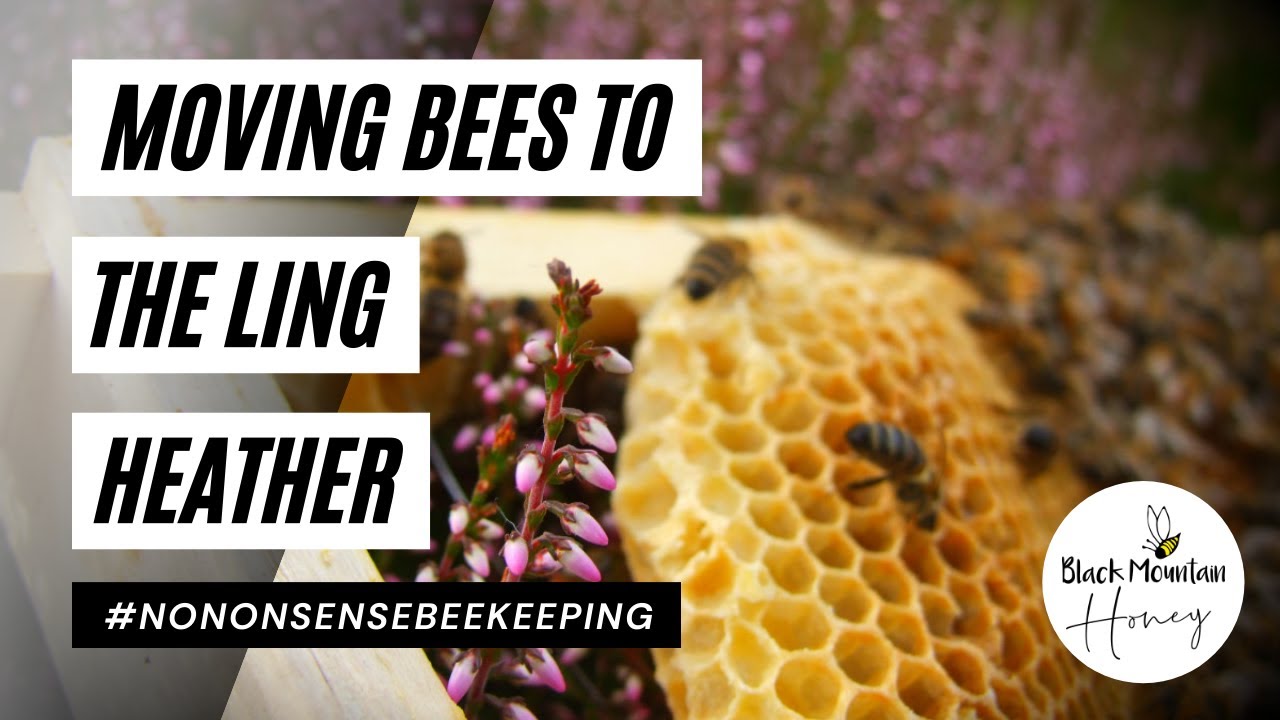
In this episode of No Nonsense Beekeeping, Laurence Edwards of Black Mountain Honey walks viewers through the complete process of moving his strongest honeybee colonies to the Welsh ling‑heather moors for the premium heather honey flow. He begins by stressing the importance of securing landowner permission and choosing a site within 200‑300 m of the moor, away from other apiaries to avoid disease spread. Edwards then explains how he selects only the biggest, healthiest colonies, consolidates them into a single 14 × 12 brood box (or double brood) with one thin‑comb super, and removes excess stores to create a compact, bearding‑minimal package ideal for the heather environment. He details the feeding regime: immediate syrup feeding (3‑4 L on arrival, topped up as needed) to draw out the thin‑comb foundation, applying the “80 % rule” to stop feeding before the honey becomes contaminated. Timing is critical – he aims to move colonies in the last week of July, giving them a week to acclimatise before the early heather flow, then keeping them on the moor for about six weeks (until early September) to capture both early and main flows. Varroa control is adapted for the heather setting: a Sublimox blast with Apibioxal on day 2, with optional MAQS strips, avoiding treatments that would taint honey. Edwards also notes the heightened aggressiveness of bees on the heather, the need for careful handling, and the high market value of true pressed ling‑heather honey despite the logistical challenges. The video concludes with a call to subscribe.
Chapters
Hi, I'm Laurence Edwards from Black Mountain Honey. Welcome to another episode of No Nonsense Beekeeping. Today I'm going to show you how I move my bees to the heather moors. So moving the bees to the moors is a difficult job, but it's one of the highlights of the season. I really, really enjoy coming up to the moors. As you can see, the weather's not the best up here. It's often a bit chilly, quite windy, but what we do get up on the Welsh heather moors is really good quality ling heather. I've done a bit of a kind of look round to see what's going on on the moors, and we've just about timed it right. I think the heather's just about coming out, and it doesn't appear to be too damaged by the heather beetle at the moment, so we will see what we get for the season. This video though, just want to give you a quick kind of recap of where we are to date and what we've done to prepare ourselves for getting ourselves up to the moors this year. So first thing to say is, when you're— if you're thinking about going up to the moors, make sure you go and speak to a landowner and get yourself a nice spot. You can't just turn up to the moors and dump your bees off somewhere. Definitely don't put them near any other beekeepers' bees. Got a bit of a risk of spreading disease, and what with all the EFB around at the moment, it wouldn't be a wise move to kind of just go and plonk your bees next to someone someone else's bees, but you need to get landowner permission. So luckily we've got a really, really nice site here. We're not directly on the moor, but we're very, very close to it. You need to be within kind of like 200 or 300 meters of the moor to make the most of that kind of ling heather flow. The bees don't particularly like foraging the heather, I've found. They'll go for the kind of other easier options, so you need to make sure that you make it Pretty much the only thing that they can really get at. And I know from experience the bees will go for other things up here. So we've got some rosebay willowherb, got some gorse, they'll pick up the pollen from that. There's still a little bit of bramble in flower, still some clover, but when that lingheather hits, they definitely go for it. It's an unmistakable smell when you come up here and you can see the bees foraging on it. So that's the first thing, is you need to make sure you've got a nice, really good spot. as far away from other beekeepers as you possibly can, and you've checked with the landowner so you've got permission. The next thing to say is you only take your biggest, strongest colonies up to the heather. And I've had my fingers burnt on this a couple of times now. It really doesn't work taking weak colonies up to the heather. Don't think that they're going to build up, they're going to become strong when they get there on the flows. Doesn't work like that. You need to make sure you've got your biggest, strongest colonies. So I go around, I cherry-pick them, I go to each apiary and I mark them up and say, well, they're the strongest ones, these are the colonies that I'm going to take to the heather. So once you've identified the colonies that you're going to take, what you need to do is you need to get them into a suitable position and a suitable size to transport them. So the way that we manage that is we take— we have a brood box, 14 by 12 brood box, and then we take all of the supers off any colony that's coming and we replace that with a single super. So you'll see in the background there, we've got loads of colonies like this. You've got a single brood box, either 14 by 12, or if you're running a double brood, you can bring your double broods up. and then we put an additional super in to take all of the bees that were in the supers that were kind of at your old apiary site. And what that results in is bees that are really crammed into a box. And that's what you want when you come to the heather. You want your strongest colonies and you want them condensed down into the smallest box possible. So it results in some bearding, and that's really what you want to see. You want to kind of identify and get that colony into the smallest possible volume you can without having 50% of the bees bearding. So I've posted up a couple of pictures. If you can just— what you want to see is minimal bearding, and then you know you've got it pretty much spot on. And then all I do is just brush off some of those additional bees, put the plugs in, and those bees will just fly off and go into another nearby colony in the existing apiary. So that's the way that I do it. It serves 2 purposes doing that though, because I don't have a heather loosener at the moment. I use thin comb Foundation to work on the heather, which means that I don't have to spin it out and I just press it all out. So I don't want my wired supers to go to the heather. So what I do is I remove all of my wired supers, I replace it with one single super of thin wired foundation, and then that's not only my transport method, but I've also got my first super on that the bees can draw out. So then the next thing to say is You've found your strongest colony. You've got a brood box absolutely full of brood. That's what you're looking for. You want literally side-to-side brood, as much brood as you can possibly get into that area. You can strengthen these colonies if you like and you're comfortable with sharing brood. I've done that on a couple of them just to add in some extra brood. You want wall-to-wall brood on the frames and wall-to-wall brood in that brood box. So 10 big frames of brood. I think I've emphasised that enough. And then what you've done is you've stolen all of their stores and you've put super of foundation in there. So essentially you've robbed all, absolutely every last drop of stores from the bees. So that's fine, but if you were just to bring them up here and there was no float, they'd probably die within a few days. So we always feed. We come to the heather and then on the first day, as soon as we get here, we put the feeders on and we give them kind of 3 or 4 litres of syrup. And then the bees are straight up in there. They use that syrup to draw out the foundation in the super, And then what we do over the next week, we just monitor it. So if we come up and there's no stores there, we'll give them a little bit more syrup. If we come up and they've drawn out that first full box and it's nice weather, we leave them to it. That's the position we want to be in. And we use the 80% rule again. So as soon as that top super is 80% drawn out, we leave them to it and we don't give them any more feed because obviously then you're going to contaminate your heather. Honey, and that's the reason that you're up here. So all I'm going to do in this video—I mean, I spoke to you kind of about the process and how we've got up here. I'm just going to show you a couple of the colonies, show you how strong they are, show you how they're taking down the syrup, and show you how they're drawing out that foundation. We're still in July. Timing is everything with the heather. I found that the kind of the traditional time of going up the middle of August is just too late. You miss the early flow. You might hit the main flow, but that early flow is what the bees need to kind of like a. Acclimatise themselves to the environment, to develop that brood, to understand that they're at the beginning of a flow and that they need to either maintain brood size— Oh! Well, that hurt. Bloody hell. Definitely one of the more painful areas to get stung is right on that bit of the nose there. Right, just recovering from that awful sting to the bottom of the nose. That really hurt. So yeah, what was I saying? You want to make sure that the bees kind of get there early in order to maintain that really big brood area, because then when the main flow hits, you've got enough bees in the boxes to give you a really, really good flow. So timing is everything. I always like to say last week of July, that's my rule of thumb for North Wales. Get them up there 23rd, 24th of July. Give them that last week to kind of take on some feed, draw out the foundation, and then you know you're not going to miss that early flow and they're going to be ready for the main flow of the heather. I give them about 6 weeks up here, so I want to be bringing them up last week of July, taking them back first week of September-ish. Obviously completely weather dependent. If I come up in the first week of September and they're firing on all cylinders and they're still bringing heather back, I'll leave them to it. If everything's finished and they've capped everything and there's no flow, I'll take it and then I'll move on to the treatments. So I just want to touch on varroa treatments a little bit as well. Really, really important thing to mention is varroa treatments, because all of my other apiaries at this time of the year, I'm taking my honey off, I'm putting varroa treatments on, I'm getting my bees into the winter-ready phase. And then with the heather, the bees that have come up to the heather, I can't actually do that. because obviously I don't want to taint any of the honey. So it's always a little bit delayed. So what I've started doing now is bringing the colonies up here, and then on day 2 when they're up here, I give them a blast with my Sublimox using some appibioxal, and then that kind of just gives them an instant mite drop, and then that protects them and keeps the mite numbers down so they're not kind of developing and growing too much throughout August. And I found that's a really, really good technique to use. You can also use Max, MiteAway Quick Strips, and we've done the previous video on that. That works well, and you can also do that with the supers on as well. So let's get into the bees, and I'll show you how big and how strong these colonies should be. So this is what you're looking for. The bees need to have at least filled that first super. This isn't the strongest one that's up here, but this is about the absolute minimum that you want. If the bees haven't filled the super by the time you've got here, there's really not much hope of them picking up a decent crop. So you just need to make sure that there's a full super of bees on every single hive that you're bringing up here. And then what you want to see is you want to see the bees starting to draw out the foundation. Like I say, you don't want to feed them too much, but you need to make sure that you give them enough food Food in order to keep them alive, but also to get them to draw out that foundation so they're not wasting your honey, your heather honey, drawing out wax foundation. Get the feed to do that for you. I mean, all these frames now, they're starting to pull it all out. This has only been in here a day and a half. And they're doing that job for me, so they're doing it really, really nicely. Still got some foundation frames over here, so these can definitely have another drink. I'll give them another three litres, and then I'll get this frame, this foundation from this super fully drawn out. So that's it for today's video. I'll do regular updates as I'm up here. We still do our weekly inspections, but it's more just to check that they've got enough food and to see how the crop's coming on, as opposed to kind of doing any swarm inspections. I've never had a colony once swarm at the heather, so I really don't bother about going into the brood box. As long as there's some food in the supers, I'm happy and I know they've got enough food to survive. I'm more conscious of the timing of the varroa treatments and checking to see if there's any colonies displaying kind of impacts of varroa. And in that case, I'll go in there and I'll do a bit of a check. Final couple of things to say are, one, that the bees can be really touchy. When they're on the heather, they don't particularly like it up here, and especially if you've just stolen all of their food and then brought them to somewhere where the heather's not out yet, they can be really quite horrible. I've taken like a lot of stings to the face today. I've moved about 100 yards away from the bees and they've all come and followed me, and the bees really don't often do that very much. So it's a bit difficult doing the video, so I'm a little bit rushed today. But you'll see we've got nice weather forecast for the next week. We'll come back up here and once that flow goes, the bees are very, very happy up here and they bring back what is, in my opinion, the best honey you can possibly get from a honeybee. True pressed ling heather is like nothing else. It's a pain getting them up here. It's a pain extracting the honey. But once you get it in the jars, it sells really, really well and it is a true Welsh delicacy. So that's it for the video. Hope you've enjoyed it. As always, please hit the subscribe button, please hit the bell so you're notified of every video, and I'll see you next time.