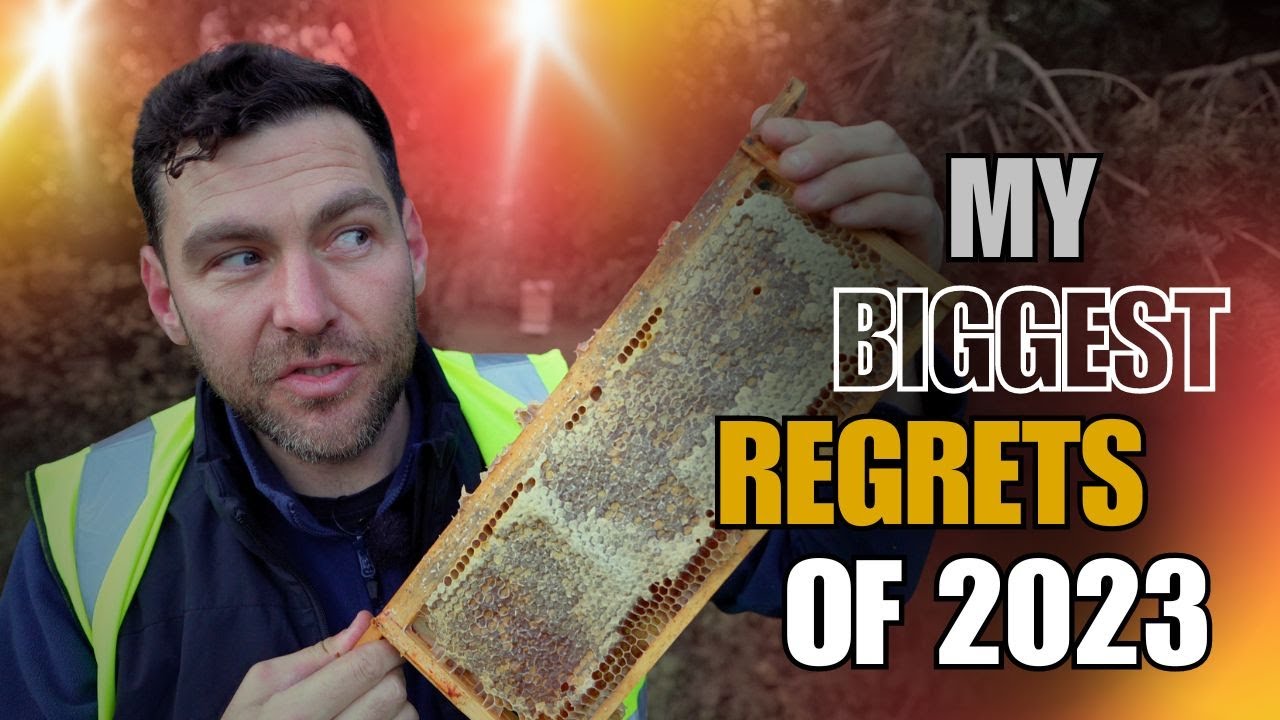
In this solo vlog, Laurence Edwards reflects on the challenges and missteps of his 2023 beekeeping season in North Wales, a year dominated by unusually prolonged rain. He explains how continuing routine weekly inspections during eight weeks of nonstop rain proved inefficient, and proposes skipping inspections during similar future wet spells to focus on productive tasks like frame building or apiary re‑arrangement. He stresses the importance of concentrating effort during brief periods of good weather—doubling queen‑mating and nuc production when conditions allow. Edwards also describes cutting the season short in his heather apiary, applying early varroa treatments, and letting colonies build up naturally, a strategy he wishes he had applied across all sites. He highlights the logistical nightmare of apiaries with poor track access that become impossible to reach during floods, recommending relocation to more accessible sites. Finally, he critiques his own habit of mixing many hive formats (Nationals, Langstroths, 14×12s, Dadants, various poly hives), noting that standardising hive types would simplify management, and offers surplus 14×12 National hives for sale. The video serves as a candid review of what didn’t work in 2023 and outlines concrete actions to improve beekeeping in 2024.
Chapters
In this video, I'm going to tell you about all of the things that I wish I'd done differently in 2023. So I'm halfway through producing a video on my 2024 beekeeping resolutions, and it has made me reflect on 2023. All of the things that I didn't do very well and all of the things that I kind of regret that I did. So the first one, and I know it's a little bit out of my control, but the weather in 2023 was just so incredibly bad. I wish that I'd spent my time more effectively during that rainy period. So for us in North Wales, from maybe the first or second week in June, it just rained nonstop all the way through until September. And what I did is I just continued doing my normal standard weekly inspections. And that was really frustrating because looking back at it in hindsight, it's easy to say, well, just stop doing your inspections and use your time more efficiently. But it didn't look like it was going to be such a long forecast of really, really bad weather. But nevertheless, it meant that I spent my time very inefficiently just Going around and inspecting colonies to stop them from swarming, when really I could have used that time much more effectively. So I think if that time came around again, what I would probably do is just not go and inspect the bees and almost just take that hit to say, okay, we might lose a couple of swarms. But going through that period of like 8 weeks of really poor weather, like, I kept up all of those weekly inspections, and I think I came across maybe one colony that was actually looking to go and swarm and would have swarmed if I hadn't have intervened. And then I'm balancing that up versus the time that it took to ensure that I was on top of all of those swarm cells. Definitely wasn't justified. Like, I would have much preferred just to not do any inspections and to lose one single swarm. So I think if I get an extended period like that again, I'm going to use my time more effectively. I'll go maybe back into a workshop and do some frame building. Or do some scorching of some boxes or rearrange some apiaries and move things around. I definitely won't waste my time just doing continual inspections when you get such a prolonged wet period. So the next point kind of follows on from that little bit as well, which is trying to take advantage of the good period of weather. And in the UK over the past few seasons, it does seem to be like April, May is really nice and settled, and then when it gets up to like a certain temperature, it just seems to rain loads. So condensing down my beekeeping activities to when it's actually a good period of weather. And again, it's difficult to forecast that, but I think all I'm saying is when the period of weather is there, double down on what you're doing. If you're looking at mating some queens, mate 50 instead of mating 25. And if you're going to make up like 10 nucs, make up 20 as opposed to making up, say, 10 nucs. Double down your efforts in the period when you've got nice weather. And try and take advantage of the weather when it is there. So this one here, I kind of did it in one apiary, and I wish I'd done it in the other apiaries as well. And that is when you get towards the end of the season and it's showing like really bad weather like that. I know everything's like weather related in this video, but I cut short the season in my heather apiary, and I think that worked really, really well. And the bees— looking at the bees now, it looks like it's paying dividends by cutting the season short. Not doing the inspections up there, getting the varroa treatments in early, and then just leaving the bees to naturally build up themselves and kind of fend for themselves a little bit, knowing that they're not going to swarm because it's so late on in the season. If I had 2023 again, I would have done that across all of my sites because that weather just completely wiped out any chance of any honey crop whatsoever. And I wish I'd just taken that opportunity to say, right, I'll cut my losses. My mite treatments on and focus on the following year and getting as many bees through as I possibly can. One of the things that became very, very apparent last year was the location of my apiaries in terms of the proximity to a viable track. Now I thought I'd done away with all of the really difficult apiaries in terms of access and egress, but I've still got a couple where when it floods and when it gets like really, really wet, it is just impossible to get down to them. And I have to be quite ruthless, I think, when it comes to looking at these apiaries now and saying if it is going to rain and be really, really wet, then I just can't continue to be managing the bees in these apiaries here. Because when you need access most is when the access is at its worst. So for me, that means like emergency feeding in the season, and you're thinking these bees are really— they're going to starve unless I get down there and feed them. So you're carrying jerry cans of syrup or you're carrying big blocks Abundant and you're having to walk like 150-200 meters through a complete swamp in order to get to your bees. It really is absolutely no fun. So that's made me reflect on where these apiaries are, and I think I'm going to move these apiaries to somewhere that's far more suitable, far closer to a viable track that's accessible during all weather. And then my final reflection, and this is completely my own doing, like I've had an absolute shocker here, and I know All of my advice is always just stick to a single format of beehive. Don't mix Nationals and Langstroth and 14x12s and Dadants and all of these other fancy hive types. And I like— I know that advice and I should have followed my own advice, but I kind of got caught up in reviewing like loads of different types of hive and it's left me in a position where I've got lots of different configurations. So I've got National Deeps, I've got 14x12s, I've got Langstroth, I've got some commercial boxes, I've got my long hives, I've got some concrete hives. I've got every single different type of poly hive that you can imagine. I've got various different poly nucs as well, and in a couple of apiaries where I have completely standardized everything, so the beehives are standardized and the nucs are standardized, it makes beekeeping so, so much easier. And it's made me think, well, I need to just get down and get back to basics. I've done all of the video reviews that I need to do on all of the luxurious beehives that are available. And I need to maybe listen to my own advice a little bit and just get rid of all of the beehives that don't fit into my style of beekeeping. If you're interested in some 14x12 National beehives, I have a lot of these for sale. They come with the frames, but you will need to put your wax in them as well. If you want a good deal on some 14x12 beehives for collection from North Wales, give me a shout. So I think it's really important to continue doing these videos. Like every single year there's something different that I look back on and say, I shouldn't have done that. And things change as well. So what works one year doesn't work in another year. 2023 was by far and away the wettest year I have ever encountered, and it's made me review how I keep my bees in such awful weather conditions. Here's hoping that 2024 isn't anywhere near as bad and I don't have so many regrets going into 2025.