My First Nucleus - Ep 9 - How to Stop my Bees Swarming - Vertical Demaree Split
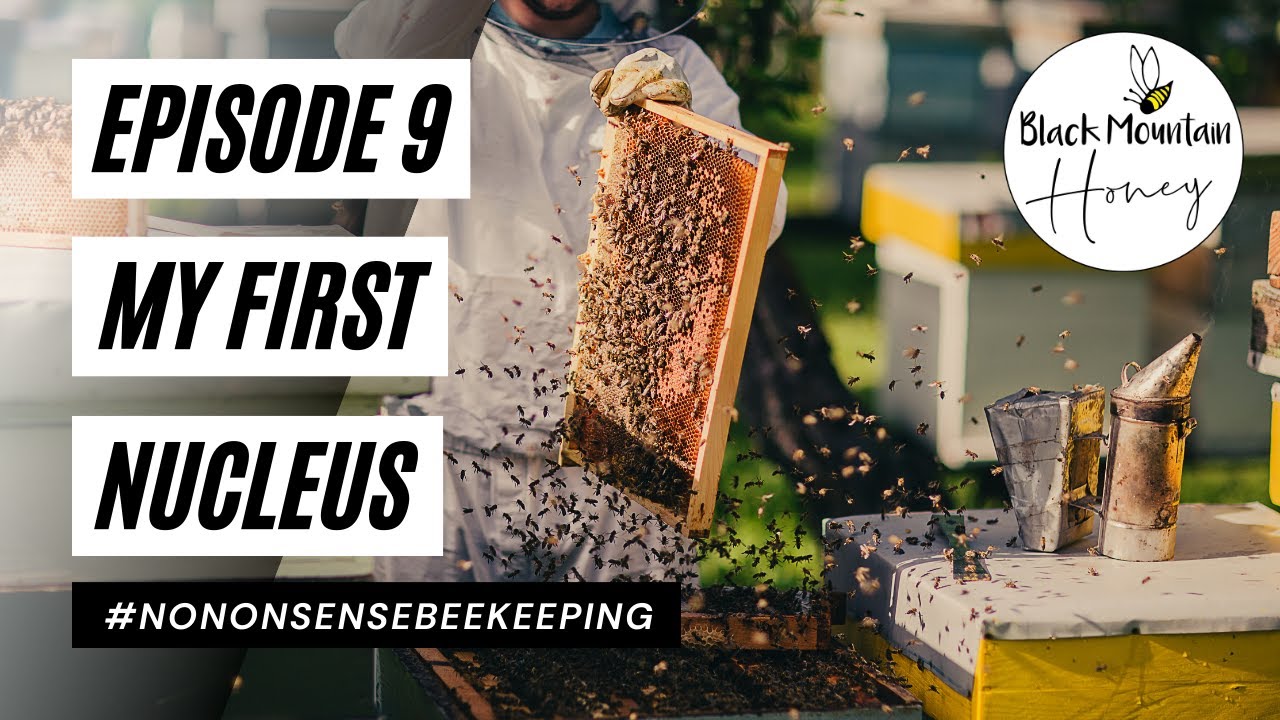
Laurence Edwards demonstrates a vertical Demaree split to prevent swarming in late May or early June. The technique moves the queen and one frame of capped brood into a new box below the original, forcing the upper colony to raise emergency queen cells that must be destroyed within a week. This gives the queen more laying space and boosts brood production before the summer nectar flow.
Chapters
Very different now. Now that we're into the flow season, which has come very late this year, we're definitely interested in that box. You want to do it earlier rather than later because all they're going to do is they're going to start pushing that nectar downwards, backfilling the brood box. The queen thinks, I've not got any space here. So the first part really of swarm management and swarm control is ensuring that the colonies have enough space in the brood area But also enough space to store honey. Hi, I'm Laurence Edwards from Black Mountain Honey. Welcome to another episode of No Nonsense Beekeeping, episode 9 of the My First Nucleus series. I'm going to get inside the bees and see where they're up to. Flows in North Wales have come to a dead stop this week out of nowhere. Hawthorn finished and that was it, the flows are over. So you might find this happening across the country. Probably happen a little bit earlier down south, actually. We do tend to find though the first week of June very, very reliable up here. First week of June you get a good flow, and then you get to kind of like 7th, 8th, 9th of June and it does tend to drop dead. It seems to be very, very reliable every year that happens. So the flow has very much stopped. I think there's not going to be too much of a June gap this year. You can already see the brambles starting to come out, so hopefully 3 or 4 days and we'll be into the Slower but much more prolific summer flows. And obviously that's dependent on where you are in the country, but for us, the summer flows is where the majority of the honey comes in, and it's a really nice long prolonged 6-week period if you get the good weather. Very steady, heavy flows. So what I like to do at this time of the year, and I do this on a lot of my colonies, and I either do it last week of May or first week of June, and what I do is called a preemptive demerit. And I'm going to do that in the video today, and I'm going to show you it week by week. And I'm doing a separate video on this at the moment and going into lots and lots of detail on that video. It's about a 30 or 40 minute video, it's turning out to be. So I'm not going to duplicate all of that detail in this video. I'm just going to try and do it and give you a real brief version of what I'm doing. Effectively though, what I'm going to do is I'm going to take the original brood box. I'm going to lift that up high. I'm going to replace the brood box with loads of empty foundation or drawn comb, whichever you've got. A mixture I find works really well. I'm going to take a single frame of capped brood with the queen, put that downstairs in the new brood area, and I'm going to separate the 2 boxes with supers. And this is no-nonsense beekeeping. I know that sounds really, really complicated. It's definitely not. It's a very easy, simple manipulation to do a few things to your colony. First one is ensure the queen has adequate space in the brood nest. So what you're doing is clearing out the entire brood nest and saying, right, there you go, have a new brood nest, new foundation, new drawn comb, no stores, no capped brood, no eggs, nothing apart from one single frame of capped brood. Tick that box, you give the queen plenty of room to lay, and the idea behind it is that you're giving that colony a real boost of numbers as well. The colony feels that the queen is underperforming, so they signal to her that they need to expand this new brood nest. So you get this double effect of giving the queen additional space but also turbocharging her laying at the time when you really want it to be turbocharged, because then when we hit the back end or the middle of the summer flows, you're going to have peak numbers in the hive. Now there's a couple of risks to doing it this way. We'll talk about this in the video. The main risk is, is when you lift up that brood box and take it away from the queen, there's such a big separation between them that they will draw out emergency cells in that top box, but it's very much a controlled artificial vertical swarm, which means as long as you take precaution, knock down all of those queen cells as they come up, the colony almost feels a bit like it's swarmed, and it should stop them swarming later on in the season. Obviously nothing is as clear-cut as that with bees, but in my experience it gives you big strong colonies, knocks them back a few weeks from swarming So I'll get my smoker on, I'll get my suit on, and I'll show you how to do a preemptive demarray on your Collins. Right, so let's get on with it then. I'm going to show you how to do a preemptive demarray, and at this point I'll just pop a link up. Now this link's not going to work for a little while because it's about 3 or 4 weeks away from being ready. If you're watching this video later on in the year though, there'll be a link up there now to show you this method in detail. This is going to be a real quickfire version of the method just to show you the first part of the manipulation. So the first part of the manipulation is really, really easy. Take off all of the supers that you've got on the colony, put them over to one side. Doesn't matter where, just get them away from where the colony is. You need to make a little bit of space to make this easier for you. Now that's 2 really heavy brood boxes there. Lots of honey in there. That's really good. In order to do this preemptive demerite, it works better, I find, if you've got boxes of supers on already. And it works better if the boxes are full of bees as well. It's a little bit more difficult to do it if your boxes are empty because you end up with loads of bees at the top, loads of bees at the bottom, and nothing in the middle. And I just like to do it with a few more bees than that. So put your supers over there, then we need to go and hunt for the queen. You need to find the queen for a Demaray. Right, this is a slightly unorthodox version of a Demaray because this queen is a nightmare to find, and I've not found her for like 2 weeks in a row now, and it's because she likes to hide out on the floor. So you can get this with some queens that they're just really, really difficult to find, and you can find them on the floor occasionally. So you can probably just about see that queen there somewhere. Right, there she is, queen on the floor. I'm not going to let her get out of my sight this time, so I'm going to pick this queen up and I'm going to put her on Single frame of brood. All right, so there we go. I've got my queen, and I've got her on a single frame of brood. That's the difficult part of this manipulation done. So I'm going to be quick now before she goes and legs it down there. So I'm just going to lift up this frame before she goes wild. This queen is like the quickest queen in the world. She's a lovely queen, really big, long, stripy queen, but she does not like being on the frames too much. So What I've got now is a floor with nothing on it, a single frame with a queen that doesn't want to be found. She's definitely on it though. And then I've got a brand new brood box. Do any size box here if you want, but obviously if you keep all the boxes the same size, does make it easier. And this can have drawn comb or foundation in. Works a little bit better actually with foundation in, but I've only got drawn comb. So then you put that On the original hive stand, take your frame, single frame of brood, preferably capped brood. Double-check it for queen cells. You cannot have any queen cells on this frame. Remember, this is a preemptive demerit, so you're not waiting to see swarm cells. You're doing this as a mitigation exercise to try and stop them creating swarm cells. So I've already done my check, there's no swarm cells anywhere. I've got one frame of capped brood. For From the original brood box with the queen on, no swarm cells. Just want to do my final check. She's definitely there, and I'm going to take that and I'm going to put that in the middle of the new brood box. Then next thing, get a queen excluder and put that back on like that. And then the next thing you want to do is put all of your supers back on to the original queen excluder. So you effectively swapped out the brood box, put the queen back down there, one frame of brood, She has got loads of space now. They're going to say to her, you're not working hard enough, queen, you need to lay eggs, that's your job. It's going to turbocharge her. It's also going to hopefully stop her swarming because she's going to feel like she's got lots and lots of space down there. So we can take our supers now, pop the supers back on there. And then at this point you take a second queen excluder. This is why I love the Demaray, yeah, because all you need to do to do a vertical split is just add Another box in and add a queen excluder. You don't need another floor, you don't need another roof, you don't need another crown board. This is a queen excluder. So you need to take off your roof now. Loads of bees up there, that's really good. Put your queen excluder on, then you take your original brood box with all of the frames in and you place that on the top. Replace the one frame that you've lost and that's the manipulation complete. I told you it's a simple, simple manipulation. And I know the bees are still buzzing around me and they're being a little bit grumpy still, but there's a real change in temperament I think already in this colony. They've not even got to the point yet where there's any emerging brood from that new queen, but she just seems to have really settled them down quite a bit. Like if you, if you go back a few videos, these were buzzing all over my face, they were really angry, and I think a lot of that comes down to climatic conditions as well. It's about 23 degrees here today now. I think the flows have stopped, but they're probably still out getting a little bit from somewhere. Definitely not a huge amount of nectar in here, but the bees are busy. They really don't mind me working them too much. But that's it. How simple is that for a manipulation? I'm just going to summarize what we've done again. So that bottom box you can see at the bottom, that is a brand new national deep that has got one queen, the only queen in the colony, one frame of capped brood, no queen cells, and then I've filled the rest of the box with either foundation or drawn comb. Then I've got my queen excluder, then I've got my 2 supers, and then I've got the original brood box that was at the bottom before full of all my brood. So effectively tip the hive upside down like that. Now you need to be really, really careful with Demerays because if you left this colony now, almost certainly within 2 weeks they will swarm. So don't think you can do this manipulation and then just walk away and come back 6 weeks later and you're going to have loads of honey. Definitely, definitely doesn't work like that. We're going to come back here in 7 days and what you will see is the bottom brood nest will hopefully start to expand a little bit. They'll be drawing out those frames, the queen will be laying eggs, might have a little bit of stores down there as well, but what you want to see down there is brood, the queen, and no cells. And then upstairs in this top brood box here, you're going to see loads of emergency cells, and all you need to do is you need to go through every single one of those emergency cells, shake all the bees off, crush all of the cells, and then that's pretty much the manipulation complete. And the reason they create those emergency cells is because you put so much distance between the queen's pheromone, which is trapped downstairs now underneath a queen excluder, and all of the brood. So the nurse bees think they're queenless, they start to create emergency cells. The aim of the demerare though, and I've said this before in this video, it is kind of like twofold. First one is you're giving that queen additional space to lay, so you're trying to stop her swarming by giving her additional space to lay. The other one though is you're going to turbocharge her. So you've got all of this brood emerging on the top box while she's laying lots of brood on the second box. So you almost get these 2 massive flurries of loads of emerging brood, and the whole plan is to time that with when you've got your strongest flow. So you can do a little bit of maths, try and work out when that strongest flow is. Obviously it's the UK, so it could just rain for those 2 or 3 weeks and it is a complete nightmare and a washout anyway. But you have to hope for the best. But you really can get some mega colonies when you do a demeray like this. You can get some really good crops of honey as well. So I hope that video is useful, something a little bit different, something I would recommend everybody to try if you've got issues kind of keeping your colonies from swarming and also not wanting to split your colonies into 2. Because when your colonies show swarm cells, it's the only real method to do is to split them into 2, or you can do a demeray like this. So this method here You can do if you see the swarm cells as well. And maybe later on in the year, maybe this colony will try and swarm. And if they do try and swarm, I'll show you a demeray once you actually get to the point where you get swarm cells in the colony as well. This one here, this is a preemptive demeray, so I'm doing it before there's any swarm preparations. So like I said, I hope you found that useful. I hope you'll give this one a go. This is definitely something you can try at home with your bees. Stick a note in the comments, let me know how you get on. But I do hope you get massive bumper crops of honey from your bees. You keep them all in one unit, stop them from swarming. So as always, please hit the subscribe button, please hit the bell so you're notified of every video, and I'll see you next time.










