My First Nucleus - Episode 12
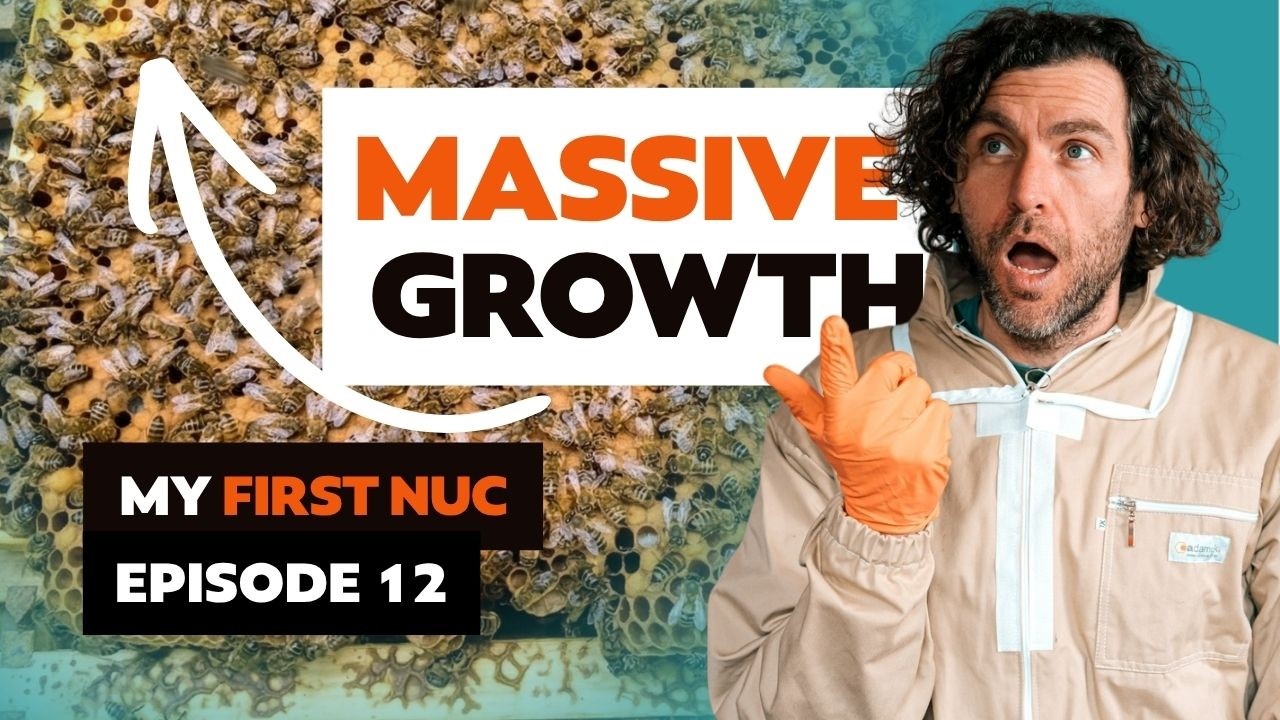
Laurence Edwards inspects his first nucleus colony in North Wales and finds the brood nest has expanded from four frames to eight or nine frames following a recent demarée. The queen is laying actively and chalkbrood, a disease that plagued the colony before, has disappeared entirely. He expects a full brood nest next week and a good honey crop.
Chapters
Hi, I'm Laurence Edwards from Black Mountain Honey. Welcome to another episode of No Nonsense Beekeeping. It's episode 12 of the My First Nuclear series. No more talking at the beginning, bee suit on, smoker on, we'll get inside, see how the colony's getting on. Right, we'll get straight into the bees then. The flow has definitely started for the summer in North Wales, just in time for there to be about a week of rain coming in. And excuse me again, I've got the cows here today and they are making one hell of a racket, so please bear with the cows. We'll jump straight in though. I've checked the boxes up top, no need for any expansion, but they are filling up nicely. So I'll show you a little snapshot inside some of those frames. Hopefully today we're going to see brood in all stages, we'll see that queen. I'm going to show you that brood nest expanding, show you some of the nectar that's coming in, just give you a general update on how this colony is Expanding and progressing. So as I predicted last week, we've got some real expansion down here in the brood box this week, covering pretty much every single frame bar one. So over 8 or 9 frames now, and that is because the last remainder of the brood from upstairs has all hatched out. And there's the queen come up to say hello. So you don't often get a queen come up and say hello like that. Really nice to see. So there we go, mission one, we've seen the queen. She's coming at a look on those top frames. But as I was saying, colony is looking really, really good now. It's that fourth week of expansion since we did the demeray, and look at the size of them. They are pretty much filling up that brood nest again. So really happy with this colony, doing exactly what I need them to do. Going to get inside some of them now, take a look at those frames, see what they're doing, and just do my general weekly inspection. So I'm so happy with that. The colony is looking fantastic. As I said, you get that expansion after about 3 or 4 weeks. In between week 3 and 4, you get all of the brood that was stacked up high, that's all emerged. All of the nurse bees up there think, this isn't where we need to be, they go back down to the brood nest, and then you get this exponential growth downstairs. So if you flash back to last week's one, they were covering maybe 4 frames. Now we've got a completely full brood box once again, and obviously no queen cells, nothing to worry about upstairs. Just got lots of bees, lots of honey, and we're getting to the point now where you're thinking maybe you need to do a demarée again. And I don't do demarées anywhere near this late in the season. I find that as soon as you get past the summer solstice, the desire to swarm reduces. Definitely doesn't go away, but you can lose swarms all the way up until the end of September. But ultimately for me, it's down to managing the colonies now. Just get fully distracted by all the cows that are running past there mooing. Down to me to manage the colonies now, and I will do a manipulation if and only if I find a swarm cell. So I'm going to go through the frames here now, show you some of the brood. I just want to bring to your attention again, I've got a few bees buzzing around my face here, and it's overcast and cloudy and a little bit drizzly. North Wales climate. But think back to what this colony was like at the beginning of the year before we did that requeening to try and eliminate the chalk brood. We'll have a look at later in the video as well. They really have calmed down a significant amount. Not got to the point yet where I'm going to judge them because these could easily and probably still are the old genetics, but it's good to see we're definitely seeing an improvement. So again, I'll just go back to that temperament piece. Look back at some of the early videos, maybe week three or week four when that colony had built up, and look what happened when I picked up frames. They were nowhere near as calm as they are now. Much more of a pleasure, and hopefully towards the end of the season they'll get even better as well. I'd expect there to be no buzzing around my face whatsoever. So there you go, one of the brood frames taken straight out of the middle, side to side brood, bees doing exactly what they're supposed to do. Expanding that brood nest down there. Really nice brood pattern, absolutely fantastic to see, and not a speck of chalkbrood on it as well. So I'm going to pull out a couple more frames as well and see and assess what the chalkbrood situation is like, but it looks like it's cleared up pretty much 100%. So there's another frame of brood there now, no chalkbrood on there whatsoever, no swarm cells, Brooding all stages, really happy with the progress of this colony. So there's my queen; she's running around on that frame doing her thing, laying it all up, getting those eggs down. It's pretty much side to side that frame. Really good strength this colony now building up very nicely, and they are going to produce a good crop of honey this year. So there we go. I've done a little bit of checkerboard in there. You can see that frame in the middle. I've just pulled that one in, split the brood box. You can definitely do that on a flow, on a strong colony like this, just to get them to even that out a bit. I predict next week we're going to come back and this brood box is going to be 100% full of bees. So there you go, that's it for the video. I'm really trying to condense these videos down, giving you the snapshot each week. I just want to make sure I keep up that consistent schedule, week-by-week updates of this colony, so you can see it throughout course of the season. Still got a few bees buzzing around my face, but I do hope that as the nastier bees die out and they're taken over by the new queen's genetics, we'll stop seeing this. So do stay tuned for the rest of the season, rest of the series. I'm hoping you'll get rid of these buzzy bees and you'll get to see how much honey this colony produces here. But the expansion from last week is tremendous. It really is a huge amount. They've gone from 4 frames of bees and brood in that brood nest, up to 8 frames of bees and brood in that brood nest. Next week it will be full without a shadow of a doubt. We'll open up that brood nest and you'll have a full brood nest there. Got brood in all stages, eggs, no chalk brood, which I'm really happy to see. I'll do a full close-up on all of the frames next week and I'll show you how well that new queen has eradicated that chalk brood. And no swarm cells either. So the colony is in a really good position. We're back to normal beekeeping, which is brood nest downstairs, queen excluder, boxes above with loads of honey in, weekly inspections, checking for swarm cells, checking for disease, trying to keep all of the bees in the box to get a bumper honey crop. So I hope you enjoyed that video. I hope you're enjoying this series. As always, please hit the subscribe button, please hit the bell so you're notified of every video, and I'll see you next time.










