My First Nucleus - Episode 2 - Finding The Queen - Nuc Inspection & Setup
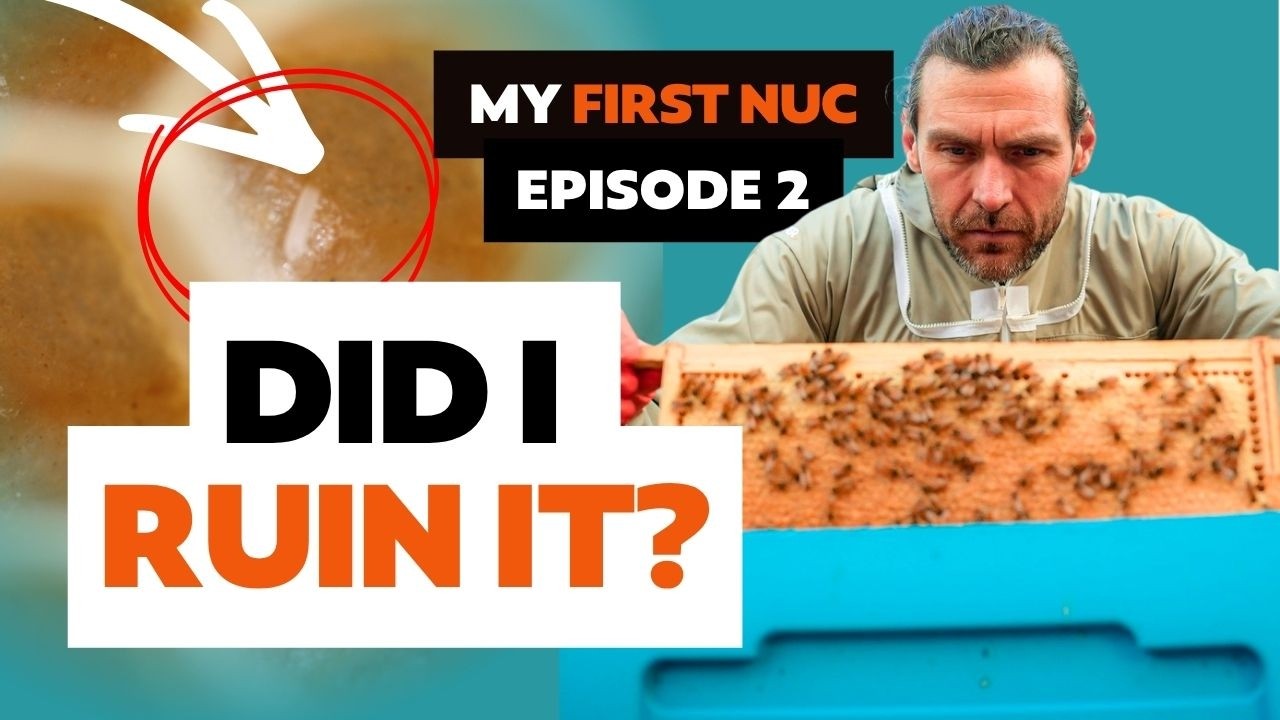
Laurence Edwards inspects a week-old nuc transferred to a full hive, locating the queen and confirming healthy brood. He demonstrates how to relieve honey-bound pressure by swapping a frame of stores for foundation, and explains feeding guidelines: 1-2 liters per week during the warmest part of the day.
Chapters
So this is the very first video in this series. First thing you want to do is go and put it in its final position. So then all you're going to do is you're going to transfer the bees over from this nuc and you're going to put them into your hive. So I'm just taking my time trying to find that queen, and then you want to give them a sharp tap, just one tap, and they'll all fall out. So once you've got all your frames in the hive like that, I would recommend feeding one to one sugar syrup. So next week we're going to look for that queen. I'll prove to you that the queen's in there. Maybe find her, maybe mark her. We're going to look at the impact of that feed and how they've started to draw out that foundation, and we're going to look at how that colony grows. Hi, I'm Lawrence Edis from Black Mountain Honey. Welcome to another episode of No Nonsense Beekeeping. Today is going to be the second video in the My First Colony Beekeeping Series. As promised, we're going to get inside the colony, we're going to look for that queen, we're going to check the feeder. I'm just going to give you a really quick status update on how that colony's getting on. If you haven't seen these videos before, we're doing a weekly inspection video to show you all of the things that happen to a single colony all the way throughout the year. We got the nuc, we put it into the hive, we made sure all the frames are in the same position, And we put the feeders on. We couldn't find the queen last week. We didn't look that hard for her. This week we're either going to see swarm cells if the queen wasn't there or she was damaged on the movement over, or more likely we're going to see eggs and we're going to find the queen. I'll look a little bit harder for this week. I always say second inspection, get in there, try and find the queen. But if you go in there and you can't find her again, if you see eggs and you don't see any cells, any emergency cells, Then the queen is definitely there and there's no problem at all. You will notice from this colony, and I'll do a closeup now, they are so much more relaxed this week. Similar temperature to when it was last week, but they're just used to their new home. They know their environment now, they know what's going on, and they're a little bit more used to kind of people walking around them. So hopefully your second inspection is always a little bit more calmer than the first, and that leads to be able to understand what's going on a little bit more. hopefully see that queen as well. So we'll get straight in there, stop talking, we'll go and find that queen, show you some eggs, and we'll top up the feeders if they need topping up. Right, so first thing to do, obviously get your veil on, get your gloves on, make sure you're fully protected from the bees. Get your smoker lit, loads of nice smoker fuel in there, and then you want to give the colony a good few puffs of smoke from the front at the beginning. Now I don't use a huge amount of smoke with my bees normally, but I just think when you're doing it first few inspections, you can really go wild with the smoke. It helps Just build the confidence so you're not going to go crazy with those bees. And it helps if you give them a few puffs and let them kind of become accustomed to it a little bit. Few more puffs, keep on doing it. It really does make a difference when you go to open up and it stops all those bees flying up at you. So hopefully we'll do a couple of like cuts to last week's video and show you how crazy and hectic things were, and we fast forward to this video and hopefully they've really calmed down. The bees are a lot more Well behaved, so you can see what to expect in your second week. So feeder completely empty, they've taken every last drop from the feeder, really good. Like I say, don't take that as a sign that you want to feed them loads and loads. You want to feed them little and often. Don't need much more than say 1 or 2 liters a week, and if you can do that over 2 feedings, even better. You're trying to simulate a flow here to expand that colony, not for them to store it. Then take your hive tool, You're going to open up from the back, little crack, and then you're going to puff some smoke in. And you can leave them for a little bit. Again, you're just getting them used to that smoke. If you go in, take that lid off, they're just going to come at you straight away. You're building confidence at this time of the year. Take your time. It's an enjoyable thing. The smoke will make it so much more enjoyable for you. So there you go. This is what the colony is looking like after 1 week, and they're so well behaved. All the way down in the frames like that. They're not even bothering coming up to see me, so it might look like they're not busy. You'll see them in a little bit. There's plenty of bees in here, so much more well-behaved than last week. So just keep your smoke on hand. If they get too much, you can put the lid back on and go and take a break. Keep the smoker with you, keep them on their toes with a smoker. Don't need to go crazy, just a few gentle puffs. Now I've got a couple of frames of stores that I put in there last week. I'm going to disregard those. I'm just going to count how many frames the bees are over. So they're over 1, 2, 3, 4, 5, 6, 7. So they've expanded by about a frame, and that's a really kind of crude way of doing it, um, because they might just be on that frame putting a little bit of nectar in, but it does look like they've slightly expanded from the 6 frames that I put in last week. You'll find out more when you actually go in. Remember why you're inspecting this week. We didn't see the queen last week, so we would like to see the queen, and we want to see Eggs, and we don't want to see swarm cells. And as always, we're checking for disease, we're checking for food. They're the 2 things that you're going to do on every single inspection. And that's it. Once you've ticked all of those boxes, close it back up again and then let the bees get on with their job. Forgot to say, always try and time this inspection with the warmest part of the week and the warmest part of the day. So around 2 o'clock's a really good time to do it, and do it on the warmest part of the day. So it's about 16 degrees here today, bees are really busy, and as you can just see, there's, there's They're not interested in me. You've got a couple buzzing around here, but they don't want to sting me, they don't want to attack me, and the reason for that is that they're busy doing other things, and that's because of the timing. Right, so I'm just going through the colony. First thing I found is the queen, so I just thought I'd take this opportunity to show you the queen. She was on the middle frame. Always a good place to start when you're looking is kind of like in the middle. That's where the brood tends to be, and that's where I found the queen. So first objective ticked off. I found the queen. Now, if you hadn't found the queen, the next objective, which is just as good, is to see some eggs. And on this frame as well, I've seen eggs and I've seen brood in all stages. So what I know now is I've got a queen-right colony that's laying healthy worker brood, and the colony is really geared up for expansion. You can see the eggs in there. Nice bit of pollen, nice bit of nectar as well. Really good mix on this frame, but that's the important one. I'll zoom as close in as I can get. They are the eggs. So if you're seeing eggs like that, you don't need to see the queen because she's been there within the last 12 hours. Obviously, bonus if you see her. And again, at any time, if they're getting a little bit more feisty, get that smoke back out. You can see almost instantly, it just calms them right back down again. So keep that smoker lit, keep it going. Really does help you with your inspections. Right, so I'm going to show you a picture of every single frame, and I've purposely advanced this colony by putting in drawn comb, because I want to kind of be a week or so ahead of you, and I'm in North Wales, so I'm always playing catch-up. We've actually reached the point where I'm not going to feed them anymore. Feeding them anymore is going to cause lots of damage because it's going to mean they're honey-bound, and they're almost honey-bound as they are. So I'm going to show you a manipulation now to fix that and to make that a little bit better. So we'll go through first each of the frames, and I'll just talk to you about what I'm seeing on the frames and the condition of the colony as a whole. So frame 1, this is the outer frame that is capped stores. Got a little bit of foundation around the edges, but frame 1 is mostly capped stores. So frame 2, again, quite a bit of capped stores on there. You've got a little bit of space, little bit of open nectar. You've got some bees on there, and then on the other side you've just got foundation. So they've still got a little bit of foundation to draw. Got a real mix on frame 2. Now frame 3 is So you've got lots of capped stores and lots of uncapped stores as well. There's no cells that are empty, and this is the problem that you get from feeding too much. So if you're seeing this in your colonies, you've come to the point where you really do need to stop feeding. The colonies need a bit of stores, but at this time of the year, maybe only 2 frames in a colony that size. You want there to be space for the queen to lay. You want them to store that nectar in the super, and you do that by giving them space in the brood box. So that's frame 3, quite a lot of weight in that one, mostly stores. Now you can see the issue and you can see how quickly it is to get a colony honey-bound. I only fed these 1 litre of syrup, maybe a litre and a half, and I've got another full frame of stores there, absolutely jam-packed full of stores, capped and uncapped, nowhere to lay in there. The colony's not going to die of starvation, but they're at risk of swarming, and that's the balance that you always need to make. Feed them too much, they're not going to die from starvation, but they're going to swarm. Don't feed them enough, they're probably not going to swarm, but they might starve. With the good weather, I'd err to the caution side of feeding. I'm definitely going to stop feeding this colony now. Right, so next frame, we're moving into brood now. Really good to see brood, but it is on frame 5. So you can see we're straight into brood. There's no spare space, and it is causing an issue with this colony. Good amount of brood though. Brood in all stages: eggs, larvae, and capped worker brood as well. Few drones running around on this frame, which is good to see as well. Then we're moving into more brood. So you've got brood on that side, brood on that side, good ring of stores all the way around the edge. These guys definitely not going to starve. So then next frame in, again, another really nice strong frame of brood, brood in all stages, egg, big ring of stores, lots of bees. This is what you want to see. Again, at any point if the bees are getting a little bit touchy, Little bit of smoke, it calms them right down. What you've not got in this video here is you've not got the bees that don't know where home is. They all know that the entrance is down there, and you've got a few flying up around my face, but predominantly they'll fly out and then they go back in home. So where it looked like chaos last week doesn't look too bad this week. Much friendlier bees. The next frame, nice, nice amount of brood. Lots of brood on the frame there. Lots of capped brood as well. Good amount of weight, nice and heavy with stores, really motoring on these bees. And then this frame here is a perfect demonstration of the strength of this colony. They're starting to expand down. They're putting a little bit of excess drone comb in between the gaps at the bottom. You've got mature drone brood on the cells as well, and you've actually got mature drones running around the hive as well. So this frame here really shows what you're looking for at this time of year. Shows that the colony's mature, shows that the colony's strong, and it shows that it's doing well and it has everything that it needs. Then this is a really good indication, and I would say indicative of what you're likely to see after 1 week. This is likely going to be a foundation frame that you've put in here, and the bees have used that store, they've drawn it out. You've now got a frame of comb, you've got a ring of stores, and you've got lots of eggs. These are the ones to look for. Nice and light, little bit of stores, full to the brim, side to side, top to bottom with eggs. That's what you're looking for. If you can't find the queen, that's the frame you wanna see. That shows that the queen has been there within the last 12 hours and she's laid it up. Within 3 to 4 weeks, that will be emerging into worker brood. And then the final frame is incredibly heavy. That is just capped stores and a little bit of pollen. So really interesting, we've been from the front to back. I've deliberately moved this colony forward in order to try and hopefully get ahead of where you are. So the position that we're in in this colony now is that every single frame is drawn out. Every single frame has something in it. So I've not got any just frames with foundation left over. And at this time of the year, that is actually a problem. So I've deliberately taken it a little bit too far just to show you how to get it back on track. Remember what we said in the last video is what you're aiming for is 8 frames or 80% of the frames with something in them. So you want to see them completely drawn out with some stores, with some nectar, with some pollen, brood in all stages, capped brood. You want something to be there. And then the 2 outer frames, they should remain as foundation. And then that's our trigger to move on to the next stage, which will be putting a queen excluder on and putting the supers on. I've taken it a little bit too far with that one round of feeding there, and I would say that this colony is honey bound now. Can't expand because there's too much honey in the stores. Now there's other manipulations that I can do to ease that, but I'm going to show you the easiest one to do that gives you a few days, buys you a little bit of time, keeps the colony going. So what you want to do is you want to take out the most full frame of stores that's not the heaviest. Sounds a little bit crazy, but you want to take out the, the least effective frame of stores that you've got. So Take out that frame, identify which one it is, and put it to one side. You can put it in the freezer, you can put it anywhere. Take out the frame of unused stores. And then you want to take something like this, so a frame of foundation. I've deliberately taken one with a little hole here just so we can see what they actually do to this within a week. You take one frame of foundation and we're going to place that in a strategic place in the hive. And the place that I like to place it isn't directly in the middle of all of the brood. I'll place it next to a frame of brood, And in between a frame of brood and a frame of stores. So you're effectively placing it at the edge of the brood nest. Now what the bees and what this colony of bees here is going to do to that is they're going to take that and they're going to say, fantastic, we're going to use our natural resources and we're going to draw this foundation out into honeycomb and we're going to use it and they're going to use it to lay eggs with the queen. That is my prediction for this. We're going to come back next week, one sheet of foundation, we're going to find this one And I think it's gonna be fully drawn out, little bit of nectar maybe around the edge, loads of eggs. That's my prediction for this one here. So we're gonna take that one in now. We're gonna put it into slot 3, right at the front, 3 frames from the front. Push all the frames nice and up against each other again, using that DN4 Hoffman spacing. They're pre-spaced frames. Don't leave any gaps in between them. You want them nice and tight up against each other. And that's it. That's the manipulation over. I use my feeder as a crown board. If your colony is in this state here, do not carry on feeding. So I'm only putting the feeder back on because that is my crown board. I'm not putting any more feed back in there now. This colony hopefully shouldn't need feeding now until August, until the autumn. They should be able to get by on what Mother Nature provides. Now, if you're looking at this video and saying, well, my bees are nowhere near that strength yet, I've done that deliberately and I'm trying to keep 2 or 3 weeks ahead, which is going to be a little bit difficult in North Wales. But if you're still seeing you've got 4 frames of foundation and they just started to draw it out, I'd go ahead and I'd add another litre of sugar syrup at this point if they've taken it down. You don't want to put too much sugar syrup in there because you don't want to get them to the point where they're honey-bound. Remember, the aim, short-term aim of this colony is you're putting enough syrup in there to give them the energy to draw out the foundation, to lay it up, to turn it into brood so you can put your queen excluder on and then they can store the honey upstairs. You don't want them storing it downstairs. There's too much stores in this colony, in my opinion, at the moment. That's why I'm calling it honey bound, and I'm doing a manipulation to give them a little bit extra space. So there we go. The bees, they're over 7 frames. We'll cut back next week and we'll do the same again. We'll take a look how many frames the bees are covering. We'll take a look at that frame of foundation that we've put in there. Almost certainly next week, these guys, they're going to be ready for a super and they're going to be ready for a queen excluder. So tune in next week and see what we do. So there you go, that's the colony after a single week in the first beehive. Hopefully your colonies are showing similar signs of growth. Don't be too worried though, you need to understand that there is a good 3-week cycle when it comes to brood. So the queen's going to go in, she's going to lay loads of eggs, you're not going to see that emerging brood for up to like 3 or 4 weeks. So put it in your calendars, from when you put that nuc into your hive, fast forward 4 weeks, that's when you're going to see the really big expansive growth in that colony. That's not to say it's not going to grow in the meantime, but you do get that real step change in the number of bees after 4 weeks. Again, another note with a feeder: if they've taken all that feed down, don't think, oh, I didn't give them enough. What you're doing is little and often. That's what you want to feed them at this time of the year. That simulates a flow and it helps the colony grow and expand. You don't want to stick on 10 litres of syrup because they'll just take it down, store it as food in the frames, and then you get a honey-bound colony, and that can really restrict the growth. Perfect way to get them to swarm as well. Now, if it is beautifully warm and you've got sun for the next 2 weeks, you can take those feeders off now. If the colony's got sufficient stores in there, the weather forecast is nice, they're bringing in fresh nectar, you really don't need to feed them anymore. So I would say even after 1 week, If the colony looks in good health, it's expanding, they're bringing in nectar, and they're clearing out the feeder, you don't really need to feed anymore. Now, if the weather is poor or it's raining and they can't get out, you want to keep on feeding them until you get 80% of that brood box full of bees with just the foundation combs on the end, so frame 1 and frame 10. So there you go, that is the update for week 2 of the My First Colony of Bees series of videos. Next week is going to be a very similar one. We're going to go in, look again, see how much that colony has expanded, check for eggs, and we'll just keep on going from there. And then later on in the year, we'll talk about putting queen excluders on, putting supers on, swarm manipulation, swarm cells, absolutely everything to do with beekeeping, all from that single colony of bees down there. So I hope you enjoyed the video. As always, please hit the subscribe button, please hit the bell so you're notified of every video, and I'll see you next time.










