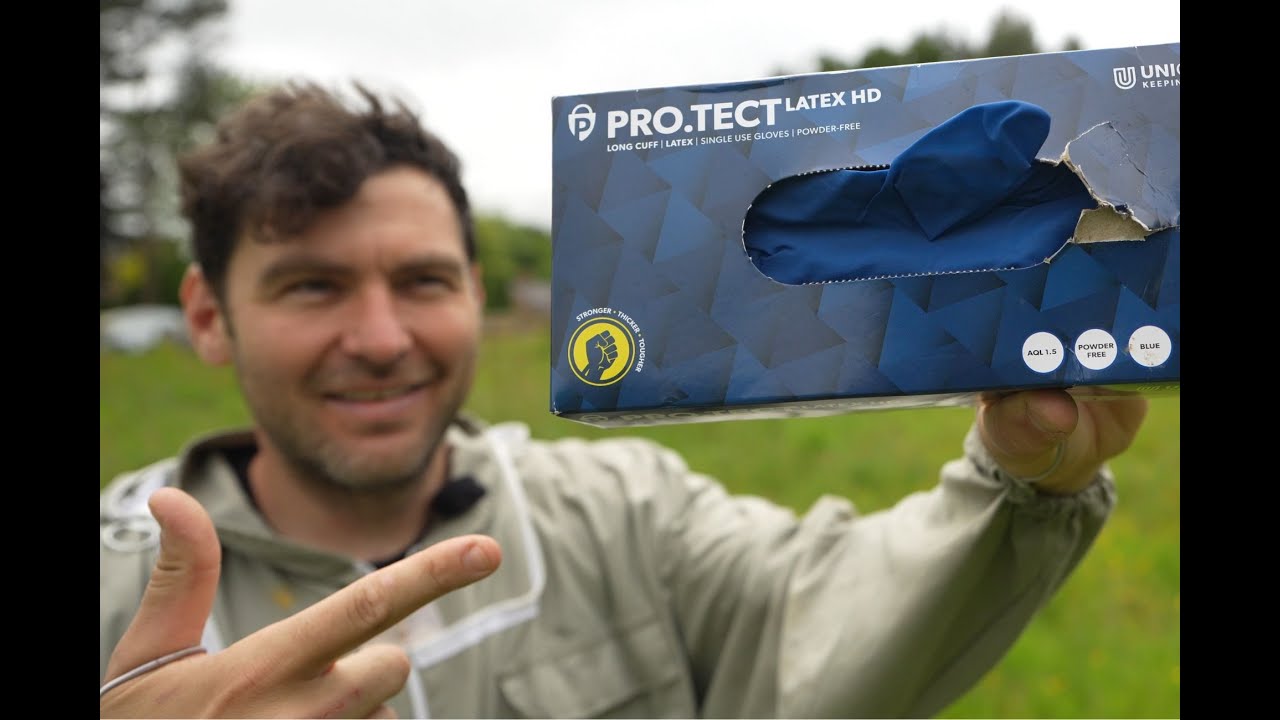
In this video Laurence Edwards reviews his newly discovered favourite beekeeping gloves, the Protec Latex HD Long Cuff single‑use gloves from Uni Gloves (sold via justgloves.co.uk). He begins by outlining his strict requirements for disposable gloves: they must be single‑use to prevent disease transmission, available in multiple sizes for his large hands, thick enough to resist bee stings yet thin enough to retain dexterity, and feature a long, ribbed cuff that stays up. After a subscriber, Jez Davies, recommends the gloves, Laurence tests them on camera, demonstrating how they fit, their thickness (four times thicker than standard nitrile, comparable to a Marigold), the ribbed cuff, and the ease of putting them on. He discusses the cost – about £11 for a box of 50 gloves, equating to roughly 40‑45p per inspection – and compares this to pricier alternatives. The gloves provide sufficient dexterity to handle bees without crushing them, which helps keep colonies calm. Laurence emphasizes that he does not earn money from the links and that the gloves are a practical, disease‑preventing solution for beekeepers who move between apiaries.
Chapters
Every beekeeper needs a pair of gloves. I've got a brand new favourite. Today we're talking about gloves, and I was really, really gutted last year when I went to buy a big bulk pack of my favourite beekeeping gloves and the manufacturer told me that they'd been discontinued. I was gutted, and I've been on a bit of a search recently to try and find some new decent gloves to fit in with my requirements. My requirements are really, really simple. They have to be a disposable glove because I don't like using the same pair of gloves across different apiaries. You can't disinfect them, you can't sterilize them. It's the perfect storm for creating a disease risk within your area. Do not like non-disposable gloves. So that rules out leather, that rules out kind of big thick plastic gloves, anything that you're going to actually try and clean. So that leaves you with a few disposable options. You can have nitriles, you can have marigolds, But for me, I have quite big hands and I have to have gloves that fit really well. So I need a glove that's going to come in a variety of sizes. And then another thing that I'm really, really keen on with gloves is that they are slightly thicker than normal, not because I lose any dexterity. That's a key factor for me, is that you keep the dexterity. So they're thin enough to have the dexterity, but they're thick enough that the bees won't regularly sting you through them. So Still get the occasional sting through, but the bigger one is that they don't rip. I get so annoyed with cheap nitrile gloves. You put them on and they just split open and you just think, ah, it's really annoying. And then you've got wet, soggy hands and you're trying to put another one on and you can't get them on. Very, very frustrating. The other thing that I must have in a glove is a super long cuff. The longer the better for me because I find that they just ride up and then the bees get inside and sting. And then the other one is that the cuff is a ribbed cuff and not a baggy cuff. So a few things there. They need to be disposable, preferably a nitrile, preferably not black— forgot to mention that bit— thick enough that they're not going to rip but thin enough that I maintain the dexterity, a long cuff that is ribbed, and a really good size-fitting glove. Not picky at all and don't have many requirements, do I? But Jez Davies, one of my channel subscribers, having watched a live stream when I said that the gloves were discontinued, he sent me a link to some gloves that he was using and said you should try these out, I think they're going to be perfect for you. And I can confirm today they are absolutely perfect. So in today's video, I'm going to show you these gloves, show me putting on some gloves, which is going to be fantastic watching, but just give you like a bit of a snapshot to show you why they're so good, and then obviously give you the details if you want to go and buy some for yourself. I don't earn money from any of these links or anything, like I'm just giving you good advice for some good gloves that I like, nothing more, nothing less. So there we go, just paused for a little thumbnail there. Protec Latex HD Long Cuff Latex Single Use Gloves, powder-free from Uni Gloves. I bought them from a company called justgloves.co.uk. They're not the cheapest gloves. They come in a pack of 50, and they're like a very dapper blue, slightly lighter shade blue than my previous ones. And I think it works out at about £11 or something like that per box. So not the cheapest glove, but 50 gloves in here, so 25 pairs, which means that for me, I get 25 inspections out of them. Costs me about 40p, 45p per inspection for these gloves. Really not that much at all. I do know people that clean these as well. I think if you clean disposable gloves, you are a little bit tight. Not dissing anyone who is that tight, but for me, I'm certainly not one for cleaning them and reusing them. One use, one apiary, they get chucked in the bin, they get destroyed, and then it's a really good way that you're not spreading disease between your apiaries. Let's get some of these gloves on now and see how well they fit. So you can immediately feel with these gloves here that they are considerably thicker than your standard nitrile. I think on the blurb it was saying they're 4 times thicker, but look, You couldn't do that with like a normal nitrile without them ripping at all. So they're much more similar, I'd say, in thickness to a Marigold. But a Marigold costs like £2 each or something ridiculous like that. And these, I would say, are a little bit thinner than a Marigold as well. You don't always get the best dexterity with a Marigold, but you can see they're super, super tough. And then this is what I was talking about here. You've got this ribbed thick cuff there. Really, really important for me to have that thick ribbed cuff. Otherwise, the bees just get in and I find it super, super annoying. So in terms of fit, I'm an XL and I have to say I'm somewhere between an XL and an XXL. I wish these were a tiny, tiny little bit bigger, but they do fit well. But you can see you've got a really good stretch to get them on. And then look how high I can get that up. And not only can I get it up, but it stays up. That's the important thing there. Super, super high. I'll show you that again with this hand. You can be really, really aggressive to get them on. I don't think I've had any of these rip yet, and I can get that cuff nice and high. And as I said, it's just, it's like the length in the fingers for me, just a little bit short. But I think for most people with regular-sized hands, you'd be all right. But I think that's just a good demonstration there. Look at the color change. Look how aggressive I'm pulling those up, and they just flip back down, and they're not ripping at all. So, good fit, no powder, really nice, good texture on it as well. So they're textured. And I'll pull out some of these bee frames now and just show you the gloves in action. So what's great is that you have the dexterity to be able to like move a bee across like that. And you know, that bee's kind of pretty much unfussed at what I'm doing, obviously not that keen. But with the big thick gloves, you can't do that without squishing them. And similarly here, I have the ability to be able to feel the bees. So you can see I just knocked one there. But if I'm going in, I felt that bee there, I couldn't pick it out because I would have squished it. So I just have that dexterity to be able to not crush bees. And not crushing bees is imperative if you want to keep nice calm colonies. As soon as you go in and start squishing them with your fingers, they just all come out and get you. So I've got that dexterity there, I've got that nice strength in the glove, I'm confident that it's not going to rip, I'm confident that the colony is not going to attack the gloves because they're carrying that pheromone. And I'm confident that the gloves aren't going to be saggy around the cuffs where the bees can actually get up and get in. Best gloves I've used, even better than the ones I used last time. I'm completely converted, and I'll put you a link in the post below.