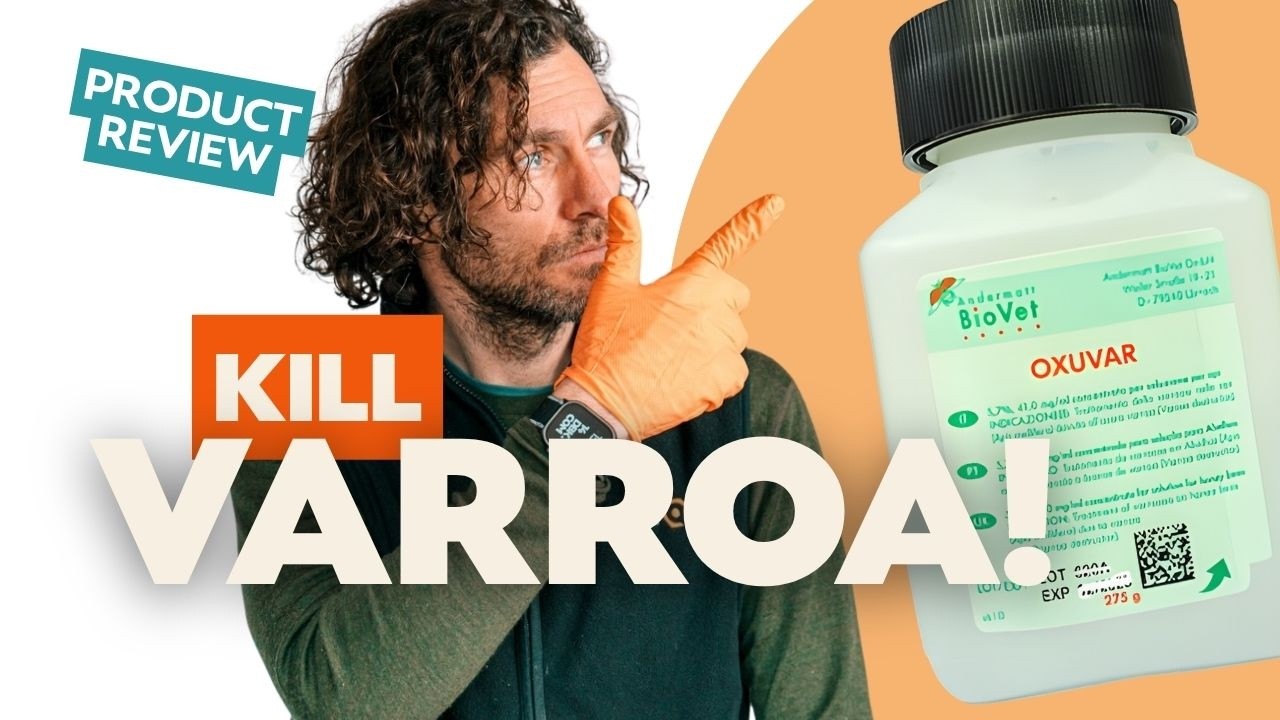
In this instructional video, Laurence Edwards of Black Mountain Honey reviews Oxivar, an oxalic acid treatment for varroa mites, and demonstrates its use with an Andermatt automatic dosing syringe. He discloses that the products were supplied free of charge but he offers an unbiased opinion. Edwards walks through safety precautions (gloves, face protection), preparation of a 1:1 sugar‑oxalic acid solution (275 g white sugar dissolved in pre‑warmed solution at 30‑35 °C), and the priming of the automatic syringe. He explains how the syringe delivers a precise 5 mL dose per seam of bees during a trickling application, emphasizing the importance of correct dosage and minimizing colony exposure time. The video contrasts trickling with sublimation, noting that trickling is simpler, safer, and more suitable for backyard beekeepers, while sublimation requires additional equipment and power sources. Edwards recommends the automatic syringe for ease and accuracy but notes that a manual syringe can also be used. He concludes with purchasing information, a thank‑you to Andermatt, and a call to subscribe.
Chapters
Hi, I'm Lawrence Edwards from Black Mountain Honey. Welcome to another episode of No Nonsense Beekeeping. Today we're going to review Oxivar from Biovet. So before we go any further, as always, please take a look at honeybeebay.co.uk, an online beekeeping marketplace connecting buyers and sellers. Right, today's video, we're going to do a full review and Demonstration of Oxivar from Biovet. This product was provided for me for free by Andamat UK for me to give you a review and give you my honest opinion. I'm not paid for the review, but the product was provided for free, and I'll give you my honest review and recommendation for the product. Also in this video, I've done a previous video showing you and doing a review of this product. This is the automatic dosing syringe. Works really well with the Oxivar. We're going to use this in the video, and I'll show you applying some of the solution to the bees in order to combat varroa mites. So this product by Andemat, one thing I really like about it is that the instructions come in a nice contained label on the front of the product. So the first thing to do if you buy this product and you don't get any instructions with it, all you do is you just peel this away and you get a really detailed information pamphlet to so you can follow all of the steps really, really accurately. Whenever you're doing anything with oxalic acid, really do make sure that you take adequate precaution. We're going to put gloves on and we're going to put some facewear on when we actually come to do the trickling. So what looks like a really small information pamphlet folds out and you get like a full book really, loads of different languages, but it gives you all of the information that you need to safely apply this solution to your bees. So you can apply this product in 2 ways. You can use a sprayer, take each of the frames out and spray them both sides. That is not a winter treatment. You can't do that in winter. So we'll follow that up with a separate video later on in the year. What we're going to do today is a trickling method. So we're trickling the solution over a cluster. So the first thing it says to do in the instructions is to pre-warm the solution. You want to get it up to about 30 to 35 degrees C, nice and warm, and then you can safely use it to treat all of your bees. You can do that by putting it in a water bath, or you can just leave it on a really kind of mild radiator with some protection underneath it. You want to get it to about 30 to 35°C. So before you cut the seal, get your glasses on, get some gloves on. No reason not to take adequate precaution for this. It's a nasty substance and you need to take adequate precautions. So what you need to do then is you need to add 275g of standard white sugar into the mix. You've already pre-warmed this. And then you put the lid back on, and you just want to shake that until all the sugar is dissolved. You're effectively making a one-to-one sugar solution with the addition of the oxalic acid inside it. So once you've shaken that up really well, make sure all the sugar is completely dissolved. What you can do is, if you're going to use this product with a manual syringe, you can just take the lid off, put the syringe in there, and suck out the amount that you need. We're going to use the automatic syringe today. Because I think it's a really nice product, makes dispensing this onto the bees considerably easier and gives you the exact correct dosage as well. So luckily the automatic syringe, also made by Andermatt, it comes fully compatible with the Oxivar container. All you do is you just take the container like that, place it underneath, and then you spin the container as opposed to spinning the hose. You give it a few pumps just to prime it. Right, so we've got the product fully primed now. The cylinder is full of oxalic acid solution that we made up in here, 1:1 sugar syrup with the Oxivar. All of the pipe is filled, there's no air gaps, we're ready to go and dispense this product onto the bees. Right, so you need to make sure that you're doing this in the correct temperature. It's about 7 or 8 degrees here today, perfect temperature for doing sublimation but also for doing trickling. This is the colony that we're going to do it on. What you want to do is make sure that you limit the amount of time that you've got the colony open, and that's why the automatic syringe is really, really good and helpful. So what I'm going to do is I'm just going to take the roof off, go straight in, and then I'll talk to you a little bit about the process afterwards. So what's so good about this product and the syringe is that it's easy to apply, it's nice and safe. You're looking to get 5 milliliters per seam, and that's why the automatic dosing syringe is so good. So that's it there. That's given me the perfect 5 milliliters dosage on that first seam. I'll rearrange the camera now. You can get a close-up view exactly what I'm doing. So there you go, that's the treatment complete. It's really, really quick and easy to use that automatic syringe. Just takes all of the guesswork out of it. You know that when that cylinder is full, it's 5 milliliters or slightly over because we put a little bit extra in there to account for the air bubble. And then once you've dispensed that all the way down, you know that you're adding 5 milliliters of that solution as we've made up on the back of the recommendations from Andematt per seam of bees. And that's what's really important here, is to get the dosing correct. So you're adding 275 grams of sugar into that solution, bringing it up to the right temperature between 30 and 35 degrees, and then making sure that you're getting the correct amount of liquid per seam of bees. And that is what you need to combat varroa if you're using it in a trickling method. So you can buy this product direct from Andermatt. You can buy it from loads of different beekeeping companies across the UK as well. Just search for it. It's called Oxivar, and this is the method that I would recommend if you're going to go ahead and use it. I would highly recommend the automatic syringe as well. They've provided both of these products free for me, but I'm not going to recommend anything to you that I don't think is a good product. This syringe works really, really well. It's well designed. It's great at dosing the correct amount of solution to treat your bees for varroa. So like I said before, there's an argument to be had whether you should be trickling or whether you should be sublimating. My preferred choice is sublimation, but there's added risks that are associated with that, and there's added issues in terms of batteries and power and generators. So for a backyard beekeeper, I would say trickling is definitely going to be the easier of the options. I would say it's probably the safer of the options as well. You're not dealing with anything coming up into your face. You don't need full respiration equipment. You don't need generators. You don't really need any specialist equipment because you can do this with a manual syringe. Obviously, the automatic syringe, I think, is a nice touch and it does make the product a little bit safer in terms of getting the correct dosage out. But you can do this without the automatic syringe. So finally, I just want to say thanks to Andermatt for sending me these products. I much appreciate you sending me the products to review, and I hope that it gives the, the general public some good information on how to use your products. So I hope you've enjoyed this video. As always, please hit the subscribe button, please hit the bell so you're notified of every video, and I'll see you next time.