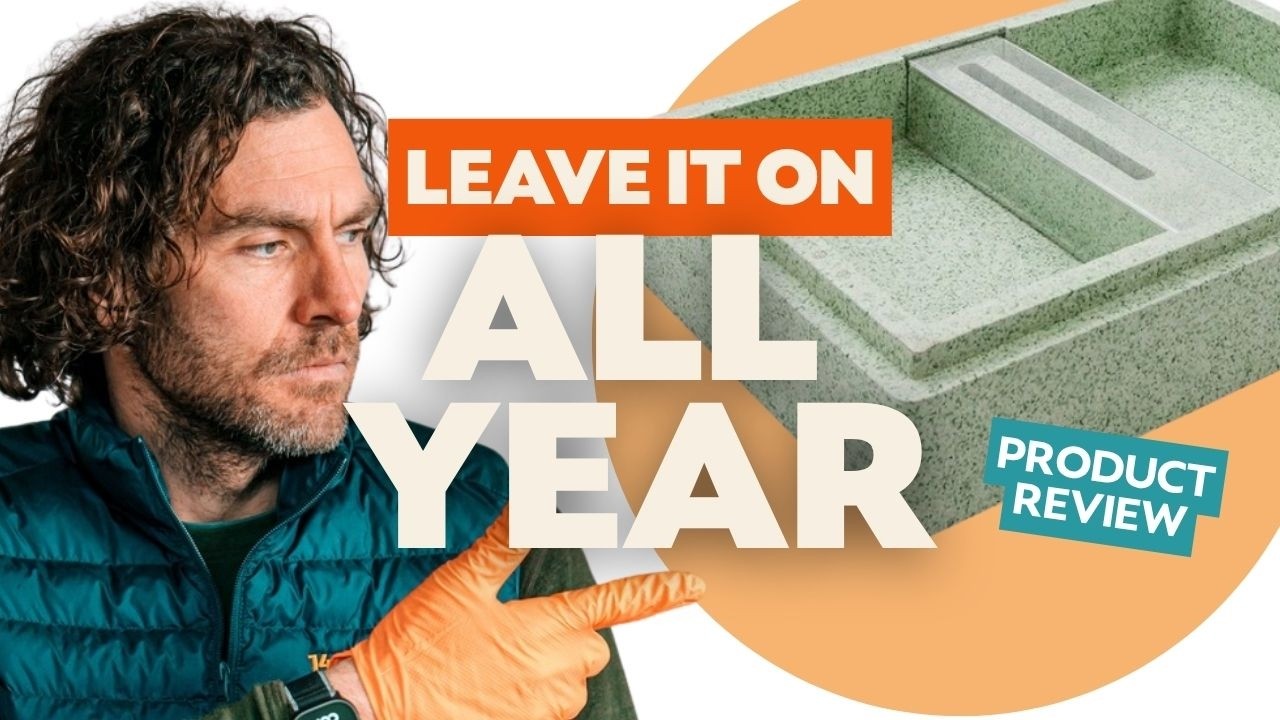
In this concise video, Laurence Edwards of Black Mountain Honey reviews the Paynes Poly Feeder (a Miller‑style poly hive feeder). He explains that the feeder must be purchased separately from the poly hive kit and is intended for large, solid feeding stations that can stay on the hive all season. Edwards covers preparation (exterior‑grade paint recommendations for interior and exterior), the integrated single‑bee‑space rim that doubles the feeder as a crown board, and the overall build quality (heavy, high polystyrene content). He discusses design details such as interior chamfers, a large side slot, and the placement of handholds, noting both positives (easy to lift, good insulation, versatile use as feeder, crown board, and eke) and negatives (slot may be unnecessary, limited depth reduces syrup volume and fondant slab size, and the Miller design is less fondant‑friendly than an Ashforth). He estimates an 8‑10 L syrup capacity, compares it to the 14 L Suyenti Ashforth feeder, and stresses that the feeder is only compatible with Paynes/Maysmoor 500 mm square systems. The review concludes with a strong recommendation for users of those systems to replace separate crown boards with this feeder, highlighting its versatility and value, and ends with a standard call‑to‑action to subscribe.
Chapters
Hi, I'm Laurence Edwards from Black Mountain Honey. Welcome to another episode of No Nonsense Beekeeping. Today we're going to review the Paynes Polyfeeder. Before we review the feeder, please take a look at honeybeebay.co.uk, an online beekeeping marketplace connecting buyers and sellers for everything beekeeping. Right, on to the review of the Paynes Polyfeeder. It's going to be a really, really quick review. I just wanted to put a separate video up because the Paynes Polyfeeder does not come as part of the poly hive kit that they sell. That's pretty standard across all poly hive manufacturers. You need to buy the feeders separately, but I'm a real big fan of a big Ashforth feeder, or in this case, a Miller feeder. Something big, strong, and solid that you can put on top of your hive, leave it there all throughout the season, and then feed syrup when they need it, and ideally feed fondant as well at the same time. A few things to say first about the poly Miller feeder from Paynes. It needs to be painted, so you need to paint it with an exterior-grade masonry paint on the inside, or you can use an exterior-grade gloss on the inside as well. Just make sure you're using the exterior grade, otherwise it will come away with the syrup. The outside can be painted in absolutely anything you want as long as it's exterior grade. I like to use spray paint because it's quick, gives the hives a bit of a unique look. So this polyhive is a Miller feeder, And a Miller feeder is shown because it's got the entrance slit in the middle, whereas an Ashforth feeder has it on the edge. My preference is for an Ashforth feeder. It's easier to feed fondant on. I'll show you that at the end of the video. However, what I really do like about this Payne's Poly feeder, and it's the first thing I noticed when I picked it up, was it's incredibly heavy. It's solid. I cannot quite believe how much polystyrene is included in this poly feeder. And the first thing I thought when I picked it up was, please, please, please have a bee space underneath so I can use it as a crown board and I haven't got to go adding my old rim. And lo and behold, they've got a single bee space all the way around. So they've got the rim integrated into the poly design. It's a must-have for me on any of these feeders because it means that they can double up as a crown board as well, which saves you messing around and buying crown boards. Especially for a bigger format hive like this where you're forced down into a bit of a route where you need to buy a separate size crown board. So really nice feature. You've got your rim all the way around like that, flat mating face to work with a bottom bee space hive such as the Panes, and then in there you've got a single bee space rim, which means the bees can actively move over the top of the frames and access the feeder. Really, really nice. So what else to talk about this feeder? It's got some really strange contours in the middle of it. So one of the problems that you're always going to have with a feeder, be it a Miller feeder or an Ashforth feeder, is that if you get the alignment of your hives wrong, so if they're not level, you'll get it like that and the syrup will tip down into one of the corners. Paynes have tried to combat that a little bit, and you do have chamfers on the interior bits here. Would have probably worked better to put them on the exterior bits as as well, just so it's channeling all of that syrup down to the slit. But I think it would be absolutely fine. You can always just tweak it, and if it is off-aligned like that, all you need to do is just switch it around on your next visit and that syrup will move back down there. So in terms of a syrup feeder, I think it's really good. So a couple of the negatives that I'm not overly keen on about this: one is this big slot here. Not really sure why they've gone down that design. I would have removed that and it would have given you a little bit more access for the bees to get in there. Would have saved a load of poly as well, so you're not paying for this extra piece of poly here and here, and just extended that polycarbonate screen. The next thing is it's not the biggest of poly feeders, so it really isn't that deep. The depth in terms of the floor of the poly hive is really big and solid. That's one of the things I like about it because it means you can use it as a crown board on any compatible equipment with this. And you've got excellent insulation where you need it most, which is above the cluster. So I will be using this on my Payne's Polyhide, which is down there. I'll use that as a crown board, and I'll keep that on all the way through the year. All it means though is I'm slightly limited to the amount of syrup that I can get in here. However, it's pretty massive anyway. I reckon you're easily going to get 8 to 10 litres of syrup in here, which is plenty big enough. The Suyenti one This holds 14 litres in an Ashforth style, but it doesn't have the rim underneath. So I'd say this is far superior really to, to any of the other feeders on the market, although it's only compatible with, say, Paynes or Maysmoor on that 500mm square format. So I couldn't go and use this on a wooden National Brood Box, it just wouldn't work. Then the other thing to say that I don't really like about this, and this isn't a dig at this particular feeder, It's the feeder in general, the Miller feeder, is that I like to keep these on as crown boards so when I come later on in the season I can invert them like that and use them to feed fondant. And on this one, obviously, I can't get a big slab of fondant in the middle, so I just have to put 2 smaller slabs of fondant either side, and it means that it's just a little bit more of a faff and I can't feed quite as much fondant as I might like to. It's a minor quibble though, you can definitely still do it. So if you've got one of these, It's really good because it, it's very versatile. You're buying a poly feeder so you can feed syrup to your bees. You're buying a crown board so you don't need to buy another crown board, and you're adding lots of insulation where it's really important. And you're effectively getting an eke as well, which you can invert and you can add fondant to your hives if they need it over winter. So following on from the Payne's Polyhive review design, it's got handhelds everywhere. There's really not anywhere that you can't hold this Polyhive, this poly feeder, and actually pick it up. It's really nice. I never really thought about it too much on the Payne's Polyhive, the way that the handhelds are off-center, but it works. It's a clever design, and it means that in the middle, you don't really pick things up in the middle there. You do tend to pick them up from one side like that. So really nice, easy-to-hold handhelds, and they're on all 4 faces, which means that you're not twisting. You're not doing anything strange. You can approach the hive from whichever orientation you want to, pick it straight up. It's a really nice clean design. So I know in these videos, uh, it's nitpicking, and I'm trying to pick up really little kind of minute things to say, I'm not so keen on that, and I'd probably do that differently. With this though, there's not a huge amount to say. It's a good poly feeder. If you're on the Paynes or Maysmore systems and you need a poly feeder, This one absolutely spot on, same as the Maysmoor one. I really can't fault them other than they are a Miller design as opposed to an Ashforth design, but it's a minor quibble. If you're on either of those systems, these are a really good buy, and I would suggest just ditch whatever crown board you've got, buy one of these for each of your hives, leave it on all year round, and you've got yourself a crown board, a feeder, and an eke for feeding fondant. So as I said, it's going to be a really quick video. I hope you've enjoyed this one and I hope it's been helpful. As always, please hit the subscribe button. Please hit the bell so you're notified of every video, and I'll see you next time.