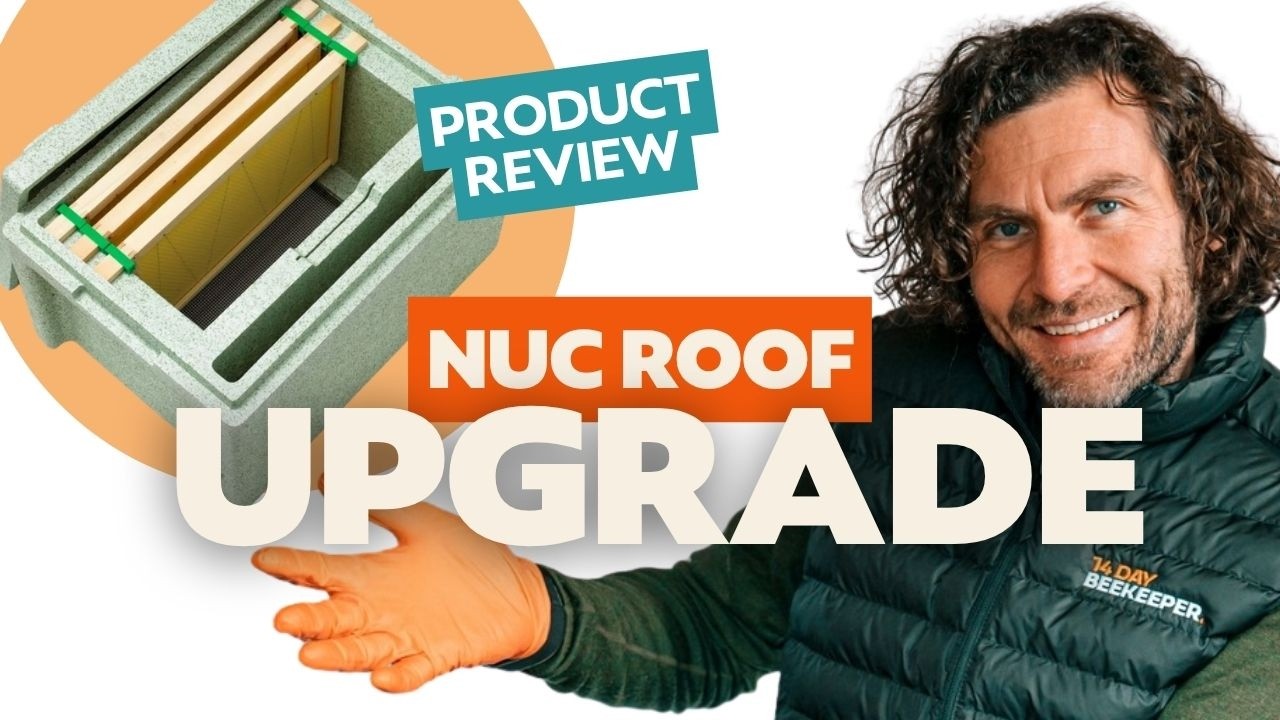
Laurence Edwards reviews the upgraded Payne's Poly Nuc, which now has denser sidewalls to stop wasps from burrowing and a deeper roof (40 mm instead of 15-20 mm) that eliminates winter condensation problems. The new design removes the internal fondant cavity, pushing beekeepers toward side-feeders instead.
Chapters
There is absolutely nothing better than seeing a manufacturer improve their product based upon research, experimentation, and customer feedback. Now, that doesn't mean that all bells and whistles should be included to cater for the whim of every single beekeeper. There is no such thing as a perfect beehive. I hate landing boards, other people can't do without landing boards. We're never going to agree on that, so therefore we can't agree on perfection. But in this video, I'm going to show you what is quite a small iterative but very powerful improvement to a very common product, and that is the Payne's Poly Nuc. Now I've used loads of these Payne's Poly Nucs, I've done previous video reviews on them, I've said what I like about them, I've said what I don't like about them, and I've come to rely on them as my go-to nuc for one specific reason. That reason for me is that they do a really good ventilated screen, which means that I can send them in the post, but I can send them in the post with the integrated feeder. All of the other nucs on the market don't give you that option. So for me, it's a very good product for my personal needs. Now originally, I really didn't like the side feeder of the Payne's Poly Nuc, but I've kind of come to accept it now and come to like it. And the only thing that I still continue not to like about it is how thin the sidewalls are and the fact that wasps can burrow in. Payne's have fixed that problem, but they've also fixed what I thought was the biggest issue with this nuc, and that is the really thin roof. I've done a previous video on it showing the heavy condensation that builds up underneath the plastic crown board as a result of not enough material above that winter cluster. Payne's have been working on this one for a while, way before I did the video, and they have come out with a brand new revised Poly Nuc that caters for both of those issues. So my understanding is there is a slight increase in the sidewall thickness internally in order to stop wasps burrowing in. It's now 120 grams per liter, and I go looking back, it definitely wasn't that density all the way through. Roger, you'll have to correct me if I'm wrong, but I believe the original ones were made at 100 grams per litre. But then the final and most significant upgrade is they've extended the depth of the roof, which means that you can say goodbye to any condensation issues over winter. So I've got a couple of nucs side by side here. I've got the old original thinner roof, and then you can see there just how thicker that new design of roof is. There's no internal cavity, and they've decided not to put any room in there to feed fondant, But they deliberately did that because they didn't think it was a suitable design solution, and they think you should be using either an eek to do that or just feeding syrup in the side feeder. So I can live with that, and having used the Maysmore one, it can get you into all sorts of trouble with the additional roof, and it means that you can't actually use it without a crown board. So if you turn these 2 roofs upside down, you can see you're still maintaining the exact same overlap. That means that the base design is the same, and all of that additional depth that you're seeing, that is additional material. Quite a substantial upgrade. I think it's gone from around 15 to 20mm up to 40mm in depth. Substantial upgrade and one that's going to give you real benefits over winter. So you can see there, that is the thickness difference. And as they've got exactly the same rebate, the difference in the depth of these 2 here is the additional material that they've added on. I would say it's got to be at least 20mm additional material, and you can really feel it in the weight as well. Like, the new one is substantially heavier and it means it is gonna completely eliminate that problem. So I'm really happy to see that the Payne's Polynuc has been upgraded. Thanks for Roger for letting me do the UK exclusive and for sending me up a Polynuc to test. I'm gonna get some bees in it, I'll run it over winter, we'll do some comparisons with the other Payne's Polynuc and see if we can see the difference in the amount of condensation.