Richard Selects His Breeder Queens
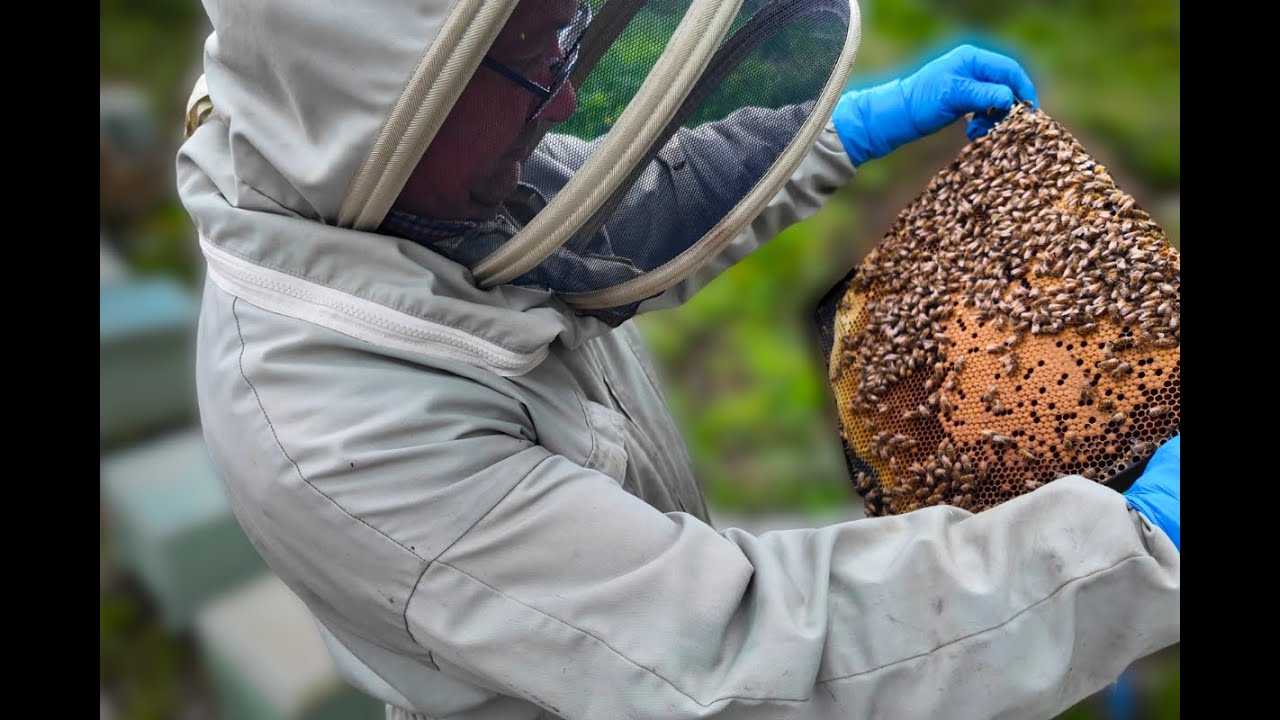
In this YouTube walkthrough, beekeeeper Laurence Edwards hosts inspector Richard at the Forest Apiary to evaluate six of Edwards’ top breeder queen colonies from the previous year. Edwards explains his annual process of purchasing 15‑20 artificially inseminated queens and a few select breeder queens, rearing them through the season, and then inviting Richard to inspect and choose the best one or two for his own breeding program. The video walks through each colony, noting queen lineage (Duncan Simmons, Buckfast, German Buckfast, Dr Stoffen), frame type (plastic 14×12 vs wax), and colony performance metrics such as temperament, brood pattern, honey and pollen stores, swarming tendency, disease signs (sacbrood, chalkbrood), egg size, and overall vigor. Richard conducts a “tap test,” checks for eggs, assesses aggression, and comments on frame handling preferences. The pair discuss practical beekeeping techniques—splitting, space management, shaking frames, and recycling plastic frames—while also touching on record‑keeping challenges. After reviewing all six, Richard selects a German Buckfast (Stoffen) queen and another strong colony, noting that the Duncan line remains valuable but will be supplemented with new stock. The video ends with the queens being wrapped for transport, summarising the selection outcome and future breeding plans.
Chapters
I'm at the Forest Apiary with Richard today, and we are going through my selection, the very best of my selection of breeder queens. So each year I buy between 15 and 20 artificially inseminated queens, and I buy a few select breeder queens as well. I run those bees throughout the season, and then early on throughout the season, Richard comes up here and he inspects the bees and he chooses his favorite from the ones that I've already selected. So I have brought the 6 very best breeder queens that I had last year up here, And today we're going to run this video and Richard's going to go through them, tell you what he likes about them, tell you what he doesn't like about them, and then he's going to select the very best one, maybe 2, to take back to rear queens for this year. This first box that Richard's going into here is very, very understocked. Had a nuc out of it here. We try and keep the breeder queens on as few frames as possible, and this one here has a little delightful trick on that first frame as well, trying to catch Richard out.
Let's see.
So as I was going through my nucs for delivery, We had a Langstroth frame that unfortunately had snapped. And there we go. Richard's just doing a little bit of a tap test there.
Just to see the reaction.
So Richard's come really well prepared. No glasses. So this queen here is a 2022 queen, yellow marked from Duncan Simmons. Very, very nice, calm Buckfast bees. I've taken a few splits off this one already this year, and I did some grafting off it last year as well. And the offspring's very, very good. Consistent across all of Duncan's lines, you know, very good breeder queens, really good genetic lines. What I particularly like about this one is how prolific they are. They were on 6 extension boxes late on last season, and then they built up this year onto about 3.5, 4 extension boxes. And then I've had to knock them back and take some splits out of them as well, because Richard only likes to take a couple of frames with him when he takes the breeder queens. So what you're seeing there, that frame, that frame was donated from another nuc. That wasn't the brood from this queen. So let's get down underneath that top extension box there and take a look at what this queen can really do. I do think this is a slight unfair advantage, this one. This isn't all of her daughters. You can see a lot of darker bees in there. I took a lot of splits and took a lot of nucs from the apiary where this one was in and then left the box here. So this has gathered a lot of different bees, and then I've added some brood in to boost it because I'd taken a split out of it as well. Have you seen any eggs in there?
Yeah, I've seen eggs in the top.
Okay, seen eggs. We'll be good then if we've seen eggs. She'll be in there somewhere. They can get a little bit rattled, can't they, when you're transporting them from site to site and the queens go—
Yeah, and we haven't used any smoke, smoker, or we haven't used any syrup spray or anything.
He's going to hold it against these bees, definitely. Well, do you know what? I'm quite confident that you will find that they're a lot calmer than this one here. There we go, there's the queen. So let's give you a close-up of that Duncan Simmons queen. Let's get right in there. There she is, marked 92, yellow marked queen. We got that in May, June 2022. We've taken a lot of daughters from her last year, but you can see beautiful queen, really big. What do you think of that queen, Richard? So go on, what are your thoughts on this colony here? You can be completely honest because I'm not 100% sold on this one, I have to say.
Well, the bees are showing signs of aggression, aren't they? Having said that, you've done so much with them, they are going to do that. I mean, the queen itself is fine. It's a nice queen. Right, let's have a look at some others. So there we go.
That's number 1 breeder queen. Richard's just putting that back together again now. We've got 5 more of those to do. So when you're looking at your breeder queens, Richard, what are you looking for? Like, tell me about all the different things that you're looking for when you're evaluating those queens, but more importantly, when you're evaluating the F1 offspring.
I'm looking for brood pattern, really. Brood pattern. Number one's got to be temperament. And then number two has got to be the brood pattern, which is a bit unfair, seeing as you've robbed so many nucs out of these. So I can't get a good judge for that, really.
And then how do you feel about things like sacbrood, chalkbrood?
Yeah, I mean, any of the viral diseases, as long as the frames are new, If you've got problems with viral diseases and you've got relatively new frames, there's no way I would even go there with breeding from that.
So straight off the list. What about swarming as well? Like on the offspring, if you're seeing breeder queens try and swarm or offspring try and swarm, what's that making you think?
Well, it's very difficult to judge a breeder queen because most of them are artificially inseminated. The pheromones, just because the queen is right, doesn't mean to say the pheromones are there. So it's like a constant battle for that, isn't it? Very difficult to judge. You can judge the offspring, but then you've got to wait another year. Got eggs in this one. Bees are calmer to start, for sure.
Yeah, we should have left the angrier one till the end, I guess, because it can sometimes trigger them. But you can already tell, can't you, the difference in temperament with these ones here, not flying off as much.
Yeah, there's a queen there. So where's this one from?
Right, so we've got the queen here. So I'm keeping this one a bit of a secret. There's a few on here that we've got that I'm not actually allowed to divulge where they've come from, but they are pure Buckfast queens from a very, very special breeder in Europe. But isn't that a beautiful queen?
Yeah, it is. Yeah, no, it's a nice queen, that.
So this colony here— oh no, it's not this one.
I mean, they're quite fast moving on the frame is the only thing.
A bit fast moving on the frame. Okay. So you prefer them a bit more—
Well, you don't want them to be balling up. Once they start to ball up, it makes everything difficult at all or anything, looking for queens. And if you film that, you can just see them running in one direction. In the end, the centre will be empty and they'll be like, if you were looking for a queen in here, to the untrained eye, which I would just do this. It becomes more difficult, doesn't it?
Yeah, a bit buzzy.
Yeah, they're not particularly aggressive because even when I do this, this is my test. Yeah, I mean, they're not, they're not, I mean, I haven't got any up the calves.
I was going to say, that's a good thing to look at there. You can see a few bees flying, but none of them are going for you like they were kind of on that first one.
No.
And I will add in there, like, I can't get a slur on Duncan. Duncan's queens are exceptional. And if you bought an overwintered queen from us in 2024, every single UK mated queen came from a line from Duncan. So Duncan's queens are exceptionally calm. That colony behind there, that is, I've added some brood into that one, hence the slight aggression. So I do think that needs to be stated there.
Yeah, I like this colony.
Like that one? Yeah.
Yeah.
So go on, tell me the things that you like about this one. Tell me the things you're not so keen on.
Well, just the brood patterns there, the calmness in the bees. I mean, the only downside is Is that they're running on the frame?
Running on the frame, yeah.
Because we haven't used any smoke, so they shouldn't be running anywhere, really.
Okay, cool. But better than the last one?
Well, by a mile, yeah.
Okay, we're going on to the next one now. So these are— Richard's going to probably curse a little bit on these ones. These are Frames and Feeders 14x12 plastic frames, Richard's number one favourite. And this is a trick that I've used quite a lot recently. It's a brilliant trick, which is you set your nucs up like that and you just use each one as a Absolutely brilliant. Right, so this one, let me give you the background on this one here, Richard. This colony, I've never seen expansion like it. You can see they've used every single jot of space in there. Giving it the tap test there.
Yes, if you do this and the bees are attacking your fingers, there's something seriously wrong, because I get stung in the leg. But, um, you know, this is extreme. You know, we're not using any smoke. We're just trying to see, you know, how they perform, really. I mean, there's 2 ways of looking at bees that come out to sting you. I mean, you want some protection against the wasps and everything else, but what you don't want is to have bees that are just constantly stinging you because the job's not pleasurable for anybody, you know. But these are getting up. Yeah, one stung me in the leg there, but I mean, In fact, I've got thin trousers and a thin suit on.
While you're loosening up those frames, let me give you the background of this one here then. So we overwintered on a 14x12 configuration, and then I put on here 3 14x12 extension boxes, and they filled them to the brim, filled the feeder in the side, and filled the top feeder as well. And you will see on these frames here, they are full to the brim with bees, absolutely full to the brim. So you like it when the bees go out and they kind of get copious amounts of pollen like that?
Yeah, especially after this spring. It's something I look for even more.
Just why is that? So it gives them like the backup so you can get the expansion? Yeah.
I mean, bees definitely harvest a lot of pollen, are definitely a bonus. So I mean, she's laying that many eggs, I can see doubles in there straight away.
Double eggs?
Yeah.
As in like she's limited for space, yeah. Which is a good thing. And it's a difficult one, isn't it, with the breeder queens? 'Cause what we're always trying to do and striving to do is to limit the amount that these queens lay. But it can be difficult with the breeder queens, can't it? 'Cause all they want to do It's just become huge.
Yeah, you've got to knock the colonies back to at least just 2 or 3 frames max, and they just can't do it then.
So I wish you'd come and seen these when they were on their, you know, the 3 or 4 extension boxes, because some of the brood was brilliant, but it was all high up. So they built the brood nest, no queen excluders in there, and they put the brood nest right at the very top of the boxes. And I've gone off and made some splits with them.
Well, there she is.
That's a pretty good brood pattern, I think, isn't it?
Yeah.
Could be better. Watch out, she's just fallen off there. Yeah, she's fallen off.
There's a mistake.
Yeah, so there we go.
Because you've cut her wings off, Lawrence.
Oh well, you know, I didn't drop her. I like it that Richard dropped the breeder queen this time. So this one here is from the exact same breeder from the previous colony. I've got 3 or 4 of these. Secret breeder in Germany. And I've just given away where the country is, but German Buckfast. And you said before, didn't you, you like German Buckfast, Richard? So there we go, beautiful long queen. What number we got there? Number 19. So if people remember back, number 19 was the colony that nearly died, so that queen maybe wouldn't have made it through. So I kind of like the idea of doing something with that queen, you know, she was probably a couple of hours away from that colony failing completely. So what are you thinking about these ones?
Oh yeah, they're Yeah, they're fine. They are. I mean, look at the pollen in there again. It's like frame full of pollen. Which is good because you need pollen to make young bees.
Yep, frame of pollen, lots of nectar still coming in. What do you think of plastic frames, Richard?
Why do you hate them?
Why do you hate them? Go on.
Well, no, no trait, but whoever designed these frames, these should be solid for sure.
Why? What don't you like about that?
Well, have you ever tried cleaning one? Yeah, it's a design fault for sure. I'm not so sure whether the bees really like them.
The bees definitely prefer wax, without a shadow of a doubt.
I mean, I've heard a lot of people say about them. I mean, I've not used them myself. I mean, there we have a cup, look. So this is just what I would call a play cup. I don't think there's a— no, there isn't.
Interestingly though, on one of the colonies that I took down, the breeder queen colonies, they were trying to swarm. So I found capped queen cells in the colony, and you might look at that and think, well, that's definitely not what you want for a breeder queen, like swarming buildup. But then they had built wild comb everywhere, and they're probably in a box that was maybe 2/3 too small for them. So I almost forced, forced them into swarming.
How good's your camera, Laurence?
Not great.
There's 2 grubs in there.
Both formed. Where?
In there. There's— I'll open it up a bit. There's definitely 2 forming grubs in there. How that'll progress is a different matter.
Interesting.
So there's been 2 eggs obviously laid, and there is 2 grubs.
Would you see that as like a defect or just like an anomaly?
Well, generally the bees will clear out one, won't they, just to be one left. I mean, I can't find another one. That's That, you know, there's nice open brood here, but generally they'll clear out one egg and just— but not very often you see a double, and especially at like 2 different stages they are, because the one is off the wall, look, and then the other one is in the jelly at the bottom.
All right.
Interesting.
I'm feeling Richard's giving that a negative mark for that one. Right, you got the queen nice and safe in that one?
She should be on one of these frames here.
What are you thinking about this colony?
They're calm bees.
Yeah, calmer than the other ones? Less runny?
Yeah, they probably are actually.
Where's the queen again?
She's in here.
Okay, cool.
You're going to blame me if she dies now?
I am, yeah.
I thought so.
Add it to the bill. It is good, isn't it, nucs next to each other, using them as a seat though? Do you do that a lot? No.
I do.
I worked it out up here. I was like, right, that's it, that's my new spacing now, which is The perfect seat.
This one weighs a ton.
Yeah, it was a lot, a lot of honey in this one. So this one here was probably my pick of the bunch, I would say, because the amount of honey they brought in versus the rest of them was incredible. And I think it had the best brood pattern for me as well. And yeah, temperament looks good.
Yeah, there's not no issues because I've just tapped and they've hardly really come up. Um, it just These are my favourite frames of all time.
Don't like these frames, do you?
I hate these frames with a passion.
Go on, why don't you like them?
Sorry, miss. Well, there's a lot of reasons. This would be number one. All these holes around the edge.
Yeah.
Because the spacings are slightly wrong.
On the foundation, you mean?
No, it's to do with the spacings up the side, I'm pretty sure. So they cut through the box.
And why don't you like that? Just easy for them to hide swarm cells, queens to run?
Well, it's very difficult to do any sort of beekeeping when you've got so many cavities in the box. I mean, these bees are beautiful. They're doing exactly what I want them to do.
So what's that?
Sort of just sitting on the frame exactly where they are. They're not balling up. They're not really even coming off the frame, are they? Plenty of eggs. You're double laying a bit, which is not a problem.
I was going to say, it's interesting the technique you use there. I'm very much of the Take a frame out, put it off to one side, and I've seen that you've done that as well. Good technique, I think, to do that. Stops you damaging the queen.
There's the queen. She's number 47, I want to say.
Right, so these are nationals. Yeah, okay, so you know who these are. So this is a 2023 Dr. Stoffen from Germany queen.
Leaves me in a predicament, doesn't it?
You have this line though, so this is— we bought 3.
I know, I know, I know, and I know what mine's like, and it's It's exactly the same.
So we bought 3 of these, 3 of the exact same line. I've got one, Richard's got one, and I've sent one out to one lucky customer, very good customer. He knows who he is. I won't say it on here to give away his details, but you can see this is the other one. So you've got a really good queen there, and I've just said your name, so I'll cut that bit out. Not flighty at all. Very nice and calm on the combs. Good brood pattern. Nice ring of stores.
Not overbuilding drones either, are they?
Not too many drones in there.
I love our DN1 actually. I mean, that's a matter of what stage the colony's got to, Mike.
Prolific honey producers. I couldn't believe when I went back into this one just how much honey they had built up over the past maybe 10 days. Huge flow going on. Bees have gone out, packed that honey right in there. So what do you think of this one, Richard? Do you like my mix of DN4s and DN1s?
This is gold star.
It's a gold star. There we go. Right, so this is probably high on Richard's list. Nice brood pattern as well, isn't it?
Yeah, it's just, I mean, I'm not going to do any more than that really. It's a good brood pattern. Queens are not particularly that big though, are they? That's what it's always the funny bit for me. People talk about big queens and prolific big queens.
I'm not so sure about your spacings in this box, Well, like I said, I've got mixing, I've got mixed ones in there, haven't I? I've got a couple of old DM1s. I wonder where I got those old DM1s from. Looking squarely at Richard for the old DM1s.
I'm gonna say you can't blame me for them others. Mine have been going in the fire, Laurence.
Yeah, well, these are the last 2, so with 4 in, that's the 4th one, and then we've got the 5th one here. So this is the pick of the bunch from my German buckfast line. And as you can see, I think already opening up that lid, very little action going on there.
They are just a little bit more like, I can already see them coming up, which is fine. This is not—
Versus the Stoffen ones.
Yeah, so I, I can just tell by the weight, see how they sit with their heads up. Well, it's not about ready to get you, but there is a line of defense. Yeah, which is like I said before, if If you've got big problems with wasps and stuff, you want—
I think it is very important to say as well, the last 10 days here have been beautiful weather, 21, 22 degrees, big flows. And then we had a huge thunderstorm on Sunday, huge thunderstorm on Monday, and now today is Tuesday and it's been drizzly all day. So the weather today for inspecting is the worst that it's been in the last 2 weeks. Really, really poor weather and the bees aren't flying. So we're going in and there's every single bee that's in here. Right, queen's on the back of that frame. So what are you thinking? Bit more runny than the Stoffen?
They're not over-runny though, are they?
No, probably the least runny of the bunch.
I like the colour of the drones.
Yeah, there's some real good drones in there. If you turn that one over, you'll see the queen on the back of there. So what number we got there? 71?
Yeah, 71.
A little bit runny there, a little bit of movement. Nice white cappings though.
If you look at the egg pattern, the egg pattern, the eggs are a lot bigger, twice the size of the others.
Yeah, so you mentioned this before to me and it's something I've never heard of. Go on, tell us about the size of the eggs and why you think they should be big.
Well, as a breeder queen, if you're taking In grafts, you want them eggs as big as possible because it means they'll have the most nutrients in them.
And how do you ensure that the breeder queens lay big eggs?
Just knock them back all the time, so you don't allow them to ever get big. No more than 3 frames, one of them being stores and the other 2 just for brood.
Constantly taking out bees and brood then?
Yeah, I tend to do it by taking out sealed brood, and that really knocks them back. You don't really want to take bees as such because you want the whole The whole cycle of bees in there, didn't he, from young to old.
It's interesting, when I found just taking out brood and putting in foundation, like, I'll come back 3 days later and they've just drawn out all the foundation and just pumped out frames of eggs, and it's almost like a bit counterproductive.
Yeah, but then if you go in a few days later and you take out the sealed brood again, it's surprising how you then over a couple of weeks will knock them back big time.
Okay, yeah, that's a good shout. So what are you thinking about this one? This was my pick of the Germans.
Yeah, it's nice.
Say again?
Nice.
You like it?
Yeah, yeah. And I'm not, you know, there's no response to my fingers. Perhaps I'll stick my nose in there and see what happens.
Well, it's true. Look, if I just pop around the front of these hives here, you can see like there's no action going on. This isn't a flying day. If I'd have come back here on Saturday or Sunday, you would have seen streams of bees in the air, but it really isn't flying day to day. So not the best conditions to do this, but I guess a good test for the breeder queens, like possibly the worst conditions for them. So what are you thinking? Number 2 behind the Stoffen?
Yeah, I would say for sure the Stoffen. But I mean, it's very important to say that you need a diverse line pool, not just one. My opinion, perhaps it's my opinion only.
Okay, so we're on to the last one here, and I realised I do have my queens slightly mixed up here. This is in fact my My number one from the German, and this one here, I've never seen so much honey built up in such a short time, or a colony expand so quickly. So again, they are on Richard's frames, brilliant frames, and there is a bee space issue with this nuc, so you'll see lots of wild comb being built underneath that, and you might— oh no, don't— that's 14 by 12, Richard. Yeah, don't take the eke off.
It is 14 by 12.
Yeah, don't take the eke off. Yeah, that's it, you just want it there, and you need to pop it And it will just come off. Just keep them going. That's it. So this one here is full, full to the brim with bees on Richard's favourite frames again.
It's got more bees in it. So it's got more bees. You'd expect a bit more aggression for sure. Yeah, but there's not really any. I mean, they've come to the top, but I You know, didn't realise they were on 14x12s.
So I have a feeling on this one here that Richard is going to really like the brood pattern.
So I would normally get a frame out and always put it by the entrance. Some people perhaps wouldn't do that, but my theory is if the queen drops off, she's more likely to run back in.
And you're not a fan of shaking frames, are you? Go on, tell us about why you don't like to shake frames.
Well, because the bees are all out of position in their hive, and I don't see the need because If you want to move bees over, you just take more time. Either just go like that.
Yeah. So my technique of opening up a colony, I like to take out the first frame, inspect it for the queen. If I can't see the queen there, I shake the bees back into the nuc and then I put the frame off to one side, knowing that highly unlikely that I'm going to put the queen there. But you don't like to do that, do you?
No, because the thing is, if you shake that frame back in there, you've got more bees back in your eye anyway to look at the bees, haven't you?
Yeah, well, that is a good point.
I mean, it is each to their own though.
Oh, beekeeping is always like that, and you just need to find what works for you. Well, I think this was the one that was having a go at swarming as well, maybe. I'm pretty bad at remembering stuff, it's crazy. Like, I'll give Richard a queen, or I'll give him a batch of queens or something like that, and he'll take them down, and then he'll come back 2 years later and say, oh, you remember that batch of 10 F1 Carniolan bees you gave me 2 years ago? I went into them the other day and one of them was a drone layer, and I'm just thinking, How on earth do you know this? Like, you must keep really good records. And he doesn't keep any records. He literally, he's like Rain Man. You just remember it, don't you? And I can't remember like which breeder queen is which. I know obviously I've got the numbers, so I've got the records, I've got the certificates. And so, go on, what are you thinking about this one? Why? For what reason?
So if I take this away, I'm going to, well, I would say I'm going to probably have to come in every 7 days and just check for cells.
Why? Because?
Because they are looking to go, aren't they? Yeah. So that's a sign either there's not enough pheromone there. I mean, the brood pattern, there's nothing wrong with that brood pattern at all.
So obviously we're just looking at drone brood on that one there.
So whether we're looking at a queen that— she's there, Lawrence— whether we're looking at a queen that they will supersede, and that's fine as long as you've only got a few to look at.
So it's definitely worth saying, though, this is the one here that they were Horribly undersized the beehive that they were in. You'll see with this frame of brood here, it was exceptionally good and they just didn't have enough space. So it's not a case of them thinking we've got swarmy genetics, it's a case of them thinking we have not got anywhere near enough space here.
Yeah, and it might be the case of there's not enough pheromones in that artificially mated queen.
Potentially, yeah.
Because in theory they have got space, haven't they, at the bottom?
Yeah, like when it was kind of stacked up and different, it was a slightly different configuration. They were in that feeder, that feeder over here. They were completely filling all of these top boxes. It had all comb in there.
I had to clean all that out. Don't you find it funny though? They never did the same.
And that's what's annoying. And that's why I'm not a massive fan of these plastic frames, because they'll just choose to do wild comb. They'll choose to do the wax. They'll choose to do everything over actually using the space on these.
I also think there's an environmental side. I know we all use poly boxes, but as much as we can get away with— I mean, what do you do with that frame once it's tired out?
Yeah, right. And this is what a lot of the frames were, you know, they're good at getting the honey, they're good at getting the pollen. And to be fair to these bees, they have drawn these out right to the end there. I've got some where they're literally halfway up. Frames and Feeders frames though, they are recyclable. So they do have a recycling system in place. So once they're out of the system, you can send them back and they will remake them into something else, fully recyclable virgin plastic. So, Gordon, what were you thinking about this one?
There's nothing wrong with the temperament of the bee. I would just worry if I took that home, I would need to go through it probably about every 5 days.
You're just worried about them going? Yeah.
No, not about them going. It's just, I mean, in theory, there's nothing wrong with that brood pattern at all. But it's what they're trying to do is supersede that queen still.
Do you think they're trying to supersede her?
Yeah.
Why, why, why are you saying that? Go on, why do you think?
I don't know, I can't talk to them bees.
It's interesting you say that because I know the kind of background and the history with this one, and it is they were swarming, like there were probably 30 cells in this colony.
Yeah.
So when you, when you got a colony that's on the brink of swarming like that and you knock down all the cells and you bring it somewhere else, I think they're You know, they're on the ropes a little bit. They don't really know what's going on.
Well, in theory, so they were lacking in space then?
They were lacking in space, yeah. It's like a forced swarm almost.
Why is this not built out?
Yeah, but that's because they don't like the plastic. You can see at the bottom there, that's where they would have, you know, there would have been the next cells to go, wouldn't they? But they're all empty.
No, they got exit.
Oh, there we go. Okay, so this is still kind of like legacy. So yeah, so you're taking that as a really bad sign for this queen that she's being forced to lay eggs in play cups, turning them into swarm cells.
Yeah, I mean, there's nothing wrong with temperament, nothing like that.
Right, so there we go. That is 6 breeder queens out of maybe 15 that we had the year before last and 20 the year before that. And Richard's going to take 1 or 2 back to his apiary now to go alongside the 2 or 3 that he's already got down there. Right, so Richard, you've seen all 6 of them there. You've got a few of these different lines or similar lines at home. Go on, give me, give me the overview. What are you thinking, what are you going to take home with you?
Well, I'm thinking 2, which is that one there, and then the one is the same as I've got.
The Duncan one?
No, not the Duncan, this one, yeah, the Stoffen. And I think I'll trial that, yeah, but I think most of the stocks will be coming out of Stoffen.
Okay, I know one young man who's going to be very, very happy with that news because he has the identical line to that. But it is very, very good queens. I've had a number of Stoffan queens over the years.
It is worth saying that I do have a Duncan's line at home, which definitely some of the nucs will come out of, which are proven, really. But as new sort of blood, then that needs to be trialled. And then the Stoffan one is proven, really.
So quickly tell me about last year's breeder queen, because it was your favourite queen, wasn't it?
Yeah, well, that was a Duncan one, and I'd had it for what, 3 years, and it was exceptionally good. And the trouble is, when you get something that's exceptionally good, you don't want to divert to another channel because you know what you're going to get out of it. That is a bit of a problem in a sense, because you should be looking ahead all the time. Because as I came out this spring and that one was a drone layer, so that ended that line pretty rapid.
And that's the thing, isn't it? And that's what I think we're trying to do, is we're trying to get ahead of the game a little bit and make sure that we've got a good selection of breeder queens from different stocks. And we'll continually choose the best of the best and use them to rear our UK overwintered nucs and UK mated queens. And what's exciting for me is that we've got some more Duncan queens on the way, haven't we? So we've ordered a good selection from Duncan, a few artificially inseminated queens, a few breeder queens specially selected by Duncan. We'll test them this year and then we'll run them into this selection process for next year.
Now let's get them wrapped and home.
Let's get them wrapped and home. Right, okay, there we go. Video finished.










