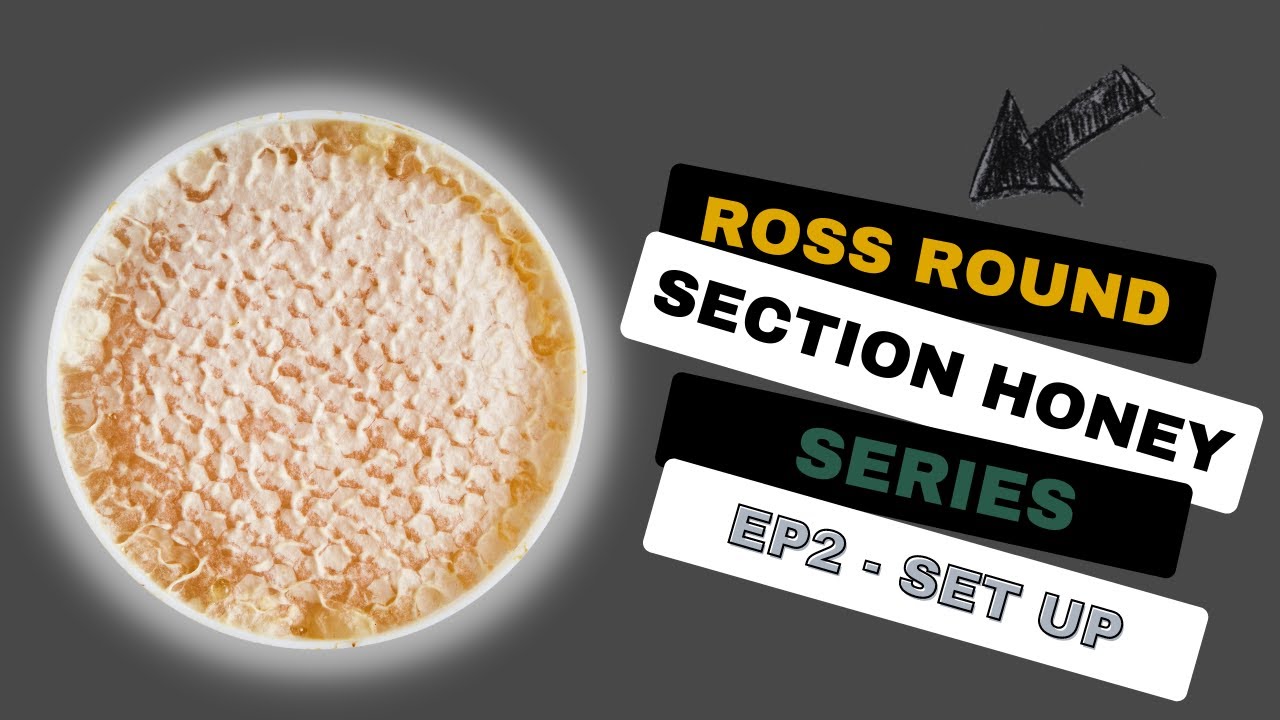
In this instructional video, Laurence Edwards explains the complete process for preparing a bee colony to successfully use both wooden section racks and Ross Round section racks. He begins by emphasizing the need to select a strong, possibly merged, colony and to time the installation early in the season—preferably before major nectar flows such as oilseed rape. Edwards details how to condense the colony by removing supers and placing the section rack directly above the brood box, between a queen excluder, to force the bees to work the rack. He contrasts the behavior of bees in Ross Rounds (which they draw out into corners more readily) with standard wooden section racks (which often leave corners empty). He stresses the importance of creating a congested colony that triggers a swarming impulse, using a short 3‑4 day window of strong flow, and ensuring good weather so the bees will draw out wax and later cap the sections. The video concludes with a preview of a follow‑up episode where the racks will be installed and the full cycle demonstrated, and a recap of the key steps: choose a strong colony, possibly merge colonies, place the rack directly above the brood, condense the hive, and rely on favorable weather for a successful harvest.
Chapters
In this video, we're going to talk about how to set up your colony to take both a wooden section rack and a section rack with Ross Rounds. So I'm combining these 2 videos in this series because the process is absolutely identical. You don't need to see 2 identical videos showing you the same thing. But what I'm going to talk to you about today is how to set up your colonies to make sure that you're going to get the absolute best from your section racks and your Ross Rounds. Now, Ross Rounds aren't quite as difficult because of the shape of the actual Bees draw those out a lot better and they tend to go all the way up into the corners. When you're dealing with the section racks though, it can be a little bit more difficult and the bees tend to kind of draw out just the middles and they can leave the corners. What I'm going to do in this video though is show you how to select a really good strong colony, talk to you about the time within the season when you're likely to go and put these section racks on, and then talk to you a little bit about timings throughout the rest of the year. In the next episode of this series, we'll actually go and put some section racks on, Wooden section racks and some Ross Round section racks, and then we'll get the bees working them as soon as possible. So in terms of any of these section racks, what you need to do is you need to give the bees absolutely no other choice other than to go into those section racks and to do some work. If you've got a colony of bees, say, in the middle of summer on a double brood box and it's got 4 supers on, and you go and put one of these section racks right at the top of that stack, the bees are just going to kind of laugh at you and say, absolutely no chance, we're not going in there. And they might go in there and do a little bit, but they're really not gonna make much of a dent in it whatsoever. You need to get that colony as close as you possibly can to the point where they are congested so much that they're going to swarm. At least you need to start it off like that. If you don't, the bees are very likely just to leave it completely. I know some people, some bee farmers that use this to do heather section racks, and what they do is they just get a massive colony and just shake it all out into a single brood box and condense like 4 or 5 supers down into the section racks. It's a very risky way of doing it, but it does work. And ultimately you're doing exactly the same thing, which is you're giving the bees absolutely no choice other than to go and work in those boxes. We'll cover that later on in this video. What I would also say though is do it as early as you possibly can throughout the year. So don't kind of go in middle of August and say, right, I'm going to put my section racks on now, unless you're working with the heather and then the timings are based around the forage. But if you're just doing this just to get yourself some nice spring honey or summer honey, preferably not near any oilseed rape, that goes without saying. If you're near oilseed rape, seed rape, do not do it until all of the oilseed rape is completely gone. Luckily for us around here, we don't have to worry about that, and our spring honey really doesn't set very quickly at all. So I'm quite confident going in doing it early in the season. You need to check that for yourself though. If your spring honey does set and granulates quickly, you really don't want that to be forming in your sections. So you're much better off waiting until the spring harvest is out of the way and then doing this the first couple of weeks of the summer harvest, just after the June gap. But the process is exactly the same. Condense the colonies down, Get the racks directly on top of the brood frames in between a queen excluder and force the bees into those sections. And then you just need to pray for good weather. If you follow all of those tips there, you should have a really good chance of getting a nice crop in these Section Max. I've done these a couple of times, both the normal Section Max and the Ross Round Sections, and I've never had an issue. The big thing for me is condensing that colony down, getting it to the right size, and then also just getting the right weather as well. If you don't get the right weather, the bees are not going to draw it out. And if you don't condense them down, they'll go up into it, but you won't get the perfect formation right up into the corners, and you won't get them properly capped over at the end. So in the next episode of this series, I'm going to break it down. I'm going to do the section one on its own. I'll do the Ross round one on its own. And at the end of the year, we're going to stitch all of these videos together, and I'll show you from the very beginning to the very end for Ross rounds and wooden sections. So just to summarize what you need to do, Identify your biggest, strongest colony. Don't do it on a weak colony. If you need to merge 2 colonies together to get a super big strong colony, you can do that. That's no problem. You need to make sure that you're putting the section rack directly above the brood box. Doesn't matter how many supers you've got on there. Don't go putting it at the very top. Put it directly above the brood box, 'cause that's where it's likely to be the most warmest, and that's where it's likely for the bees to draw it out with good numbers of young bees. The next tip is to make sure you're condensing that colony down suitably. So if you're doing this in the middle of summer, and you've got them on, say, like a double brood configuration of 4 supers. What I would suggest you do is take away some of those capped supers, maybe 2 or 3 depending on the time of year, replace it with this section rack, and you're going to force the bees into working it. You don't need to leave the bees like that for a long time because you will trigger the swarming impulse, but at least for like 3 or 4 days over the course of a good flow, and that will get the bees drawing it out. Once you've got it drawing out wax all the way up into the corners, you can just treat it like a normal super. Keep it down low, close to the brood box. The bees will cap it over when they're ready, when the nectar's down to the right moisture content, and then hopefully at the end of the year you have some very nice section racks or Ross rounds to sell.