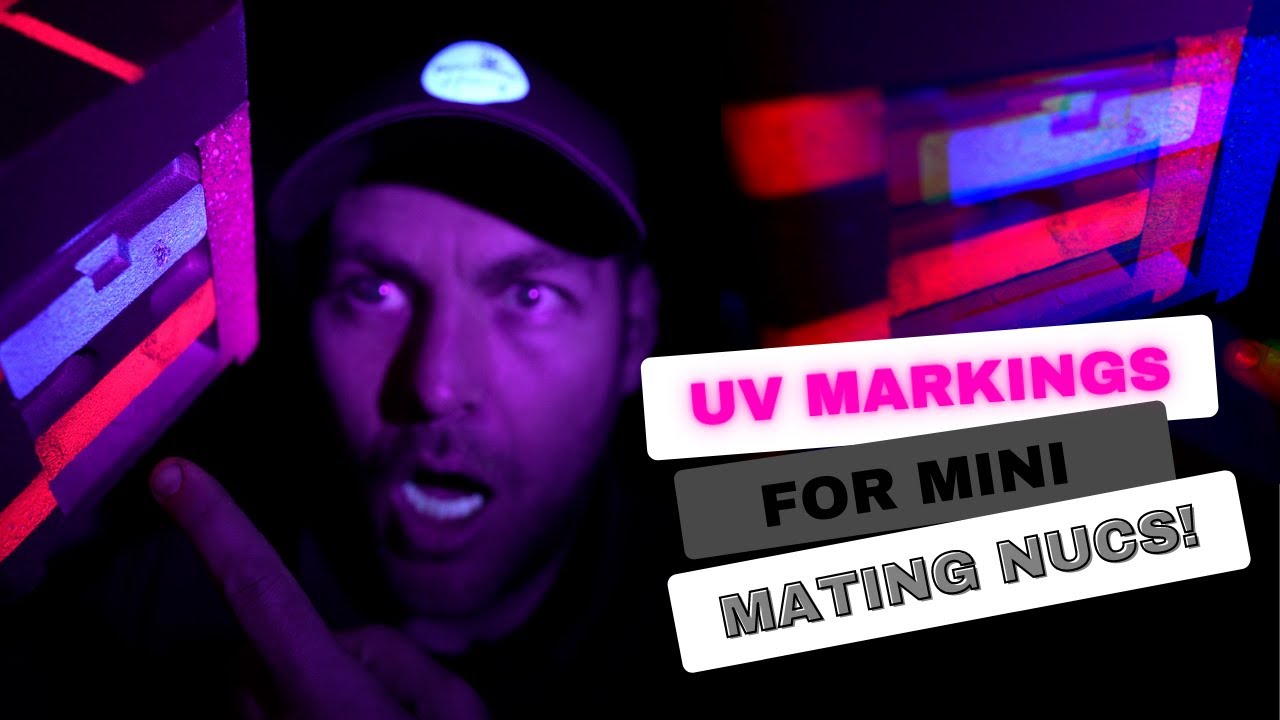
Laurence Edwards uses UV-reflective paint on mini mating nucs to help bees find their way home. Bees navigate by high-contrast landmarks and see ultraviolet light, so he painted each nuc with different UV patterns that glow under a UV torch. The setup costs about £60 total and he plans to test it on all his mating nucs this season.
Chapters
So this must be a really, really scary image, but I'm going to use this torch to try and give my queens the best possible chance of returning to their mating nucs. In this video, I'm going to show you a really cool experiment that I'm doing where I'm putting bespoke shapes on the front of mating hives in order for the bees to be able to navigate their way back to each individual hive. But these markings have a little bit of a special trick up their sleeve, and that trick is that they're painted on with UV reflective paint. So when queens go out to mate, and when bees go out and they do orientation flights, they use various different methods of finding their way back to their hive. The orientation of the hive is really important. Any clear landmarks around, like trees or power lines, all really important. But also any clear, distinct, high-contrast shapes that you can put on that hive do help the bees find their way back to their hive or their mating nuc. So you might have seen people do this before, where on the front of their mating nuc they put different kind of codes or dashes or different shapes in different high contrast colors to try and give the bees a better indication of which mating hive they need to go back to. It's widely regarded that that is really good practice and the bees are able to distinguish those shapes in certain high contrast colors. I'm going to take that a step further though, and I have not seen anybody do this yet, but I'm going to take the mini mating nucs, I'm going to put those shapes onto them, I'm going to do it on some normal nucs and some hives as well, but I'm not putting them on in any old high contrast paints. I'm putting them on in a special UV reflective paint. So if you take a look at this nuc box here, this is one that I'm just playing around with, but as you can see, we've got a bit of a purple strip there, a pink strip there, and then 2 different colors here, and then a dash at the back like that. Now if you were to put that on in any old normal color paint, as long as it was high contrast, the bees should be able to see it. And I'm talking about this like so confidently, like I think I know how this is going to work. I'll get it out there straight away, this is Definitely an experiment. But what we do know is that bees are very, very good at seeing in the UV spectrum. So these paints here, these aren't just standard paints, they're UV reflective paints. And the way that I'm gonna show you that is by using this. So that'll be really interesting to see what that's doing to the camera there. Probably break my new camera. But this is a UV reflective torch. So if I take this, this is the back of the nuc, and I shine my UV reflective torch onto just some paint that I was playing around with, you can't really see any reflection going on there. Just looks like a little bit of a purple light. Now if we turn that around using the UV reflective paint that I've put on there, and then I put this light onto it, look at the reflection that you're getting back from that light there. It really is quite astonishing. And even more so, I'm gonna show you this now with the lights off, because when you do this with the lights off in the pitch black, it is absolutely outstanding how reflective those shapes are, and it gives you the impact in a different color as well. I'm gonna do that this season. I'm gonna run it on all of my mating nucs and all of my mini mating nucs. Nucs. I'm going to use kind of like a different coding system, completely random, but using different UV reflective colors on the front of each of those hives and on the top of those hives as well, to try and give the bees the best possible chance of finding their way back to their specific hive. The bees can see in UV light, we know that. The paint that I'm using is UV reflective, we know that works because I've got the UV light on it and you can see just how reflective it is. It's going to cost me pennies in terms of the actual paint. Cost me £50 to buy 5 different colors of UV reflective paint, and also paid a tenner for that little UV lamp as well that you can get from Amazon. But that will probably do 200 mating nucs. You really don't need a lot of paint to put on them. I'll get some tape on, I'll tape them up. I'm going to do it to every single mating nuc, and hopefully it's going to improve the return rate of the queens. Do you think it will work? Have you seen anyone else do this before? Stick it in the comments. I think this could be a really good tool to help get more queens to return to their mini mating nucs. If you're interested to know the mini mating nucs that we're using this season, check out this video here where I'll give you a top to bottom review of the Swybind poly mating nucs.