Should I Strap My Bees Down - Strapping Bees for Winter - How to Strap Down Bees - Straps or Bricks
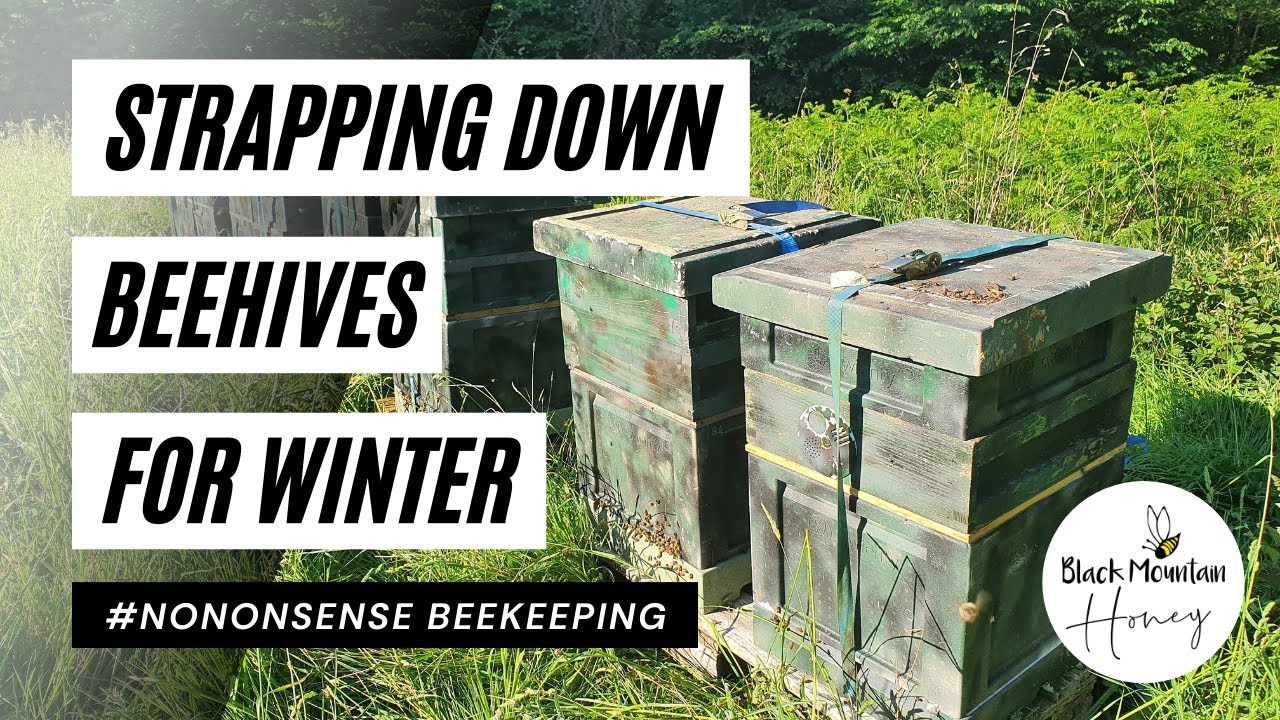
Laurence Edwards of Black Mountain Honey shows how to strap hives down for winter to prevent wind from toppling them. A knocked-over hive gives you 24 hours to rescue the colony before cold kills it. Ratchet straps work for most setups; bricks may work for heavy, low hives.
Chapters
Hi, I'm Laurence Edwards from Black Mountain Honey. Welcome to another episode of No Nonsense Beekeeping. Today I'm going to show you how to strap down your hives for winter. Now, I always recommend, whether you use a strap or a ratchet strap or a brick or anything throughout the year, I always recommend strapping your hives down for winter. And when I say strapping them down, I mean strapping them to the hive stand. And if there's any way you can add some ballast to that hive stand as well, That is what I would recommend. So in this video, that's all I'm going to show you how to do is how to ratchet strap your hive down to make sure that it doesn't get blown over by the wind and it gives your bees the best chance of getting through the winter. Now, these colonies that I've got here, they're wooden roofs, they've got a wooden brood box, and there's a poly floor. Now, I've got these strapped, but I don't have these strapped down. Now, I think even if I didn't have a strap on these colonies, They're on a very low base. They're just on a couple of wooden pallets, and I've got a brick on them as well. So these ones, they're not strapped down for winter. This is just my kind of normal configuration throughout the year. I don't normally have the brick on it, that's just randomly there. But I just kind of keep everything strapped together because normally I'm using poly kit, I'm not using the wooden kit. So if you've got a setup like this where you've got a low hive stand, maybe kind of 30 centimeters high, maybe a pallet or 2, and you're using a fully wooden setup, so you've got like wooden floor, wooden brood boxes, and it's heavy because it's full of bees, wooden roofs, then I'd say you can probably get away with just a brick on the top. That's the bare minimum that I would suggest, but with so much wood and so much weight, as long as they're not in the middle of a field where they can potentially get kind of bashed over by a cow or something like that, I would say that the bees will stick all of that together and the chances of it getting blown over by the wind, relatively slim. So a hive like that, I would say just put a brick on and they should be good to go. Now, a hive like this one here, this is our BB Ware sponsored hive. This is a poly roof, poly feeder, poly brood box, and a floor. And you lift this one up. And it's really heavy, like it's really heavy. That's on 3 pallets high, but you kind of look at it and you look at the center of gravity of that and you think, is the wind gonna come and blow that over? And like, it's not, the chances of the wind coming along and blowing that over are pretty much like zero. I just can't see it happening. Obviously I've got my ratchet strap on there, So the poly roof can't just blow off, because that's the big reason, do you know what I mean? You put your bricks on and stuff like that. There's 2 aims that you're looking for here. One is to keep the hive all together, so all of the components of the hive, the floor, the brood box, the roof. I use a strap all the way throughout the season to keep everything together, because even in the middle of the summer you will get gusts that can kind of blow off a roof. Now on this one here, if you're not interested in using straps and you don't like straps, A brick will do, and I think this colony here, that would be fine like that without a brick, but just kind of for my own sanity, I like to strap these ones up as well. So on this one here and all of the rest of them along here, I just put a simple ratchet strap on, and I would just lift the whole hive off, ratchet strap it up, and then put it back into position, and that's all I would do with that. And then what you've done is you've ratchet strapped the whole hive together, Nothing can come apart, and then the wind, do you know what I mean, it can't, it can't move it. It's just too heavy to go anywhere. So for hives like this, I would suggest just ratchet them up, or as a very minimum, put a brick on it, and that should keep it kind of in situ and not blowing over by the wind. Now then, we move on to single-story nucs. Now I always think a single-story nuc should be strapped Down to something. And what that means is that you try and lift that up and you can't lift it up. And the reason that you can't lift it up is because that strap is not just around the nuke, it's around the floor as well. So in this instance, it's strapped around a pallet. So if I try and lift that, I can't because it's strapped down. So that means that any direction whatsoever, that can't go anywhere because it's fully strapped. And that's going to give me real strength throughout the winter. So if you've got a single-story nuc, I would suggest definitely strap it up with a ratchet strap as a minimum, and I would also suggest strapping it down to your hive stand, and then that way there is nothing that can kind of move it or budge it even in really, really high winds. And then the final configuration we're going to talk about, these are the 2-story high nucs. So these are like a 12-frame nuc, These are the ones that are going to fall over. The center of gravity of these is a lot higher than the rest of them due to their kind of shape and their size. So your center of gravity is considerably higher, which means that it only takes a considerably less amount of force from the wind in order to topple them. So I've had colonies like this topple in the past. I've had it happen in the summer. These are the ones— always, always strap them up. And make sure that they're strapped to the thing as well. So you can see that it can't go anywhere. It can go a little bit that way, but then it can't go, and that way can't go anywhere. It's fully strapped down. And I've done that by taking the ratchet strap, feeding it down underneath the pallet, and then just making sure it's nice and tight, as tight as you can get it. Maybe damages the poly a little bit. You get dents and marks, but you get the safety and security of knowing that even in the strongest winds, Your colonies aren't going to topple over. So that's it for the video. I really wanted to kind of get that video out to everyone and show you the different methods that I use for strapping up hives. I know we didn't do like a full demonstration of it, but it's pretty straightforward. The only difference is, is on those taller hives, on the taller double-story nucs and the nucs, I just feed that ratchet strap underneath the pallet, underneath the hive stand, just to connect it all together. which gives you kind of greater stability and avoids those hives falling over in the winter. So I suggest everyone get out there now and strap up your hives, or if you're going into the winter period, make sure they're fully strapped up. Gives you the peace of mind that they're not going to get toppled over by the wind. If they get toppled over by the wind, you've probably got 24 hours max to save them, because if they're toppled over and the boxes break open and then it's like -2 or whatever at nighttime, You've got kind of zero chance really of saving that colony. So unless it's in your garden, if you've got it at an apiary, you'd be incredibly lucky to find them in time enough to save the colony. So take the precautions, get the straps on, make sure they're protected from the wind, get those colonies through the winter. So as always, thanks for watching my videos. Hope you've enjoyed this one. Please hit the subscribe button, please hit the bell so you're notified of every video. I'll see you next time. Bye.










