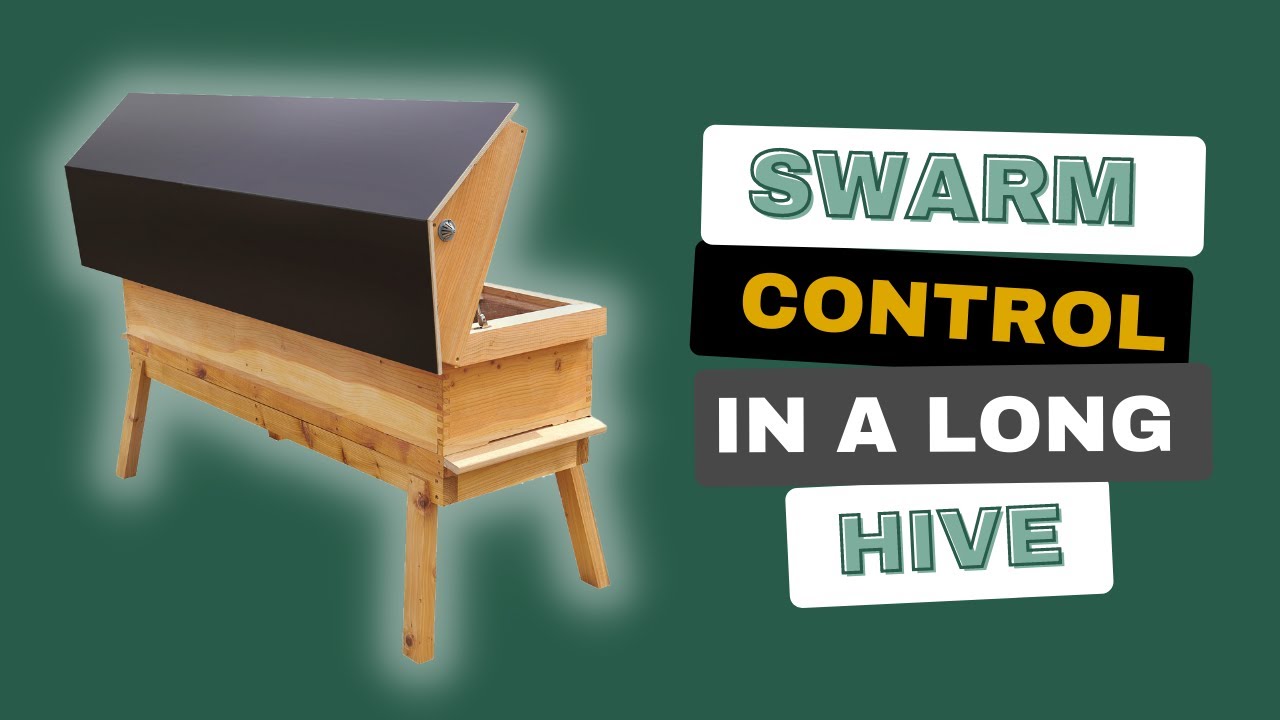
In this tutorial, Laurence Edwards presents a straightforward, early‑season swarm‑management technique tailored for long (horizontal) hives. After acknowledging the effectiveness of Cayman Reynolds’ pull‑back and checker‑boarding method, Edwards proposes a simpler alternative: taking a modest 6‑frame split from the parent colony and placing it into a Payne’s poly nuc. He details the preparation—selecting two frames of brood, a frame of stores, a frame of foundation, and the mated queen—while leaving the original hive queenless to induce a brood break. This queenless state also creates an opportunity for a spring varroa treatment before the new queen is introduced. Edwards explains how the split reduces colony size, buys time before the bees outgrow the limited space of a long hive, and can be sold or used to start a new colony. Throughout, he emphasizes the constraints of horizontal hives, the importance of managing brood placement and honey storage, and the practical benefits of his method for both swarm prevention and apiary economics.
Chapters
In this video, I'm going to show you a really simple, easy swarm management technique for a long hive. Now, I'm just like you, I watched the recent Cayman Reynolds video on how to do swarm management in a long hive. What he did was a pullback and combined that with checkerboarding. Absolutely genius, what a great idea. Without a doubt, I'm going to be using that in some of my long hives. In this video, I'm going to show you a slightly different, slightly simpler technique than that. And okay, I'm calling it a swarm management technique, But what we're really doing is we're going to take a split out of the long hive. And the reason that I'm doing that in this apiary is that we're at an apiary here where we get quite a lot of heather. They get quite a lot of summer buildup, and I'm not overly fussed about the spring crop that comes in here. Not a massive spring crop, and I find that the bees get very big very quickly. And in a long hive, you're always battling against space. Not like a standard vertical hive where you can just keep on stacking it up, keep on going as high as you can go. You can do vertical splits, you can really manipulate that colony quite easily in a vertical hive, where in a long hive you're quite limited to what you can actually do in terms of that manipulation. And the restriction that you've always got is a finite amount of space. So the Caiman Reynolds video where he did this pullback and where he did the checkerboarding, I really did like it because it combined 2 very effective methods for a long hive. One is you're determining the movement of travel for the colony, And what you want in a long hive is you want all of the brood as far back as it can possibly go, and you want them to store honey at the front. Sometimes bees do strange things in long hives, which is if you've got all of the brood at the front, which is predominantly where it kind of tends to end up over winter, I guess so it's as close as possible to the entrance. But that move back is a really good method to kind of just slow down the bees' ability to go out and swarm, gives them more space to actually store some honey. And then combining it with just a standard checkerboard, which is putting some frames of foundation in between the frames of brood, gives them some foundation to work. I really like that method. However, if you've got really big, strong colony of bees in a long hive, even using both of those 2 methods, I think you're going to struggle kind of come the end of the season. I really like to see the follow-up to that video to see if he manages to mitigate the swarming impulse just by doing those 2 things. I definitely think it will prolong it, And as I said, I think it's a really, really good idea, something I'm definitely going to use, the combination of those 2. But for me, by far and away, the most effective way to manage your colony swarming in a long hive is to take an early season split. Knock the bees back, identify where your honey flow is, build the bees up for that honey flow, and try not to let them outgrow the space. That's what I'm going to show you in this video. So I'll go and get my bee suit on, I'll jump over to the long hive, I'll show you what the colonies are looking like, and we're just going to take out a straightforward 6-frame split And really knock the bees back to pretty much nothing. So we've got lots of activity at the front of the entrance here. The colonies in here are looking really, really nice. I'll get inside now, show you just how big they've grown and how well they've come out of winter. So I've whittled the colony down to the frames that are actively in use. We've got 9 frames at the moment. And the Cayman Reynolds video, what he did was he took the bees from this side and he moved them over to this side. That was his pullback. And then he interspersed the brood frames over here with frames of foundation and then let the bees move back this way like that. Really good technique. I'm going to do it slightly differently though. I'm going to take my split early in the season and then let them build up. And then what I'm going to do is I'll probably use that technique later on in the year once the bees have built up a little bit. But the bees are looking nice and healthy. They've overwintered well. These are 14 by 12 frames, so that's a really good-sized colony at this time of year. Equivalent to, say, a National Deep and a Super, something like that. Good-sized colony of bees. So I'm going to put my split into a Payne's poly nuc, and I appreciate not everybody's going to want to do this, but if you make up this split here, buy a poly nuc, £50-60, make up the split— I'm going to put the mated queen into the split— you'll be able to sell this nuc with the bees in it, absolutely no problem at all. I appreciate not everyone wants to always make up splits and they don't want to increase numbers, but if you've got a long hive, maybe 2 long hives, and you want to really mitigate warming, I think this is going to be the best way of doing it. I'm not suggesting you need to increase numbers, buy polyhives, but make the split. You'll definitely be able to sell this nuc of bees. So there's my queen, really nice white mark 2021 Buckfast queen. Very gentle, this colony. Very happy with how they've come through winter. I'm going to get that queen now, I'm going to get that onto a frame of brood, and I'm going to put that into the nuc. So really nice frame of brood on there. The queen is on this frame as well. This is going to be the frame that I'm going to take and I'm going to put into the nuc first. Brood in all stages, and then I'm going to build it around that. But the way that I'm doing it is I'm taking the queen out and then I'm going to let this colony go queenless and I'm going to requeen it. That in itself knocks the bees back quite a bit because it means that they're going to have a brood break as well. What I really like about this method is it gives you the option to do a spring varroa treatment. So not many methods let you do a spring varroa treatment, 'cause you've got brood in all stages, without using a formic acid product, something that you can use while you've got supers on and while you've got brood. Doing it this way, you knock them back, you get them hopelessly queenless, you can let all the brood emerge, and then you can knock that varroa right back as well. So first frame I'm taking out, nice big frame of brood, all of the bees, and the mated queen as well. So next frame I'm taking out, I've got another frame of brood. I'm not gonna overstock the nuc. I wanna kind of split this roughly 50/50. I'm going to take this nuc away to a different apiary so I can really manage the fly as well, make sure that both sides of the split have a good amount of bees left over. So I've got 5 big frames of brood similar to this split across the whole of that long hive. I'm going to take 2 frames of brood and bees in the nuc, and then I'm going to leave all of the rest of them plus the flying bees in the original long hive position. So that's my 6-frame split. I purposely not made that split too strong. I want to buy myself a little bit of time in there. I've got 2 frames of brood, the mated queen, 1 frame of foundation, and then a couple of frames of stores in there as well. So whilst I've taken away some really key resources from this colony in the mated queen and some frames of brood, I'm giving them back some drawn comb. I know that one there's not drawn, but these 3 here are good quality drawn-out comb that's going to save that small colony of bees quite a lot of work. Doesn't matter though, if you've got foundation, add foundation, either will work fine. This will give them just a little bit of a boost, and it means that when that new queen's in there, it gives her lots of space to lay. So this is what I've ended up with: 2 frames of brood and a frame of stores over here, no mated queen. I've filled up all of the frames. You don't need to worry about spacing a long hive because you only lose heat upwards. All of the bees are returning. They don't know what's going on. They're congregating around where that cluster used to be, but they will work their way back up to here and find that brood. So when we come back next time, you'll see that that's just all clustering around that brood. Similar in the way that Cayman did it, he pulled it back, made sure that the brood was at the back, and gives the bees the space to move this way, create the brood nest on the left-hand side, and then start to store the honey on the right-hand side. I'm confident that when we come back later on in the year, this colony will have completely filled this void. 3 frames of bees, 2 frames of brood, A couple of cycles later, they're going to be on half a box easily, and if you get a good flow, they're going to fill this up with honey. I'm confident I've not set them back too much, and I think this is a really good method, easy method, to mitigate swarms leaving your long hive. So what do you think? You think I set them back a little bit too much? I'm confident that they are going to grow and they are going to expand, and what it means is that I'm not going to lose a swarm from that colony because I've set it back so much. And the swarm that would've gone, I've got now in a nuc. I can use to go and sell, or I can use it to set up another colony. Just a little bit of proactive swarm management. If you wanna see a really good swarm management technique on a vertical hive, check out this video here showing a preemptive devoray.