Technoset Q8 Queen Castle Review
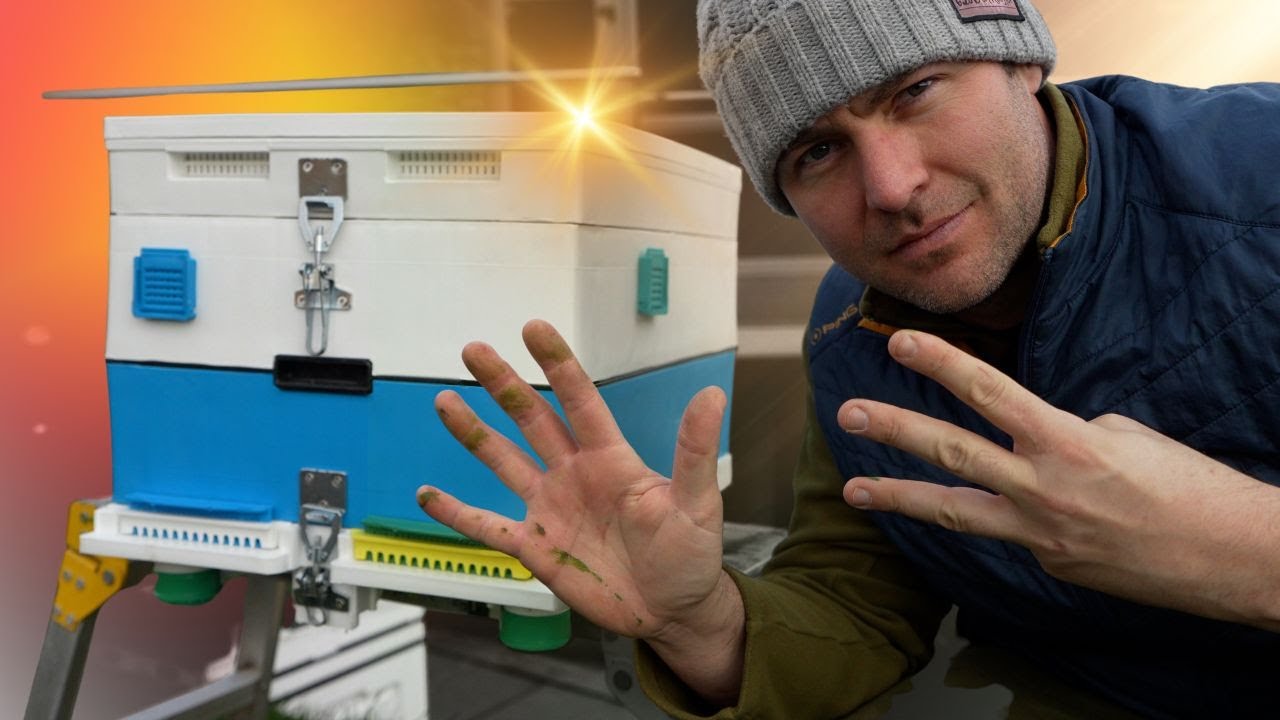
Laurence Edwards reviews the Technoset Q8, an eight-section queen-rearing hive with polyurethane insulation and eight individual feeders. The centerpiece is a three-section folding frame that clips into a standard Langstroth frame, letting you raise queens, then collapse it into a 4-frame nuc for winter. Edwards plans to stock it this season and make follow-up videos.
Chapters
In this video, I'm going to show you the Q8 queen rearing hive from Technoset. Now Technoset have very kindly sent me this hive free of charge, but obviously, as always, my views are my own and I get to say what I want. First impressions are it's a really nice, well-made hive. Rock solid, really, really tough polyurethane insulation, and then it's got like a hard plastic coating around it, very similar to the NL beehive design. However, this is not just a standard beehive. This is a very specific queen rearing set. Setup. So the idea here is that you have 8 little mini nucs all in one box. Some people like to call that a queen castle, but the Techniset design has a hidden trick up its sleeve, and it's something that I really, really do like. So let's get inside, take a look at the hive. So it's got a nice simple design, blue and white, and then you can see around the edges you've got all of these different entrance blocks. So an entrance block there that you can fully close up, and I think you can switch them out for queen excluders as well. And they do just flip down so you get like little mini landing boards for each of bees in each of these different compartments. Don't worry, we'll open that up in a bit and you'll be able to see inside. But you can see at the front there you've got 2 standard entrances as well, and then around this side you've got further entrances, and then on the back you've got another 2 entrances. So the Q8 obviously stands for the 8 entrances around the side, and then you've got the 2 main entrances that work in a slightly different mode. So you can see these entrances here, you kind of pull them down, and then I think you can like chisel out the plastic to run that as like a queen excluder setting. So if you've got like a mated queen in there, You can put it up so the bees can come in and out but the queen can't. And there's queen excluder settings inside as well that you can use. But if that's not the case, and we'll find out in a little bit, then all that is there is a lovely little landing board. It's quite handy, nice little retractable landing board, good quality plastic there as well. And everything at the moment feels really nice, like good quality plastics, nice and hard. Obviously I'm going to run this this season, see if we can get some queens mated in here. But I like the fact that all of the plastic is really nice and rigid. Now another nice little design feature here is the straps that they have. That means that the lid's not going to come flying off anywhere. You can see they're really simple to use. You can kind of tighten it up like that if it needs tightening or loosening, and you just want to get it to a point where it's going to kind of create that tension. You can see I've taken too much off it there, so I'm going to put it back down again, and then you'll feel a really nice little click. Very nice and solid. So also you can see on the outside there you've got some vents. Not a massive fan of vents in the top like that, but of course you can block them off if you need to. But queen mating nucs are slightly different to normal And if you don't give them the chance to be able to ventilate it properly, there is a chance they can abscond. So good idea to have those vents in place. So let's open it up and take a look inside. So the roof comes off nice and easily once you've taken those straps off. And as I said, hard plastic coating, polyurethane insulation in there, so the bees are going to be really well insulated in there. Nice heavy weight, like all of this is good heavy weight. That's not going to blow off anywhere. And for anybody who's used like mini mating nucs before, is one of the problems that they have is that they're super, super lightweight, very easy to blow away. And even if you just put a brick on them, they can completely go in the wind. So this item here, really nice, definitely not going to blow away anywhere. So taking the lid off there reveals 8 separate little mini feeders. You can see the bees will come up in the middle there, and then you've got access to kind of put syrup in there and to be able to put fondant in there as well. Really nice that you've got individual feeders. And again, the quality of the plastic here, really top quality plastics. Now what you'll see in each one of those pink boxes as well, the pink feeders, is a little queen excluder setting. You've got like a full queen setting and then you've got a queen excluder setting. So this side here, that's the queen excluder setting. And then this side here, that's the queen mating setting. And then as expected, these just slot into these holes here. Really nice, simple design. So once you've got your queen cell in there and the virgin's emerged, she wants to go out and mate, you use it on the big settings, then the queen can get in and get out. And then as soon as you've got eggs in there, you can take that back out. You want to trap your queen in there, you revert to the queen excluder setting. Really, really simple and nice design. So then if I flip one of those feeders upside down, you can see that is the entrance slot where all of the bees go up, but they've also got a secondary slot over here that relates to the yellow bit of plastic here. So when I switch it back over, the bees will come up and they can basically access the sugar syrup feed on this side. But then if you want to feed them fondant, you can place the fondant directly in that section there. And the bees can access it via those slots. And then when you don't want the bees getting up in the roof, you just close that yellow flap there and it keeps it all nice and secure. A really well-designed, versatile feeder. Really, really like that. So when I take that feeder off, you look inside and it looks like you've got 3 frames in there. But this is where the TechnoSet is a little bit different. It really does have an amazing little party trick here. So when you take out these 3 frames like that, and again, it does look like there's 3 frames, you You can see we've got a hinge on this side here, and basically what it is, is it clips out into one single frame. Now, my pet hate with mating nucs is the fact that they run on like a different format to basically everything else that you're using. So you might be on like national frames and you're using like little mini mating or mini plus, or you might be on Langstroth frames and you're kind of shaking them into Apidaias, and there's no cross-correlation between the mini size frames and the big size frames. That's what Techniset have developed here. So they have put together a folding frame that does require like a little bit of work to get them in together, and I'm doing this without kind of any brood or anything in the inside. It might be a bit tricky to do this when they've got brood and bees on them, but basically all 3 of those sections clip together like that, and that forms a single standard size Langstroth frame. Really, really clever. I do like that development. And what it means is that you can take these frames, you can clip your foundation into them, they take like plastic foundation with wax coating, you can put these frames directly into like a standard Langstroth box, get the bees to draw them out, stick them onto like a brood area, get 10 of these in a single Langstroth box, and then once they're drawn out, they've got brood in them, they've got honey in them, got stores, you can just declick them again and you've essentially got all 3 of your frames ready to go. It means stocking this hive is going to be such a breeze compared to doing it like an Apidea or a Mini Plus where you've not got that frame compatibility, so you're shaking bees in and trying to get them to feed, really likely that they'll abscond. And for anybody who's used mini boxes before, you will know the earlier that you can get brood in there, the easier it is to get the bees to stay in there. This design means that you're almost certainly going to be able to get the bees to remain in there without So you can see there I've got the licensed standard nine frame poly Langstroth box, and all I've done is I've just taken that frame out, that Techniset frame, unfolded it, and as you can see, it fits nicely in there. It's not perfectly straight, so I'll be interested to see how the bees react to that. But I'm sure once you get all of them in together, the bees will work them just fine. So I love that development, and luckily I've got loads of Langstroth hives now, so it's going to be really easy for me to stock this Techniset Q8 with bees. I'll take out all of the frames. There's eight sections, so I'll have eight frames. I'll stick them on the top of a double brood Langstroth configuration. I'll feed them up. I'll let the queen lay into this new comb, get it all nicely drawn out, bees and brood and stores, and then I'll collapse them all back down again and I will stock the QA, take it to a new apiary, and then I can immediately start raising new queens in here. So that's how I'm going to get it started off, but you'll see in here there's additional flexibility in that system as well. So I've taken all of those feeders off there. I've got 4 sections, each with 1 Langstroth frame split into 3. But if I start taking out these dividers, I can merge all of those frames together there into a single colony. That there is going to equate to a 4-frame Langstroth nuc going into winter. The perfect configuration to overwinter these. So in the first year they're going to be really easy to set up, but in the second year they're going to be even easier because I'll be able to overwinter them in this configuration. Now if you compare that to what you have to do to other little mini mating nucs or Apidaias, they're basically only good for the season. You can overwinter them, but you're not going to get a huge amount of success, and it's definitely a faff to overwinter them. The Q8 here does away with all of those issues, and I have to say I'm really, really excited to give it a go. Now if I take out all of the frames from that section there, you'll see at the bottom you've got a really open mesh floor. And again, with small mini mating nucs, this is really important. It means that you're lowering the chances of the bees absconding, and the fact that the rest of the hive is so insulated should mean that the bees are going to really, really like it in here. So putting it back together again is just as simple as taking it apart. Basically pop all of the frames back in like this, and then you just get the plastic dividers and they just slot straight in like that. Really, really simple. I'm very happy as well that they've used this kind of like Solid plastic as a divider. There's no Correx. There's nothing that's going to buckle. All of this plastic here is top, top quality. You can feel it. It's solid. Definitely not light, but that's what you want for something like this. You don't want it to blow away, and you want it to last for a long, long time. So you can see once you've populated this with bees, you've got all of those separate entrances, which means that the queens can go out, go and get mated, and they come back to their respective section here. So it's compartmentalized into. 8 separate sections, and then those 2 entrances at the front give you the ability to overwinter in 2 4-frame Langstroth formats. So there we go, that's the first look at the Techniset Q8. I'm going to have so much fun with this hive this year. I'm going to stock it full of bees, I'm going to raise some queens in it, and I'll do follow-up videos throughout the year.










