The Birth Of A New Beekeeper
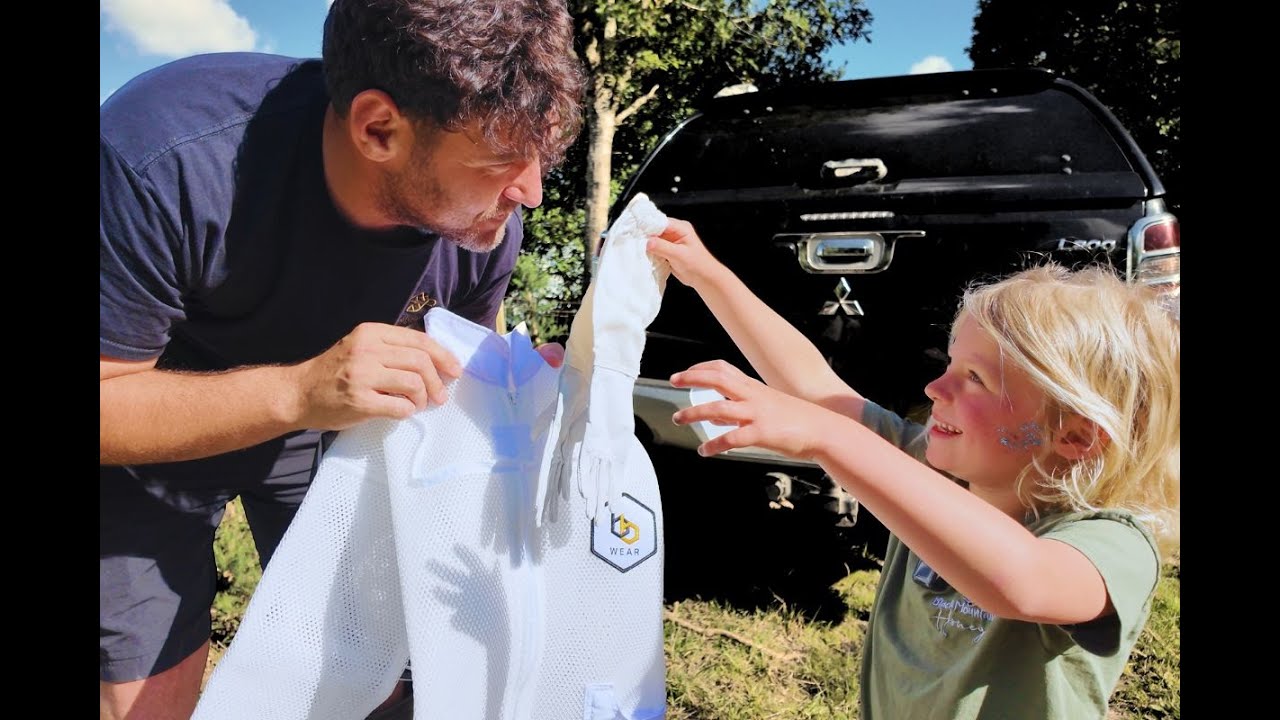
In this family‑oriented beekeeping vlog, Laurence Edwards introduces his six‑year‑old daughter Ivy to the world of apiculture. The video opens with Ivy being suited up in a BBwear Ultra Suit – a full protective ensemble (suit, gloves, veil, wellies) that Laurence praises as the top choice for children, noting the sponsor’s provision of the gear. After the safety gear is on, Laurence guides Ivy through a step‑by‑step hive inspection, teaching her the three bee castes (queen, drones, workers) and their roles, and prompting her to recall them. Together they examine hive frames, identifying wood foundations, honeycomb, beeswax, stored honey, pollen, eggs, and larvae. Ivy learns how the queen lays eggs, how larvae develop into adult bees, and the concept of capped brood. The pair engage in interactive challenges – locating the queen (identified by a number on the cell), spotting a “boy bee” (drone) among the workers, and counting bees on frames – encouraging viewer participation via comments. Throughout, the dialogue balances educational content with playful banter, acknowledging Ivy’s nervousness and excitement, and Laurence’s own early‑career anxieties. The video also hints at future plans: creating a nucleus colony (nuc) for Ivy to manage in a later episode, and promoting Black Mountain Honey Nucs as calm, kid‑friendly bees. The narrative blends safety instruction, basic bee biology, hands‑on observation, and family bonding, aiming to inspire other families to start beekeeping together.
Chapters
Today is Ivy's first day being a beekeeper. I think I'm a little bit more excited than she is. So today in this video, we're gonna get Ivy in her BB Wear Ultra Suit. We're gonna get her all dressed up, suit, gloves, and we are gonna go and meet the bees. Now there are 3 different types of bee. Can you remember what they are?
Queen, drones, and workers.
The other ones?
The girls.
The ones that do all the work?
The girls.
The girls. And is it fair?
No.
Why not?
Because the girls have to do all the work.
And what do the boys do? Nothing. Are they lazy?
Yes.
Whoa, they are a little bit lazy.
Like you.
Excuse me. Right, that is it. We're gonna— time to get our bee suits on, I think. Yeah, so Beeware have kindly provided this suit free of charge for Ivy. But you know what, even if they didn't provide it free of charge, this would be the one that I would have bought. When your children are involved in beekeeping, you want that absolute number one protection for them. And I know firsthand, after years of experience using this bee suit, this is the number one bee suit to protect your kids. Should we get it on? So why do we put bee suits on?
So we don't get stung.
So you don't get stung. And have you ever been stung by a bee?
Yeah.
Where did you get stung?
At our house, because we have lots of wasps.
Is it a wasp or a bee that got you? Wasp. Right, you—that is a very good fit, isn't it? So that one there is a size six ultra suit. Yeah. Got a little bit of growing left to do in that one, haven't you? But that is really, really good, right? Well, no, we don't need wellies, do we? Oh, we do. We do need wellies.
Okay. So how's that?
Good. Does it fit nice? Yeah. Should we go like that? You ready for the bees now? No. What's that? The what? Veil. Oh, the veil. Very good. Da da da da da da da da da da da da. You are now officially a beekeeper. So today we are going to do some beekeeping. Ivy's going to find the worker bees, she's going to find the queen bee.
And maybe we might make me like a little beehive.
And maybe we're thinking one day, maybe not in this video but maybe in the next one, we'll make Ivy a little split. We'll take some bees and some brood and some pollen and some nectar, and then we'll give them a queen bee, and then you can have your own beehive. Good idea?
Yeah.
Right, we're gonna do that. Right, what Do I need a bee suit?
Yeah.
Do I need one?
Yeah.
Should I get my suit on? Yes. Okay, 2 secs. So I know Ivy is excited about this, but I am so, so excited about this. Ivy has been asking to come beekeeping with me for years now, and it is about a week and a half past her 6th birthday, and you know what, the time is right for her to start beekeeping. So we will do many videos of Ivy and Laurence doing beekeeping together. This hopefully is the start of a long career in beekeeping. Right, so are you excited? Yeah. You want to tell me everything you know about bees first? So the boy bees are called drones.
Boy bees are called drones. In all hives there will always be a queen bee.
There's always a queen bee, yeah. And what does the queen do? Lay all the eggs. She lays all the eggs, doesn't she? And is she tiny or is she big? Big. She is big, isn't she? And sometimes she has a little dot on her back. And what else does she sometimes have? Numbers. A number. Do you think the one in here might have a number?
And We were thinking about putting a number on the box and a number on the bee so they know which hive to fly into.
So Ivy had a really nice idea, which is take the number on the back of the bee and you put it on the box, and then she knows what her address is. Great idea!
Yeah, I was thinking if we put a number on the bee and the same number on the box, then they'll know what box to fly into.
I really think that's a great idea. High five! Right, you ready to get inside?
Yeah.
You scared?
No.
A bit nervous though? Yeah, I'm a little bit nervous as well. Do you know, I was super scared first time I did this. Yeah, I'm just saying you'll veil up. Oh, that was a good thing that Ivy reminded me. Right, veil up and we will start the first ever Black Mountain Honey Beekeeping with Ivy and Laurence. Oh yeah, let's do it. When I open this up, lots of bees are going to come out, but don't be scared because you've got your bee suit on. They can't get into your bee suit. This is, this is the best bee suit in the world. The bees can't get through it. You've got your gloves on, you've got your veil up. So you're well protected, okay? So for the eagle-eyed people out there, Ivy isn't actually that tall at 6. We've got a little stand for her so she can see up over the top. But let's get inside. So first thing we do, Ives, is we undo the ratchet strap. Yeah?
Well, I am really scared.
You're nervous? Oh, love, don't be nervous, it's fine.
I'm scared of this.
Say again? Right, so they won't come out straight away because I'm going to take the lid off, and then that is the roof. Yeah, so we put the roof over there. And then this is a little feeder that you put feed in for the bees when they need a bit of feed. Look like they do need some feed. And look, if I open this up here, you may be able to peek down and see some bees down in there. Yeah. Can you see them? Yeah.
So is there a little hole there so they can come up and eat food?
So there is a little hole there, and you can see the bees through that hole. Yeah. Right, you ready? Yeah. Yeah? Ready to do it?
Yeah.
Da da da da da da da da da da da da. What do you think?
Good.
So how many bees do you think are there? So let's have a look at some of these frames first. So you know about beehives?
Yeah.
And then you know what these frames are made of?
Wood, because I see you making them.
You do? Daughter of a beekeeper, she will always see me making them. And then what's this bit in the middle here?
Honeycomb.
Honeycomb. And they make that out of— remember?
Oh, I see some bees in between it there too.
Yeah, so So the few bees on there, so this is what the bees will use for their home.
Yeah.
And do you know what, if you smell it, does it smell nice? What does it smell of?
Honeycomb.
Honeycomb. So it's made of beeswax, that is. So then what the bees do, get a few more bees on that one.
Whoa!
Yeah? Do you want to hold that frame?
Yeah.
So all you do is just hold it by those bits there, and then you can just have a look.
There definitely won't be the queen on there because they're like busy workers.
Because they're busy workers. So there's not a huge amount going on On that frame there, that's just like one of the starter frames. So as the bees grow, they start to turn the foundation, that beeswax, into honeycomb.
And there's also another side.
And there is another side as well. So what is inside the honeycomb there?
All sorts. If you can see now, there's like a little white bit.
There's a little white bit in there?
Yeah, see, it's white there. So that is where they turn the yellow beeswax And sometimes they might lay eggs in those, Dad, I don't know.
Sometimes they might lay eggs in there, they will. So they use all of their honeycomb for exactly the same thing. So they'll use it for storing honey, they use it for storing pollen, they use it for storing eggs and larvae. Do you want to hold that one?
Yeah. And some bees are—
So is that one a bit heavier or not?
A bit heavy.
A bit heavier?
Yeah, because there's more bees on it.
More bees on it.
Bees can just see some types of colours, not so many though.
That is true. I think they can just see 4 colours, can't they?
Well, Dad, you don't have to be land on your phone. I can see all their colour stripes a bit.
What colour stripes have they got?
Oh, I can see— I saw some— I saw a little beekeeping in the— to a bowl of its little red thing.
Yeah?
I see something really funny. They made like a little entryway.
They do. So what they do is they make little entrances kind of in the corners and anywhere really. There's one at the top. So they can get around.
This one, huh?
Hold that one. Hold it. Yeah, I'll get you out another one in here that you can hold. Did you enjoy holding it? Yeah. Oh wow, you're so good.
Well, that one's even busy. That's really busy as well. Really busy. It's like a town of bees. Oh my goodness.
Wow. Right, so you have a look at those big— what is that? It's got a 30 on it. A 30 on it? So what— why has one of them got a 30 on it?
Because it's the queen.
Do you want to hold the one with the queen?
Yeah.
Tell you what, you hold it that way and then I'll be able to show the camera. So you hold it nice and steady. Right, so you tell me about a queen. What does a queen do? So if I don't— you know, go on, what does the queen do?
Lay the egg.
She lays the eggs, didn't she? So let's have a look at that.
I think I know why they might— the queen might be on there.
Why?
Because, you know, I said before they lay the eggs in there. Yeah.
So she might be laying Right, so if the queen is on there laying some eggs—
Yeah, there are lots of bees near me.
Lots of bees near you, but they're being nice and friendly?
Yeah.
That's good. Right, so—
I'm trying to get one to land on my finger.
You want to get one to land on your finger? I'll show you a really good way at the end to get one to land on your finger if you want. Right, so look around the edges up here.
Yeah.
What's in there?
I think there's some eggs.
Is that eggs?
Honey!
Honey! So they put honey around the edges like that.
I think—
And then in And in the middle, if you look right in, can you see little tiny eggs inside?
Yeah.
Little tiny— they look like little Tic Tacs, I always think.
Yeah.
Yeah, you can see them. So we've got honey and eggs, and we've got the queen. So let me just show the camera on there. So honey around the edge, and then the queen's down at the bottom, and then we've got eggs in there as well.
I see that one bee. I just saw some bees crawling over. They can not just a little entrance, they can also crawl over to other little bits. Really? Yeah.
Okay, cool.
So if you can just keep watching, see that bee there?
Yeah.
It's crawling over to another one.
So it's going like from frame to frame?
Yeah.
Right, so—
Dad, Dad, look at that!
Right, excuse me, Mr. Bee, it's not time for feeding.
Yeah.
Right, so what we're gonna do—
Ah!
What? Are they coming up?
Yeah.
Right, so what you can do is you can lift up a whole box like this and put that over there, and we know the queen is safely over there. What do you think about them? So this is brilliant, just having a helper like that to be able to hold my frames for me. That's a big frame. What can you see on that frame?
All sorts of bees.
All sorts of bees.
Definitely no queens.
Definitely no queens.
I think I can see an egg though. I see quite a lot of dark things in one area, so I think there might be eggs or honey.
Okay, you show me what you can see.
Look, see there? There's lots of bees over it. See there?
Oh, very good. Right, so do you know what that is?
What?
That is where they're starting to put some pollen in there.
Yeah, I think I know because it's a bit bumpy there.
It's a bit bumpy there, and that means that there is going to be some pollen just starting off in this corner. But what I'll do is I'll put this frame up here and we'll show you some of the big strong frames in the middle.
Yeah.
So you know the queen turned— you know the queen lays eggs?
Yeah.
What do the eggs turn into?
Baby bees.
Baby bees. So before they emerge as baby bees—
We probably want to get the black ones up because they're kind of stuck to What'd you think about that one? Yeah, it's really good there. What?
Right, so this queen has played a magic trick on us because look, how did she get down there? Oh, that's another! That's the same queen. Well, we need to check. Is it the same queen or is it a different queen? Let's have a look and check that number.
Where'd it go? Where'd it go? You see the queen? No. 30. Okay.
It's the same queen. So what must have happened is when we put the box back on, the queen went down just to run away. Said, all these silly humans are trying to get to me.
As you can see, there's more— quite a big bumpiness down. And look, they're kind of full up.
So what's in them, do you think? Let's put this one back in with the queen.
Pollen or honey or something.
Maybe. So whenever you find the queen, you always put her off to one side so she's nice and safe.
Yeah, because we want her to—
What's that bee doing to me? What's he doing? What's she doing?
Finding nectar.
Oh, I wish she was finding nectar. She was trying to sting me.
Come on, come on, little bee.
So bees will sting. You always got to make sure you're well protected. How are you feeling in your BBwear Ultra Suit?
Good.
Good?
Yeah. We've got another big— oh, we've got some more bumps here too.
More bumps.
And really big filled up ones.
Really big filled up ones. What are they?
They're like mountains.
They are like mountains. Right, let's talk a little bit about this frame. Before we do that, if you want nice calm bees for your beehives in your garden, bees that you can manage with your kids, Black Mountain Honey Nucs, calmest bees around. That's what we've got here.
You can see there's also like some plain bits.
There is some plain bits, so they've not finished drawing these out. So, so what do you think's on that frame, Ives?
Lots of bees, and I think these stuff here was Honey or nectar?
Right, so it's a good guess, honey or nectar, but all of those things there, they are actually— it's called capped brood. Yeah, and what that means is that inside there are baby bees. So inside every single little one of those cells—
That looks like a baby one, Dad.
It does, the little baby ones.
Oh, look at that!
So you know what that one's doing? That one there is cleaning out a cell, or it's putting a little bit of honey in it. But inside all of there is thousands and thousands of pupae.
And when they fill them up with honey, they can't fill them up again because then they will like overflow the whole thing.
They will overflow. So if you don't give them enough space, they'll do something that's called swarming. Yeah, which means they'll fly off and go and live in a tree somewhere.
Yeah, and that won't not be good.
That is not good.
Because they have like little wasps Yeah, and wasps are kind of the same as bees but just kind of different, and sometimes they actually fight each other.
They do fight each other. So wasps— that's really good knowledge, Isaac.
Wasps come along, they don't want— and sometimes the bees go to the wasps because they get all squished together, and the wasps go to the bees because—
and because they get squished together. Maybe that's a— he's right, I think. So the wasps come and they try and steal the bees' honey. Did you know that?
Yeah.
Right, so all—
If they want honey for themselves and not to give it to people, they probably won't know that there's wasps.
They probably do, yeah. Right, so all of the bees that you can see on here, well, most of them are girls. So girl, girl, girl, girl, girl, girl, girl.
Oh, like these ones are yellow and these ones are white.
So that's honey.
Oh, and there's another clean one out.
Yeah, they're clearing them out.
Right, but let's play a challenge. Oh, there's another heatless coming out now.
Let's play a challenge on here, Rives. There is a boy bee on this frame. See if you can find it. I'll show it on here first. There's lots of them up there too.
Can you all see if you can find a boy bee as well?
Born YouTuber there. You're setting a challenge for the viewers. So everyone at home, go on, what is it? Challenge for everyone at home.
So you have to find a boy bee on this— you have to find a boy bee on this colony, and if you do, you could send us like a note or something.
So you can send a note or something, or maybe put it in the comments and tell us where that boy bee was. Right, you can do it as well though. Let's see if you can find any bees at all.
There's another clean one out. Oh yeah, there's all sorts of clean ones out.
Right, so how do we know the boys? What do the boys look like?
And sometimes, you know, they actually go in there to get their babies. Oh, there's another little There's so many.
What's that one there?
A boy!
Can you see the difference?
Yeah!
What does that one look like?
A chubby man.
A chubby man! That's a good way of remembering it. The boys are a little bit more chubby, aren't they?
And see, there's also a seam here.
Yeah.
They're a bit stuck.
It is stuck.
So you can't really get them out. That's why you also need a tool.
Right, I do need a tool. I'll bring the tool next time. Right, remember we said about eggs? Look in there and see if you can see the eggs now.
Yeah.
Can you see them? Little white eggs?
No, not really.
No? So just look right at the bottom, tiny little eggs.
Oh yeah, now I do.
You see them?
Like that tiny, like little long things.
Yeah, and then the eggs, after 4 days, they open up into larvae. And let me see if I can show you some larvae. So look in here. You see the little larvae, white curly sea things around here? Yeah, so that's, that's the grub, that's like a larva, it's growing, and then the bees come along and they cap it over with beeswax.
I know that because you told my class.
Yeah, I did. I went in and did a little Q&A with Ivy's class about bees.
And you gave us like little goodie bags of honey.
Goodie bags of honey. But look in there, can you see the larvae in there?
Yeah, you're thinking about doing it great. Dad, can I just see that again? I thought I saw one a bit stacked up. Yeah, there, they look like a bit stacked up.
They do look a bit stacked up, don't they? So that's when they get nice and fat and chubby, so they're growing, and then the bees will cap them over. So all of these ones in here are going to be girl bees. Yeah.
Oh, I, I saw the white ones. Are they going to be boys?
Well, so it's not the colour that you're looking for. What you're looking for is the difference in So all of those are nice girl bees.
Yeah.
Let's find some boy bee ones.
Daddy, some are crawling into there now.
That's okay, they can crawl in. So do you remember you said about the lumpy ones?
Yeah.
See them? So all of those lumpy ones there—
They look a bit like mountains, don't they?
The mountain ones, they're going to be boy bees. So these ones up in this corner here—
Like this, they're lumpy and they're trying to sting me.
So how are you enjoying your first beekeeping experience?
Good.
You good, fam?
Yeah.
So first ever beekeeping inspection with Ivy. I think she really enjoyed that. We'll definitely come back and do some more videos. We'll create a nucleus colony and Ivy can have her very own nuc to look after in 2024.










