The Cut Out That NOBODY Else Wanted - And I Can See WHY!
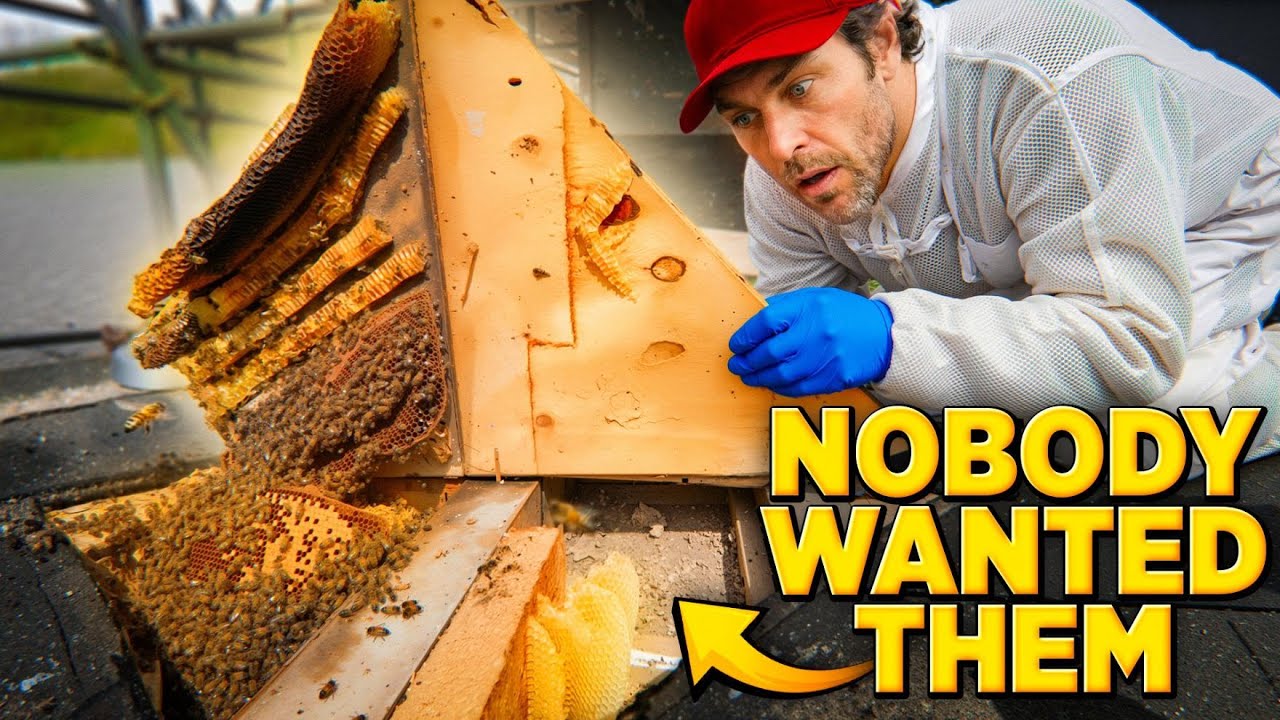
In this documentary‑style beekeeping video, the presenter performs an emergency cut‑out of a honeybee colony that has nested under a manor‑house roof. He climbs scaffolding, cuts through felt and roofboard, and searches for the queen among frames of honey, pollen, and brood. After locating and caging the queen, he salvages as much brood, wax, and honey as possible, improvising with zip ties and duct tape to assemble a nucleus (nuc) on wired Langstroth frames. He then uses a homemade bee‑vac to vacuum the remaining bees, transfers the queen, bees, and brood to a quarantine apiary, and feeds the rescued colony with invert‑sugar syrup. Over the following weeks he monitors frame building, wax orientation, the appearance of play cups, and the risk of swarming, ultimately declaring the rescue a success and inviting viewers to follow future updates.
Chapters
Today I'm going to cut out the bees in this house, 3 meters up on scaffolding. I really hope we've got a good colony of bees inside. So the colony of bees is living underneath this roof here. You can see comb on the outside. Check these photos out. This colony here expanded out last year onto the windows, stored a huge amount of honey that melted in the sun and fell down onto the ground. The landlord does not want the same to happen this year, so we need to get inside there and get those bees out. So what we're gonna do, we're gonna cut a hole in that felt there, get through the board, and lift them out that way. I'm very, very excited. Got a bit of felt off. Oh man, that was a lot of work. Now we can cut down into that board and hopefully we see some bees. Right, so we're in. Let's have a quick look and see what we've got. So managed to get that bit of wood up. You can see connected in a few places there. First thing I wanna do now though is I wanna get in here, see if I can find that queen. So just looking through these frames here, can't see a queen on that one there. Next frame, got some pollen, we've got some crystallized honey, lots of blonde worker bees, no drones. No queen just yet. So if I was a queen, this is where I'd be hiding out. These bees here have been here since early 2024. They swarmed in, they built up over that time. So still no sign of the queen. So here, got a lovely frame of honey. Trying my best not to break that up. So another frame here, brood on this frame as well. Kind of got like a bit of double comb there. I just want to look at those sequentially. Really do need to find the queen here though. So the game now is find that queen. We've got the board up there. She could be over there. I just hope she's not living in there. I think, oh, I like this look over here. This is where I'm gonna look. Look at the bees fanning like that. Sure sign that there is a queen somewhere around there. So you can see what I mean. We've got light up there now. You can see the wax there. There's a few little places where I just can't really get the wax out. So we're just gonna have to chisel that away as best as we can And hope that we come across Her Majesty. I found the queen! Yes, I found the queen! She is beautiful. So there's my queen. She's not marked, but isn't she very, very blonde? So let's pick her up now, get her into a cage. The rest of this is easy. What I'm going to do now is try and recover as much of the brood, as much of the wax as possible. And just get it into some frames, really, really haphazard. Normally I use elastic bands for this, but I was called out here in emergency, didn't have any elastic bands. So I have got zip ties and I've got duct tape. What we're gonna do, piece it all back together into a nuc. We'll then clean up everything with the bee vac, dump the bee vac bees in when I get back to the other apiary, and then we'll put the queen back in, we'll give them some feed, we'll let them build up, and then later on in the year we'll shook swarm them anyway. Now for the frames here, I've just got some wired new Langstroth frames. And I'm just gonna kind of embed that wax on there, put a bit of tape on, hold it in position, and leave them be. I do quite like having the wire there though. It can make a little bit of a mess, but you almost just get that bit of support to hold the wax into position. You can see there, that's kind of balancing in position already. And then all I'm gonna do, single bit of tape, that's held in place there. You can see, not going anywhere. And once the bees get in there, they'll just kind of draw all of that out and expand anyway, and then I can remove that tape. You can see, it just kind of Gently pressuring them on to try and get them to sit on that wax kind of equidistant if you can, and then just one bit of tape holds it in place. Really neat system. Now I just realized there I got the wax the wrong way. If you didn't know, wax does actually have an angle. It's not perpendicular to the foundation, so they draw it out at a 15-degree angle to hold everything in. That way there. I've just got that the wrong way round, so that needs to go that way. And I should have realized there, that's the top, that's the bit there where it is connected to the roof. So obviously that needs to go facing up like that. Now you might think, well, that's pointless just doing that bit of comb there. This is going to be very stressful for the bees. Anything like this you can do to kind of make their life a little bit easier for them to store some honey or pollen or for the queen to lay, have to do it. So I'm going to fill up all of the frames, get as much wax and as much brood and honey in there as possible, and then we'll take them back and we'll give them a good feed as well. Right, so that's all of the frames in there now. Everything else is going to be waste, so I've just got a box. I'll clear everything up first. That'll leave just the bees, and I'll get my bee vac up and running. I'll get all of those bees into the bucket, We'll dump them into the nuc and then we'll take them home. Forgot to mention, this video does not end today. We'll get them back to our apiary, we'll feed them, we'll build them up, and we'll see how good they are. Might even give them away. If you're interested in this colony here, stick it in the comments. Tell me why you'd like this colony in your apiary. So we're getting to the point where we are tidy. I'm just gonna go away, get the rest of the wax, gonna close everything up for a little bit, and then we'll get that bee vac out. So let me show you the bee vac. So the bee vac, super, super simple. It is a massive, massive box. Massive bucket. Has a hose, so connects up to a Henry hose. Next thing that goes in is a ventilated Perspex lid, kind of like a screen, and you just have to wangle that in and make sure it sits very nicely. See, it sits like that, and then none of the bees can get out. And then the final thing to go in there is the motor. This motor is a brilliant motor. It allows you to use Makita batteries, but you can have any battery you want. So that sits on the top like that, and then all I do, turn that knob, and we have power. You then put the lid on and you just turn it closed like that. You don't do it tight. You never get it off. And then you just do a test to see. That wasn't getting any bees there, so I'm going to turn it up a little bit. Yep, still not quite enough. And there we go, that's just about enough. Give it a tiny bit more. Put that lid on. We can start vacuuming those bees. So then you can see in there we've got a decent amount of bees, not a huge amount, but that's going to be enough to tend to all of that brood. And for it to emerge and for this colony to survive. So I'm gonna transfer all 3 components back to the quarantine apiary now. So the queen that's in my pocket here, hopefully, the bees that are in the bucket, and then the brood that is in that box. It's in a polystyrene box, so it should remain warm during that period. First thing though, I'm gonna have a really quick tidy up, close everything up as much as I can, scrape off the wax, and just leave it in the best condition I possibly can. So I'm gonna take my bucket of bees, I'm gonna give it one tap, I'm gonna take out this screen, And then all of the bees are sitting at the bottom. I'm gonna pour them straight in like that, and I'm just gonna put that roof on there. I want them to go into the brood. Don't wanna squish them, but I just wanna give them kind of every opportunity to go in. So you can see there, all of these bees here have been through the vacuum. Not ideal for the bees, and you do get the occasional one that dies, but on the whole, they look pretty good. You can see there, we've got a big cluster, but give it a few minutes, they'll all go down. And everything will be fine. So final thing we need to do is take that queen. She's still in there. I've done this before and I've lost the queen and it's very annoying. So she is in there. I'm just going to tape that to one of the top bars, make sure that it stays at the top. That will attract all of the bees in and it'll do a really, really nice job at cleaning up this site. So there's the nuc. All of the bees are in there. All of the frames are brood. The queen's in there as well. I've jammed them up with some tiles, trying to get it as close to the entrance as possible. And hopefully with a little bit of luck, the bees will work out where that new entrance is, which is Just there. I'll be back here later on tonight or tomorrow morning to collect these bees and take them home. So 48 hours later, I left it until it was a bit rainy to come and get the bees to make sure that all of the bees have gone back into that nuc. And it is hammering it down, so I'm just kind of waiting in the truck, waiting for it to die down a little bit, and then I'll go up there and I'll get those bees. So it's been 1 week since I went and did that cutout. It was pouring down when I went and got those bees. I've done a full inspection of them. I've checked that brood. I am confident there is no disease there, so I brought it into my apiary to build the colony up. I put the feeder on. I fed them about 2 or 3 liters of invert sugar syrup just to get the colony going again, and the bees are building out all of that wax beautifully now. So let's get inside and see how those bees are getting on. On. So standard roof, and then I've got a feeder. It's a national feeder. Worth noting, what I should say as well, is I kept the queen caged. She was caged, she couldn't get out. I started feeding the bees, and then I came back the day after and I popped the cage open. At that point, feeding bees whilst doing a queen introduction is really, really good idea, and it means that everything is good. So what I also did at that point is I went in and I added a couple of drawn-out frames for the bees, just some stores. And what you can see here now is the bees have taken down that syrup and they're storing it in the frame here. Now it's difficult when you're doing cutouts like this and you just need some perseverance to try and get the bees to draw stuff out correctly. So what I'm doing here is I'm just pushing that wax back on because I want it to all fit within that frame there. See how on this side it's coming out a little bit, whereas on that side it's not coming out? That's not good, so we want that to be more embedded on that side. That is what we want to see, and we want to fill the whole frame, every single frame up with comb, just like that there. All these bees here need is a little bit of time to get going. So let's fast forward 3 weeks and I'll show you what they're looking like now. So it's been about a week since I did the last update. The bees were starting to draw out those frames. I was pushing them back in to get that alignment correct. They have really expanded over the last week. Let's get inside to see how they're getting on. So you can see the colony is looking very, very nice. The bees have really, really settled down. So I'm going to go through one by one and show you the frames that are in here. A few of the frames are getting stuck together and you'll see that the wax starts to come back out again. So all you need to do, like I did last time, is just try and push it back in to mount it onto those frames. So the fact that these frames are coming out one by one is very, very good news. You can see here this frame came out nice and easily. So you can see there all of that frame there being completely built out. Can't see the queen on there just yet, but this is exactly what we want to see. And before you know it, that whole frame there will be full. So then the final frame, you can see, look how well the bees have drawn that out. If we go back, that bit there is the original piece of wax, and they've filled all of this up here with some drone comb and then some worker comb there. Really excited to see how the bees develop this over the next few weeks. Back at the cutout nuc, and I just want to tidy things up and get that tape off before the bees completely draw everything out. So you can see what I mean, the bees are starting to draw it out now and they're avoiding the tape. So now that we've got that structure in place, I can take that tape off and these frames are not going to fall out. And I'm just going to go through very gently removing this duct tape. Now the bees do not like the duct tape. So there we go, that's the first one off, and you can see The impression where the bees have been very much avoiding that tape. So hopefully now they'll start to fill out that middle section and then these frames here will be complete. So I'm going to leave this colony now for a good few weeks for them to build up and expand. Don't go anywhere though because you want to see what this colony ends up like in a few weeks' time. They are going to be brilliant. It's time to finish this video off. Let's see how these bees have expanded into this poly nuc. So you can see all the way up to the edge, up to the last frame now, the bees have filled in all of those gaps. You can see in the middle here, this section, the darker section, that is the old section of brood. And then all of that lighter wax around the edge, we've got a mixture of everything. We've got some drone brood, we've got some wax, we've got honey, we've got open stores, closed stores, capped worker brood, open worker brood, even a little play cup on there as well. The bees have filled all of that in. And they will continue to fill in those little gaps as and when they need it. But the bigger risk that I've got with this beehive is that unless I do something kind of today or tomorrow, once all of that brood emerges, they're definitely going to swarm. So they need a new beehive now. So you see, same on this frame here, little bit more space. I would say this is the frame that's left that's got the most space. And you can see again, little bit of overlap. You've got the old comb down there and then all of that is new. They will fill in all of the gaps as you'll see on the other frames. Frames. More of the frames are now being drawn out, so there's not as many gaps. All of this wax around here is brand new. So just around there, there is a play cup. That is a cup that the queen will lay an egg in, and it'll either be a supersedure cell or a swarm cell. At the moment though, it's just a play cup. There's nothing in it, but worthwhile pointing out what a play cup is. So that frame there is a brilliant example of what starts to happen. Look, you can't really tell where the old comb and the new comb begins. The dark old comb Used to be around here and then they built it all up. You can see pretty much filling up that frame there. And also we've still got the queen on that frame. Really did want to see that queen before we closed everything up here. But as you can see, a beautiful golden queen. I think this is going to be some sort of island-mated lagustica queen, something quite pure. Really like the look of her. So I've got the ID on my queen there and I'm going to really carefully put this frame back. I'll just show you the last couple of frames here as well. So again, that one there, that had old comb in it. You can see it down the bottom there. Same on that side. As you can see, mostly filled out now. And then the final frame, completely full. I think we can say this is a success. So we've come to the end of the video from a cutout in a manor house. We've taken the queen, we've taken the brood, we've taken the bees, housed them in a nuc, got them back on track. They're ready for their new beehive. And if you wanna follow the next step, definitely hit the subscribe button. I'll be doing plenty of updates on this colony. And the best compliment you can pay to me if you like this video is giving it a share on social media.










