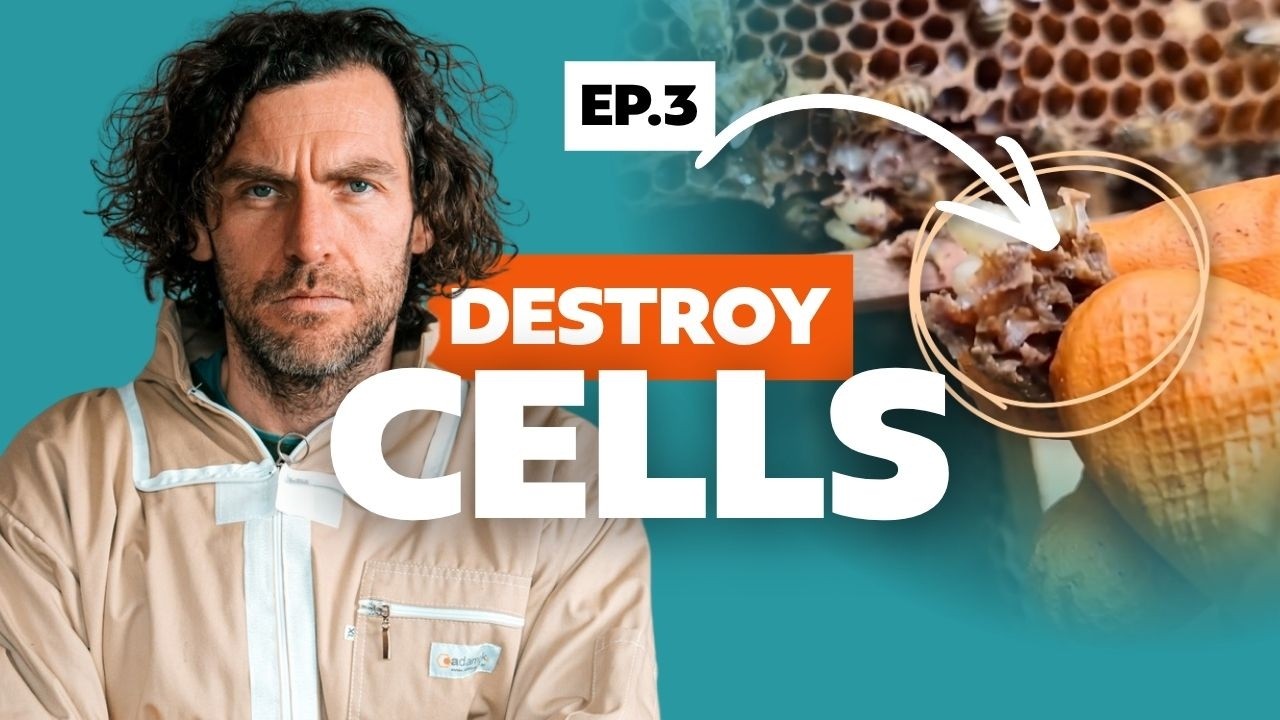
In this instructional video, Laurence Edwards of Black Mountain Honey walks viewers through the third episode of the "Making Splits for Winter" series, focusing on preparing a 2‑frame nuc for overwintering by removing any emergency queen cells and introducing a mated queen. After confirming the colony’s bees have settled away from the feeder and locating the queen, Edwards demonstrates how to shake frames to expose and eliminate all emergency (or swarm) queen cells, explaining why missing even one can lead to the new queen’s death. He then opens a queen cage, removes the tab, and places the cage between the brood and store frames, allowing the bees to slowly eat through fondant and release the queen. Edwards stresses the importance of leaving the colony untouched for seven days—avoiding any checks within 24‑48 hours—to give the queen the best chance to be accepted and start laying. The video concludes with a preview of the next episode, which will assess the colony after seven days and provide winter feeding guidance.
Chapters
We're now on to episode 3 of the Making Splits for Winter series. Today we're going to knock down the queen cells, open the queen cage, and release the queen. Hi, I'm Laurence Edwards from Black Mountain Honey. Welcome to another episode of No Nonsense Beekeeping. As I said, these videos are going to be really short. All we're doing today, taking down the queen cells, releasing that queen, and then we're going to close them up for 7 days Come back and check to see whether the queen's laying. Recap of the last episode, all of the bees were clustered up in the feeder, and like I said, don't worry if they do that. It takes them a little bit of time to work out where that brood is. I'm sure what we're going to find today is they're going to have clustered up all around that brood, they've found the queen, and hopefully all will be okay. So I'll get my bee suit on, I'll get the smoker lit, let's go and check how our 2-frame split is getting on. So I finally got around to strimming this apiary. First time this year I've had a really good tidy up. Right, let's get inside this nuc then, see how they're getting on. Hopefully they're not clustering over in that feeder anymore. Checking for queen cells, checking the queen's still alive, and then we're going to pop the tab. And there we go. As predicted, they're no longer sitting over there in the feeder. They just do that when they transport them sometimes. They go and find a nice little void. As predicted though, they've gone into the middle. They found that frame of brood. They found the frame of stores. More importantly, they found the queen. Look at that really nice behavior to her. Let's get inside this colony, see if we can find the emergency cells. Probably only going to be 2 or 3. We'll take those down and then pop open that queen cage. So there's our queen, and if you remember, all of the attendants were dead in there. The attendants, when you're introducing a queen like this, really don't make a huge amount of difference. The nurse bees in the colony will feed the queen through there. You can see she is in perfect condition, that queen. Every single attendant is dead. It's been in there for 7 days now, so no problem at all if your queen's ever arrived with dead attendants. A lot of people do take them out for introduction, but just goes to show, queen looking really nice and healthy. Let's go and find those emergency cells now. Now when you come to find the emergency cells, I always recommend shaking the frame. Obviously when you're introducing a mated queen, you don't need to preserve the The cells, emergency cells or swarm cells. So you're much better off shaking the frame, all of the bees off, so you can find every single emergency cell. It's really important to find every single emergency cell because if you miss one, the chances are when we pop that cage later on, they are going to kill the queen because they think that they're queen right because they've got a cell. And I know they're not technically queen right, but they do do that, and they will kill a mated queen over one of their own cells. Just shake the bees off, make sure every single queen cell is dead, and then you can pop the cage open and do a slow release through the fondant. So here's our emergency cells. They've only done 2, and I know they look very, very much like swarm cells, but they're not. They are emergency cells that they've just pulled out just by coincidence at the bottom of the frame. Got some old ones there, they're previous cells, nothing to do with this at all, nothing in them, they are just empty. These are the 2 that you want to get down. So go over all the frame. You can see all that brood has emerged now, barring a few little bits around the edge. Obviously nothing in the cells, no queens, no laying workers, no drone-laying queens. We're going to take down all of those queen cells now, and then the colony is hopelessly queenless. So all you do is you just take the cells out like that. You can see lots of jelly in the middle there. Bee's trying to clean it up, but sorry, that's not going to be a queen. Pop them off to one side. Same again, you can see larva in there. We're taking those down because we're going to give them a mated queen. And then anything like this, I always recommend just take them off just to be on the safe side. You can see that they'd actually gone into that one there and started to put some royal jelly in. No larva or anything like that in there, but it was charged. The bees, they do funny things sometimes. And then nothing on the other side of the frame there, so we are now hopelessly queenless. So once you get the bees to the point where they're hopelessly queenless, all we're going to do, take the cap off, loads of fondant in there, going to do a nice slow release, and then we're going to come back in 7 days and hopefully we'll have a laying queen and eggs in the cells. So there we go, that's my queen cage with the tab removed. That's what you're looking for, give them nice easy access on the big tab there. They're going to eat through that fondant now and they're going to release that queen. All we need to do is take that, pop it back in between the brood frame and that stores frame that you put in there, make sure it's nice and tight, and then we can leave them for another 7 days. So this is what your nuc should look like now. We've got no queen cells, hopelessly queenless. The tab is open. You can see they're making a fuss of that queen. Really nice behaviour. You can always gauge what the behaviour is like just by putting a queen in there like that. We'll put the lid back on, come back in 7 days. So that's it, that's that part of the manipulation complete. Really important warning here, don't go back in 24 hours to see how they're getting on getting through that fondant. Even the smallest handful of bees will work through fondant in a matter of, say, 12 to 48 hours. They don't need you going in and checking up on them, and if you go in and check up on them, there's a high chance that your queen will be bald. So all I always suggest is just give it 7 days, don't go back into your colony, and then when you go back, you're going to find an empty cage and you're going to find a queen walking around on the frames. Give the bees the best chance for the introduction and don't be the reason why the introduction fails. So that's it for this video. Episode 4, we're going to come back and we're going to check on this colony and we're going to set them up with a little bit of feed just to get them expanding nicely into winter. So I hope you enjoyed that video. As always, please hit the subscribe button, please hit the bell so you're notified of every video, and I'll see you next time. Bye.