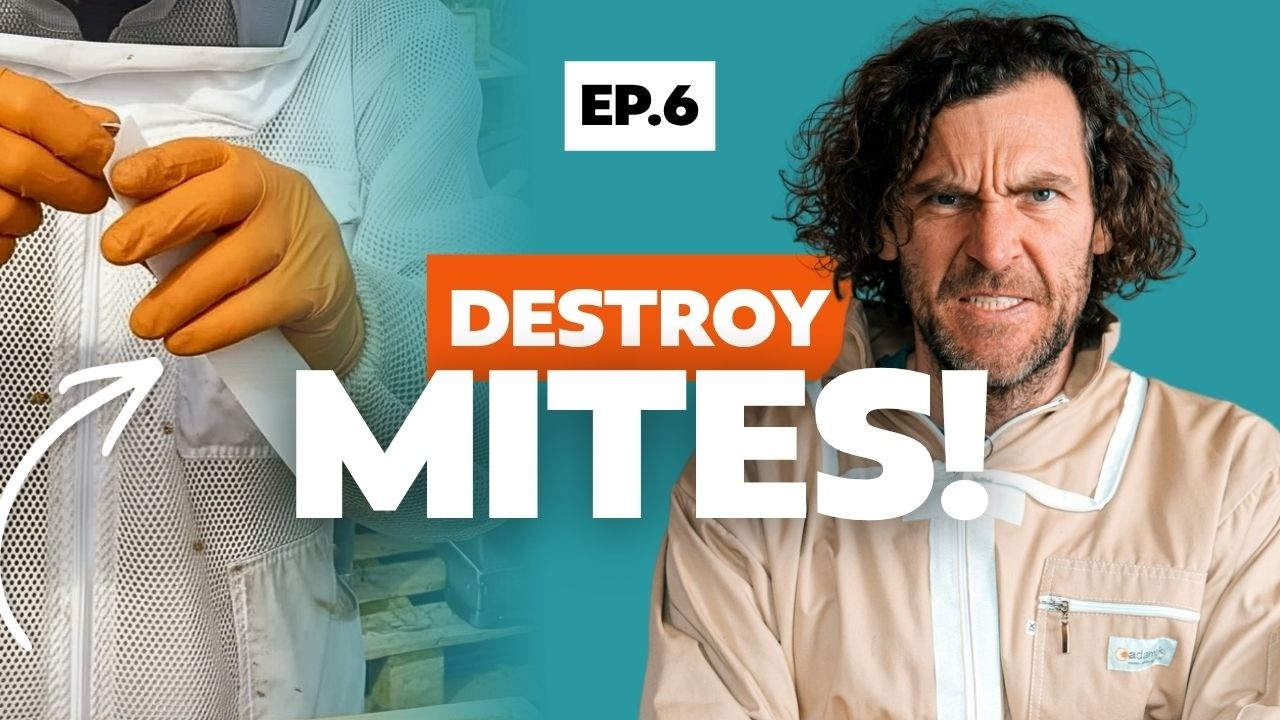
In this instructional video, Laurence Edwards of Black Mountain Honey demonstrates how to treat overwintering nuc colonies for varroa mites using Apivar (amitraz). He emphasizes the importance of applying the treatment early—right after making splits for winter—rather than waiting for the traditional autumn window, because smaller colonies can be treated more effectively before supers are added. Edwards explains the correct dosage (one strip per up to five frames of bees), shows how to open the packaged strips, place a single strip between the two most populated brood frames, and leave it in for the full eight‑week period, removing it before overwintering to avoid resistance buildup. He stresses checking the product’s expiry date, discarding old or unsealed strips, and proper disposal. The video also briefly compares Apivar to other treatments such as Max, noting Apivar’s low risk of brood or queen loss and its ease of use. Throughout, Edwards provides practical tips, visual checks of colony size, and encouragement to treat varroa early to improve winter survival, concluding with a call to subscribe.
Chapters
Episode 6 of the Overwintered Nuclear series. Today we're treating our bees for varroa mites using Apivar. Hi, I'm Laurence Edwards from Black Mountain Honey. Welcome to another episode of No Nonsense Beekeeping. Today's video, we're going to focus on treating for varroa mites, and we're going to use a product called Apivar. Now, I've done numerous videos on the use of different varroa treatments, and I've done a specific one on the use of Apivar as well, so I won't go into too much detail on this video. But all I will say is that when you're making splits for winter or you're building up colonies and you're not going to put supers on them later on in the year, get your Apivar on or do your mite treatment as early as you possibly can. All of the narrative on the packet generally says after supers come off, do it late in the year, it's an autumn treatment, and it's all based around the fact that they don't want to taint your honey supers. However, if you're making splits and you haven't got honey supers, Much better to get it on as early as possible when the colony is as small as it can be. You don't want to overdo it though. Apivar is supposed to be 1 strip per 5 frames of bees. We've got about 3, 3.5 frames of bees here, so I'm just going to go ahead and use a single strip. I'm not going to trim that down. I'm going to keep it in for the full period, which is 8 weeks, and then I'm definitely going to take it out before they overwinter. You do not want your bees getting used to amitraz, which is the active ingredient in Apivar. Because then they will build up resistance to it, and then it's really difficult to use it to treat varroa mites. So I'll get my bee suit on, I'll go and show you how to treat your nuc using Apivar. So Apivar comes in a pack like this, really nice light pack, contains 10 strips, and that's enough to treat 5 full-size national colonies of bees, 2 strips per 5 frames of brood. When you're treating nucs though, you only want to use 1 strip, and it says 1 strip per 5 frames, I tend to go with anything between 4 and 6 frames of bees, you're fine just to use one strip of Apivar. It is the easiest treatment in the world though, I really do love it. Make sure the expiry date's fine. This one here, we've got the 2nd/22, so the 22nd of Feb, well within date. It can go out of date and then it's not anywhere near as effective. Also, if you've got any remaining from last year that hasn't been sealed, get rid of it. It's not going to be any good. You need to make sure that you get a nice fresh open packet. And you need to make sure that you dispose of it correctly as well. So let's get inside the bees, we'll do a quick checkup, see how much they've grown, and then we'll get the Apivar strip in and see if we can get those varroa numbers down a bit. So not a major expansion, this is only a couple of days after I fed them, so they've still got sugar syrup in that feeder there. Good-sized colony of bees though, over between 4 or 5 frames of bees now, so we can do 1 frame of Apivar. Really happy with how this nuc's coming on. Get through to that first round of brood and this is going to be a monster colony. So really, really happy with their progress. So Apivar strips, I've said it before, they are so simple. Just open them up. Sometimes a little bit difficult to get them out. They do stick to the side of the packaging. They come as a bonded pack of 2, so that will treat enough for 10 frames of brood. You want to tear it down the middle. So you've got 2 individual sticks of Apivar. The weather here is amazing today. It is pouring it down and it is super windy and there is a storm coming. So I'm trying to be as quick as I can. And then I used to use matchsticks, but I don't even bother anymore because I just haven't got the time. All I use is this little strap here, pokes out, and then I pop that in between the 2 most populated brood frames. Tends to be slap bang in the middle of the hive. And that is it. That is the varroa treatment complete for the year. You can see why I like Apivar. It is foolproof, it is simple, I can feed at the same time, and I don't have any risk of any brood or queen mortality. So that's it. I'm going to close these guys back up. Tune in next week, we'll see how far this colony's come along. We've fed them now, we've treated them for varroa, the queen's been released, the colony is expanding. All is good when we're making up splits for winter. So there we go, it's as simple as that. Apivar is by far and away my favorite varroa treatment because it is so incredibly easy to use. There's very, very little risk in comparison to, say, using a Max. And I do appreciate Max, you get the benefit that you don't need to take your But I just hear so many horror stories when people use Max. I've personally not had any queens fail using Max, but I have had brood that's damaged using it when it's a little bit too hot, so I do steer clear of that now. Hopefully you found that video useful though. I will just re-emphasize, get your varroa treatments on as soon as possible when you're making splits. Makes a big difference to the varroa numbers going into winter, and that is how you get your colonies through. So I hope you enjoyed that video. As always, please hit the subscribe button, Please hit the bell so you're notified of every video, and I'll see you next time. Bye.