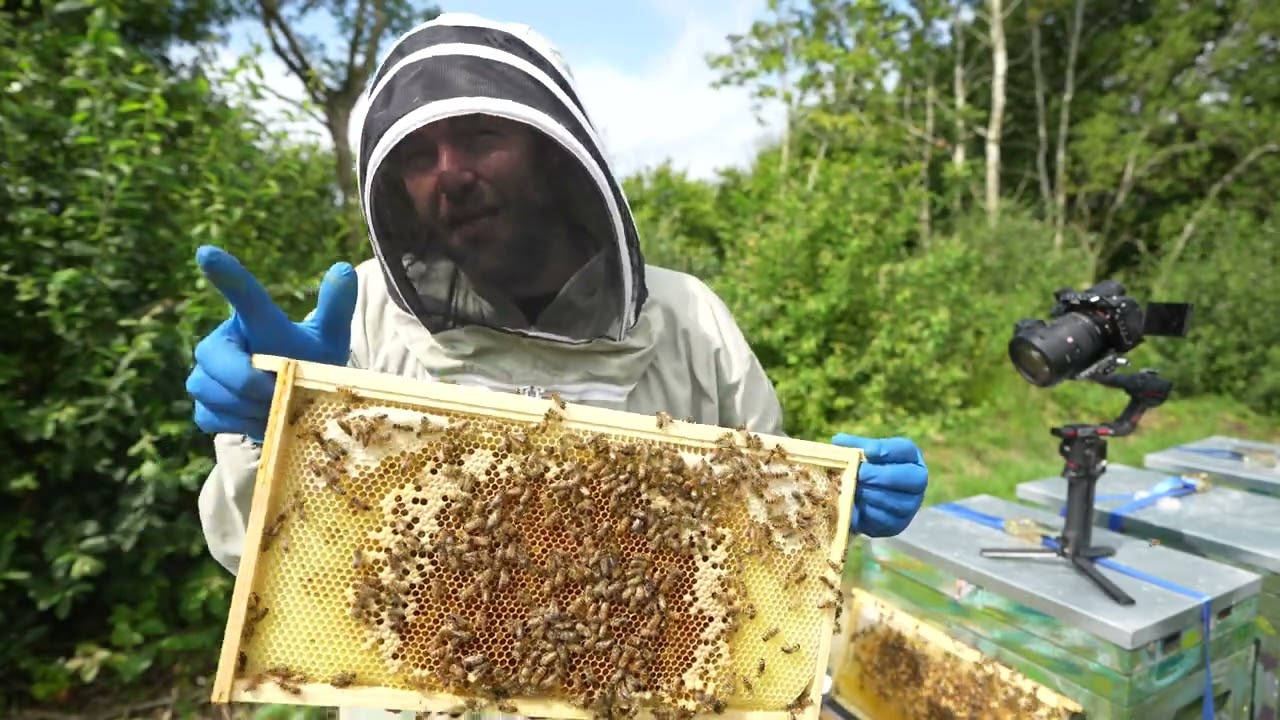
In this beekeeping vlog, Laurence Edwards walks viewers through a real‑time supersedure event in his apiary where the queen named Splodge is being replaced. He begins by explaining how to distinguish supersedure from swarming, offering a simple rule‑of‑thumb based on the number of queen cells present (1‑2 cells = supersedure, >3 cells = swarming) and noting typical cell locations on the frame and within the nest. Edwards then inspects the colony, describing the condition of Splodge’s brood pattern, the presence of drone brood, and the appearance of a single supersedure cell near the edge of the brood nest. He speculates that the queen’s green paint markings may be perceived as a defect, prompting the bees to supersede her, though he also acknowledges that the queen could simply be failing. The video shows close‑up footage of the queen, the supersedure cell, and the frame being carefully returned to the hive. Edwards outlines his management plan: he will let the bees complete the supersedure, expecting a new queen by year‑end, and will monitor the outcome, providing future updates. The tone is instructional and observational, with cautious optimism about a successful supersedure and the continuation of Splodge’s genetics.
Chapters
Bit of a disaster in this apiary. Splodge is being superseded. So remember back a few weeks, I received 3 or 4 queens from Melitta Bees that were marked not very well. Couldn't send them out to customers because they weren't marked well enough, but I thought I'd introduce them into some colonies and see how they got on. They are superseding Splodge, so I thought I would take this opportunity to show you what happens with a superseder, what to look out for, and how to tell that your colony is actually superseding. Now, supersedure cells look exactly the same as swarm cells. The only difference is the number of cells that are present within the colony. My rule for supersedure is if it's one cell, it's supersedure, doesn't matter where the cell is. If it's 2 cells, it's probably supersedure, doesn't matter where the cells are. If it's 3 cells, kind of pushing it, but I have had colonies supersede with 3 cells. If there's anything more than 3 cells, it is definitely swarming. If you want a safe rule, 1 cell supersedure, 2 cells supersedure, everything else is swarming, irregardless of where they are on the frame. That will work 98% of the time. Bees don't read the textbook, so you're always going to get slightly different numbers. The location of the supersedure cell in terms of where it is on the frame, it's generally towards the middle. It's not always towards the middle, it can be anywhere. The location of the supersedure cells in terms of where they are within the nest, They're generally towards the edge of the nest. What you rarely find is like one supersedure cell on one side of the nest and another one on the other side of the nest. That's very, very rare. So if you do have the instance where there's going to be 3 supersedure cells, you'll probably find a cluster of 3 towards the outside of the nest somewhere. When I had 3 supersedure cells, that was exactly what I found— 3 all in a line right on the edge of the nest. So before we get in and take a look at splodge being superseded, what am I going to do with this colony here? They're trying to supersede and it's the beginning of August. So it is, I think, the 2nd or 3rd of August here today. The weather's beautiful, and for the next couple of weeks it's getting a little bit more rainy and it's hovering around 20°C. I'm going to let these bees supersede and we are going to run with it and see what they do. And I suspect that we'll likely have a new queen before the end of the year and Sploge will say goodbye. We'll say our last goodbyes to Sploge today just to make sure. Or failing that, what will happen is that the new queen will overwinter with Sploge and then Sploge will go out of action at some point next year. I'm going to keep a really close eye on this colony to see what's going on, but let's get inside now, take a look, see Sploge, see the supersedure cells, and we'll take it from there. So this colony here is a drone-laying colony that I fixed with Sploge about 5 weeks ago. Now Sploge is doing a fine job, although you can still see some remnants of drone brood on that frame there. But if you take a look at these frames here, these are frames that Sploge has laid up, and she's done quite a nice job. You can see a good ring of capped brood around the edges, eggs and larvae in the middle. But what I suspect with Splodge is that they just do not like that she is covered in green paint. They see it as a defect and they've taken the opportunity to supersede her. So again, reasonably nice looking frame there. I always have so much fun with this camera because the view of it is upside down, so I don't know whether I'm going up or down. If we flash back to that camera there, you can see reasonable brood pattern. Like, it's not great, is it? Because you've still got the old drone— because you've still got interspersed old drone within it, but it is old drone. But you know, if I was looking at that, I'd be thinking, sorry, Sploge, I don't, I don't actually think you're up to it anyway. So if the bees hadn't superseded you, I think I might have manually superseded you. There's another frame though. If I was seeing that on all of the frames, I'd be very happy with her, willing to give her a little bit of an extended chance. And look at that, how convenient, Sploge is right next to her superseded cell. You don't often see that, do you? So let's get a close-up. So there is Sploge. In all of her beautiful artwork on her, running down the side of her thorax, bit on her leg, bit all over her wing. You can see why they're trying to supersede her. But she's still happy, she's healthy, she's laying. Maybe not in the best pattern, it might be completely irrelevant, might not be the paintwork, it might just be that she is a failing queen anyway. Very high likelihood that it is the paintwork that they're superseding her. So let's take a look at that supersedure cell. You can see it's not in the center of the frame, But it is relatively high up, probably in the 25th percentile, if that's even a thing on a frame. But it's quite close to the top. So if you were told that supersedure cells are only ever there and you saw a cell there, you might be thinking, oh, it's not a supersedure cell because it's not on the face of the frame there. But you can argue that that is the face of the frame as well. It's a charged cell, royal jelly in it, and it's just a single cell on the outside of the brood nest. Super straightforward for me. This is a classic case of supersedure. Bees are tending to it well, and I'm going to let this one run its course. So just give you a close-up of Sploge on that side as well there. Might be the last time you ever see Sploge. And then really carefully with the supersedure cell up here as well. Yep, up in that corner. Let's give you a close-up, as close as I can get with this camera. One supersedure cell. And let's put this frame with the queen and the supersedure cell back into the colony. Obviously really carefully putting it back in there. So that is what a supersedure looks like. If you want to stay tuned to see what happens with Sploge, to see if she gets superseded, definitely hit the subscribe button. I'll give you regular updates both this year and then definitely into next season. Fingers crossed we get a successful supersedure and Sploge's genetics can continue in this apiary.