This Colony Is Back From The BRINK
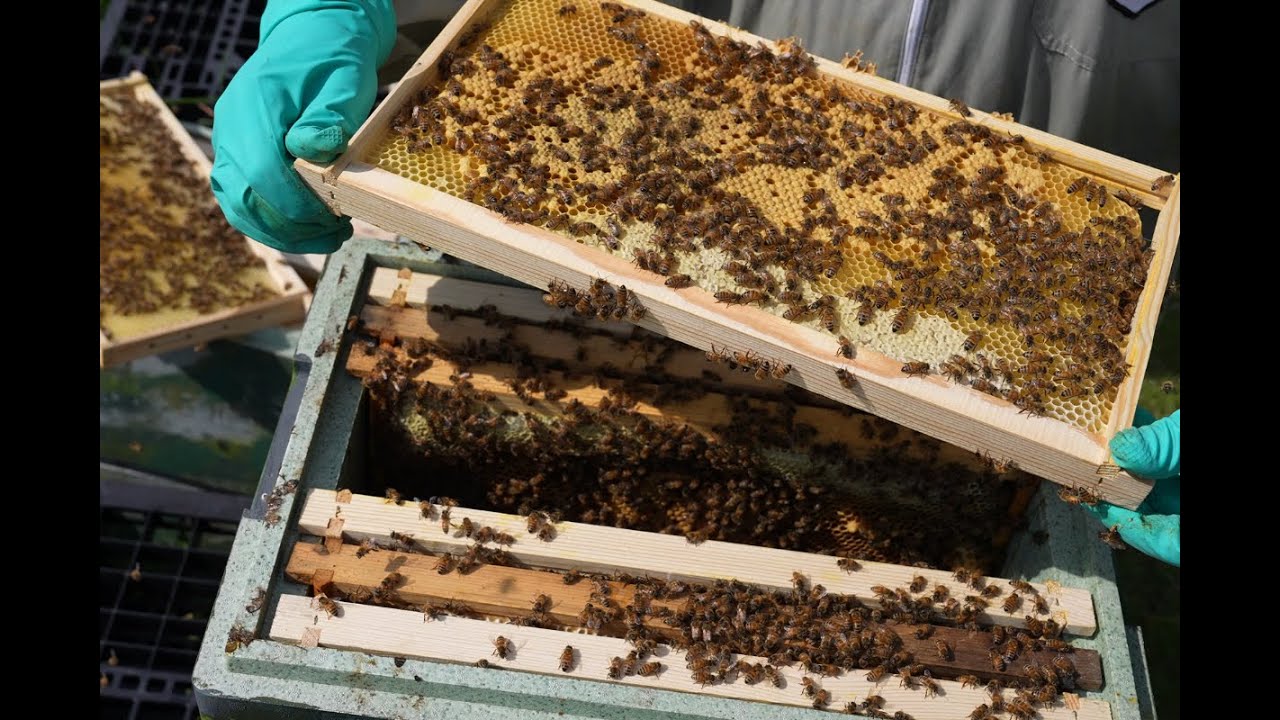
Laurence Edwards checks on a bee colony he rescued four weeks ago with sugar syrup feeding. The hive has exploded with growth, filling six 14x12 boxes and sixteen Langstroth deeps with brood, eggs, and stores. He notes the bees prefer drawing comb on wax foundation over plastic frames.
Chapters
4 weeks ago, this colony was hours away from death. I'm going to give you an update to show you just how well it's bounced back. Look at the height of that colony there. Let's get inside and see how well these bees have done. Now that top box there was mostly empty, but I've come around here and given additional space because I know in this apiary here, as soon as the sun comes out, which it has today, it's early May at the moment, the bees will really, really take off. So we have got 6 14x12 boxes at the bottom there, And then I've done a real strange manipulation. I've added on some Langstroth extension boxes 'cause I want to kind of transition from 14x12 over to Langstroth. So we've got 6 14x12 frames. That was the configuration I overwintered on. And I've added on 16 Langstroth deeps, which is at least the equivalent of 2 national deep boxes. A lot of space for the bees to work on here. And we've got a couple of frames of foundation on there. But as we work into the middle there, you can see the bees are starting to work all of that comb really, really nicely. Building out that foundation that I've added on there. Probably about 40 or 50% of those frames in that box there starting to get worked now, and then we're on to more frames of foundation. So the top 2 boxes, they've not done a huge amount, but remember this colony was on its last hour of life. They were nearly dead, and we saved them with some sugar syrup, so they did get knocked back quite a bit. However, this is where the fun starts. So like I say, that was only 4 weeks ago. That was like one full cycle of brood. Plus an additional week, and just look what these bees have done now. So beautiful frames, really nicely drawn out. That last side there has not been drawn, so I will flip that frame around and I'll pop the foundation side facing inwards. But here we go, look, beautiful frame of stores. We didn't have this when we came here last time. We didn't have sufficient stores because the bees were starving. They were nearly dead. So good to see that they're kind of managing their own work at the moment and they're not just creating significant amount of brood and then starving themselves. Like, there's a decent flow on at the moment and they are making the most of it. Next frame in, got a really nice frame of eggs there. Might just be able to see it on that camera there. Beautiful frame of eggs. Gonna pop that off to one side, give myself a little bit of space to work. And here we go, we're into the frames of brood now. So onto the second frame of brood there. First frame is a frame of eggs. That one there, lots of brood, huge amount of eggs in there as well, full ring of eggs. And then we get into the business side of things, pretty much full frames of brood backfilled with nectar as well. This hive here is getting primed, ready to expand. Really nice to see such a dramatic comeback. So another nice frame of brood, lots of stores on that frame as well, huge amount of pollen coming in. Really good to see such amounts of pollen, that means that the bees have Sufficient protein in order for them to expand rapidly. So we've got a little bit of brace comb there that they were building in the feeder. We'll take this off now, we'll pop it off to one side, and we'll go back down to the original brood nest. So this is the configuration in which they overwintered, and I do think it was maybe an issue with the plastic frames where I hadn't given them sufficient feed. And because they required more feed to draw out the combs versus other colonies that were using wax foundation, I maybe underfed these a little bit. So I will take that as a lesson. Make sure that I don't do that again. But you can see down here, look, they look really, really good. That's the brood box, basically double brood configuration now, plenty of space to expand. And I'll be using these bees to make up some splits over the next couple of weeks before they get too big for that box. But there's nothing worse than seeing a colony die when it's your own mistake. But you know what, there's probably nothing better than saving the colony, getting them back to the point where they become a thriving colony once again. These bees do look very, very nice now. So an interesting observation though is when I've got the mixture of plastic frames and wax foundation in here, it's really clear to me that the bees do prefer the wax, the genuine real wax, as opposed to the wax-coated plastic, because they are still prioritizing working the wax over the existing brood frames down here. They're still not completely drawn out, but the bits that are drawn out, you'll see, and I think you'll agree, the queen is doing a Fine job. Lots and lots of brood there, but you'll see at the bottom still not drawn that out completely. I'll just pull out a couple more frames, see if we can find that queen. Not too fussed if we don't see her. Lots of nice young bees on that frame. Always nice to see some young brood emerging. So no sign of the queen, but that's no worry. I've got lots and lots of frames of eggs, so there's clearly a good queen in here, and I've got no reason to believe that it's not the pure Buckfast breeder queen that was in here before. Let's do a couple more glances on some of these frames, see if we can find her. Never that fussed about finding queens except when it's the breeder queens because they are quite expensive and it is always nice to see them. However, they are always clipped now, so they're not going anywhere, and there's no signs of any swarm preps or anything here. So unless they've superseded her, which I don't think they would, I don't see any reason why they would, I'm pretty sure she will be in here somewhere. Hopefully we'll find her as we put it all back together. So no signs of her on any of the plastic frames. She'd be a really easy one to see because she has got an orange disc on her, but you can't do anything about that. You can't go searching for her. She will come out. If she's down there, at least she's safe down there. Just moving the bees off there now. Put this box back on. Remove that bit of wax. So no, no sign of that queen. Just making sure this box is back on properly. Again, we're doing that conversion between 14x12 and Langstroth. Which means that I have a very dodgy bee space in the middle. So I just want to make sure that I'm not squishing any bees when I put that back together, and I'm not creating any unwanted work by creating gaps for the bees to fill in. So I'm going to give up looking for that queen, confident that she's still in there. But how about that for a comeback? This one was near to death, they've doubled in size, and within a few weeks they will be filling all of these boxes.










