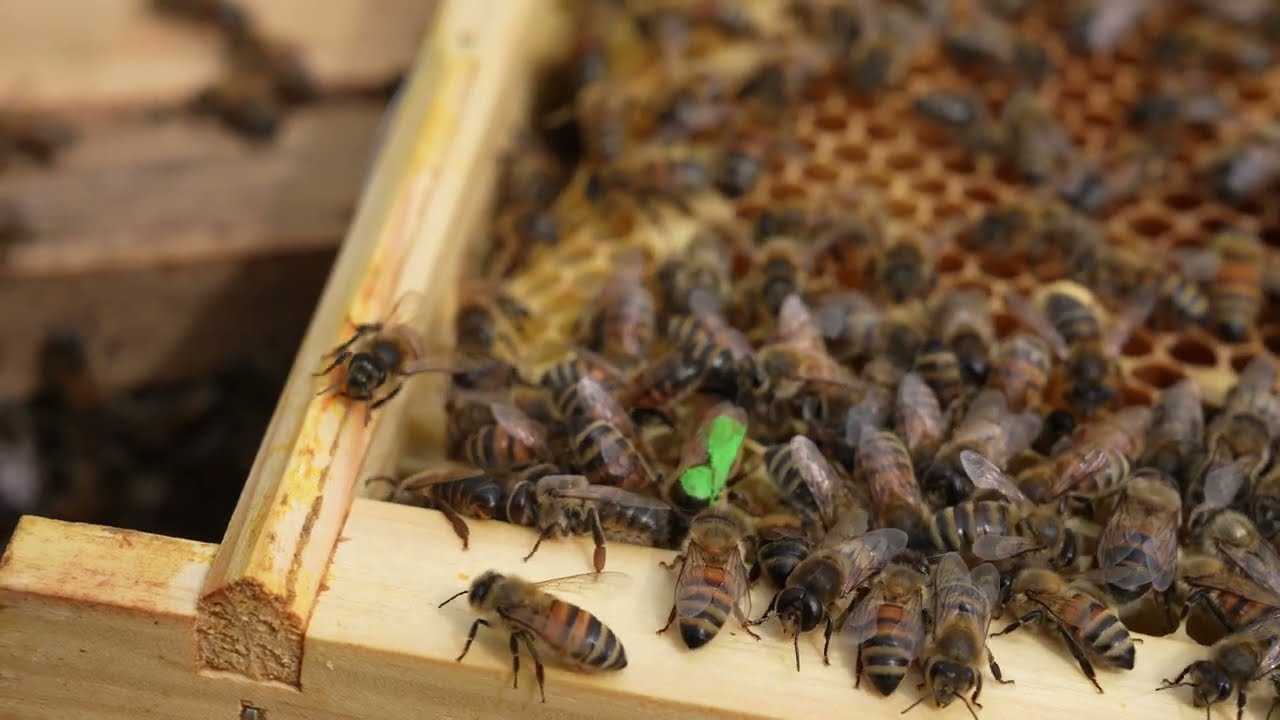
In this vlog‑style walkthrough, beekeeper Laurence Edwards introduces a newly acquired queen he nicknamed Splodge, whose body is heavily marked with paint from a batch of 600 Melitta Bees queens. Unable to sell the queen due to the markings, he re‑uses her by introducing her into three separate colonies across three apiaries. One colony accepts her immediately; another initially rejects her, prompting Edwards to locate the queen within a ball, rescue her, and re‑introduce her successfully. The third colony previously housed a drone‑laying queen, leaving behind drone brood and neglected larvae. Edwards explains how he is converting this colony back to a healthy worker‑brood population by adding frames of brood, monitoring nurse‑bee numbers, and observing the transition from drone to worker brood. He provides a close‑up of Splodge’s paint‑covered thorax, wings, and legs, noting that the bees accept her despite the imperfections, illustrating the tolerance of honeybees to beekeeper errors. Edwards emphasizes that the bees ultimately “know best,” and he plans to keep Splodge as a long‑term queen, expecting the colony to build strong stores for winter 2025.
Chapters
Today we're going to meet a brand new queen that I have affectionately named Splodge. Now Splodge came to me a couple of weeks ago in a batch of 600 queens from Melitta Bees, and you know Melitta Bees, top of their game, perfect green dot on the back of every single queen. But in this batch, I think they may have let the apprentice have a go on it because I had 3 queens that had a rather funky paint job. Now there's no way I could send these queens out to customers. There's paint on the back, there's paint on the thorax but falling down the side of it, there's paint on the wing, there's paint on the body, there's even a little bit of paint on one of these queens' faces. So I can't send them out to my customers, but there's no way that I could just like kill the queens. I need to put them to good use. So I've introduced them into 3 separate colonies across coincidentally 3 separate apiaries. The one in this apiary here though has been accepted. I have another one where I put it into a colony and it wasn't originally accepted. I went in, found that they were balling the queen, dug through the ball, found the queen, got her out, put it back in the cage, and then reintroduced her. And that actually worked, and that queen is also successfully introduced now. So let me get inside, I'll introduce you to Sploge, and I'll show you why sometimes it doesn't matter if you make a massive mistake. The bees will put up with what the beekeepers end up doing. Let's get inside, let's meet Sploge. Now Sploge has got her hands full because this colony here had a drone-laying queen in there, and you can see the remnants of the drone-laying queen. Little bit of chilled brood in there as well, and I am doing a separate video showing the transition from a drone-laying queen colony like this, having killed the queen, put in a new queen, Sploge, and how she is transforming this colony back to worker brood. But she's only been in there for about a week or so now, so I'm not actually expecting to see any capped brood. But we'll definitely get this colony back on its feet. I've donated a couple of frames of brood over the last couple of weeks as well, just to ensure that there's sufficient amount of nurse bees in this colony. So again, you can see the remnants of drone brood in there. And if you're finding colonies like this where they're drone laying and then you're trying to requeen them and you're looking at some of the larva and thinking, wow, those larva don't look good, it is just neglected brood. There's nothing wrong with it. You've not got enough young nurse bees or worker bees in here to tend to all of that brood properly. So you do get a few that look a little bit iffy, but as long as they're still segmented, as long as they're not twisted, you should be okay. But of course, if you are concerned, get a second opinion from the bee inspector. But you can see as we work through to the middle of this colony now, less drone brood, a little bit more worker brood, a few more worker bees. Let's see if we can find Sploge. So hopefully you can see on that frame there, you can't see the queen, but you can definitely see signs of the queen. We've got eggs in the cells. And then just as I was turning it over, there we go, we have found Splodge! Now isn't she a beauty? You pay extra for that kind of marking, I think, at Black Mountain Honey. She is really badly marked up. That is about the worst I think I've ever seen. And, uh, she's legged it now. I think she's a little bit shy, so let me put this frame down and I'll give you a close-up and show you just how bad that marking is. So you can see, completely covering the thorax, and I think what's happened there is a drop of paint has just come down, spread all the way down her wing, And then it's obviously overlapped with the other wing as well. So fully painted both of her wings there. The bees have accepted her. You can see that's really, really nice behavior towards her. She is not fussed at all by the poor paint job. And I think it just goes to show what we do as beekeepers. We think we know best. We think we're tricking them. They tolerate what we do and we try and get the best for them. But really, the bees know best. And they probably looked at that paint job there and thought, what are you doing? That's absolutely shocking. But yep, she's laying eggs, she's well mated, so we are going to keep her. We're going to stick with her and we're going to build up regardless of the shocking paint job. So I'll keep Splodge for as long as possible. It's like my own personal pet queen. Paint on the thorax, paint on the wing, paint on the legs, but she is doing a fine job in this colony and I'm sure they're going to build up really, really strong going into winter and do a fantastic job in 2025.