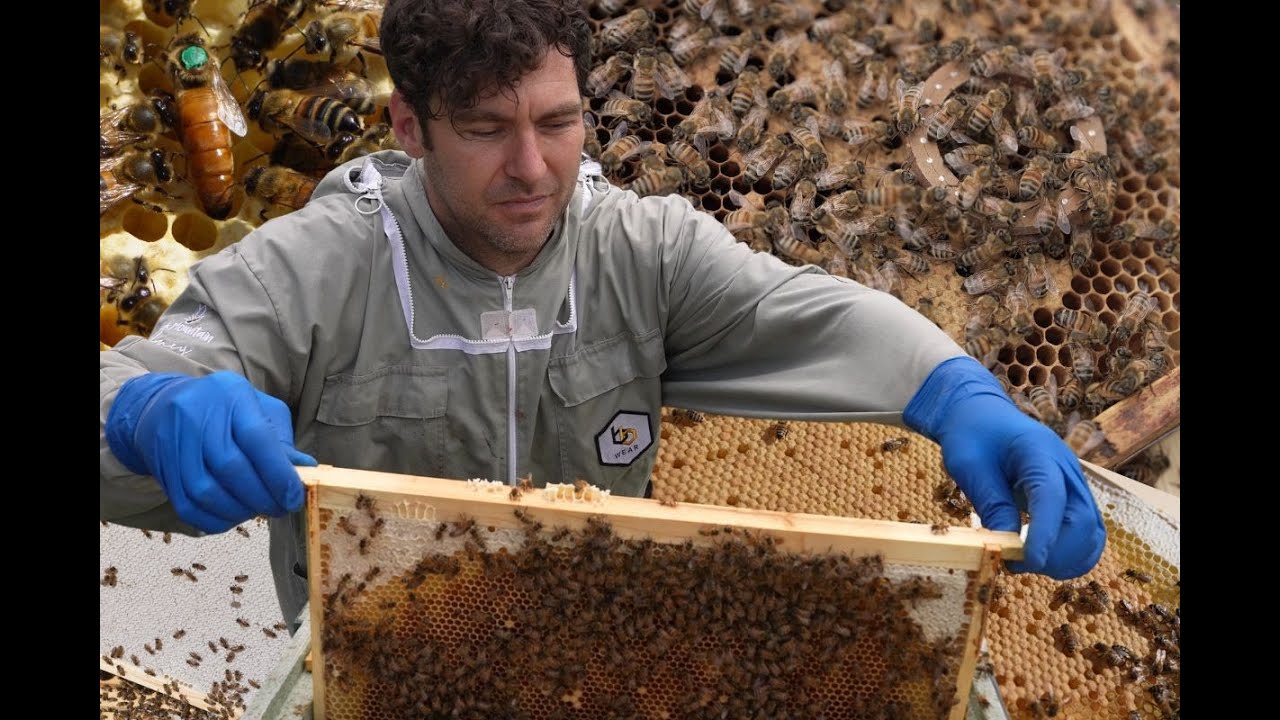
In this field walkthrough, Laurence Edwards inspects a thriving German Buckfast colony at Black Mountain Honey, explaining his annual breeder‑queen acquisition program and the management techniques that keep the colonies productive. He describes how overwintered, artificially inseminated queens are housed in nucs, the rapid colony expansion that forces the use of emergency extension boxes, and the process of moving colonies to full hives for overwintering. Edwards highlights the exceptional brood patterns, honey stores, and drone production of these Buckfast queens, noting their calm temperament and high honey‑gathering ability. He outlines his breeding strategy: selecting 2023 queens based on appearance, brood pattern, temperament, and honey output; rearing F1 daughters; flooding the apiary with pure Buckfast drones to improve queen quality; and planning multi‑year evaluations (2025‑2026) to determine which queens become long‑term breeders. Practical details such as wing clipping, queen marking, and swarm prevention are also covered.
Chapters
Today we're going to take a look inside a booming German Buckfast colony of bees. Every single year at Black Mountain Honey, we buy a number of potential breeder queens for the subsequent years. I keep a lot of breeder queens in my colonies. I run them as production colonies. I fill the air with top quality Buckfast drones. I take daughters from them. I test the daughters. and then we transfer some of them over down to Richard, some to be used as drone mothers, but some to be bred from as well. Every single one of our overwintered queens that we sell in our nucleus colonies is bred in the UK, and they are bred from these breeder queens. This is the reason that we buy them. But I thought I'd just do a video showing you a couple of them today because they are absolutely phenomenal. The growth from these German Buckfast queens is really, really good, and you can see today we've got a lovely flow going on. And I'm running out of space in these boxes. So I came across all of these nucs before. People who have been following this on the live inspections on the channel membership page, you will see how small these colonies started off. I had to come back in and fit some emergency extension boxes with 6 frames of foundation in them, and that was about a week ago. And I'm fully expecting to go in today and there not to be any space left. So what I'm going to have to do is make up some more nucs or move these colonies and transfer them over to full hives to get them into a position where they can overwinter. Really calm, really gentle, excellent at gathering honey. Let's get inside and take a look. So there is a wonderful flow on today. The bees are definitely working the clover. I'm just going into these now and I'm hoping I've not left it too late and that they've swarmed due to lack of space. But these are overwintered queens, so we had selected overwintered artificially inseminated queens and we put them in not that long ago. And just look at Look at some of these frames that are coming out here. Absolutely beautiful frames. But you can see we've got really good ring of stores all the way around there as well. And what I'm particularly impressed with, with these German Buckfast, is that they seem to rear like almost more brood than it seems that the colony can handle. Like you'll see here, we've just got frame after frame of fantastic brood. I'll just pull a few of them out just to show you kind of one by one. It's not like individual frames of brood and then the bees think, oh well, you know, there's enough brood there, we probably can't handle all of that. Take a look at that frame, really, really well-mated queens, only missing the cables but leaving a nice ring of stores all the way around as well. Now these Buckfast queens are Incredible honey gatherers. They were only fed once at the very beginning. That is a super, super heavy frame, and they have just taken it upon themselves again to go out and gather an incredible amount of honey. So I've been using this breeder for a number of years now, and I can't divulge the name unfortunately, but I'm really, really happy with them. And we do get a batch of like 20 or 30 breeder queens each year And I've already started taking some grafts from some of these ones here, and I've been very, very impressed with what I've seen so far. We will run them in production colonies in 2025, and then we will take a look and see what we can do with the breeder queens in 2026. But I always like to give them a year or so to see how they go. But what's great about these colonies here is that they've already come pre-selected, so I'm not just buying big batches of island-mated queens or artificially inseminated queens. These are 2023 queens that have been selected already just based upon the appearance, based upon the brood pattern, based upon the temperament, based upon the honey production capacity. I'm bringing them here now. I'm doing my own test. I'm rearing F1 daughters from these queens, and I will evaluate those next year to potentially use the breeder queen in 2026. That's right, it's a 2023 queen being used as a breeder queen in 2026, and As long as you've got sufficient breeder queens to do that, you can risk it. That's the 3rd year for the queen being alive, but once we get through this season here, all of these queens will just go into 6-frame nucs, and I will continually bleed off the bees, continually bleed off the brood, to ensure that I'm restricting the queen's laying as best as I possibly can, to make sure that I get her through to the next year. Right, let's have a look further down, see if the bees have been doing down here. More of the same downstairs, which is really good to see. Lots of emerging brood coming out on that one, which is nice. And there we go, that's what I wanted to show you there. A few drones, quite a lot of drones being built on that one there as well. So the colony has built up sufficiently in order to already start flooding the apiary here with the very best quality drones that I can get my hands on. And I do think that is the secret to rearing good quality queens, is just not one colony, not two colonies, not one apiary, but All of your apiaries, flood them with good quality pure drones. And I think just by doing that, you're ensuring that you're giving your bees, your virgins, the very best chance to go out and take advantage of this temperament of this nice calm-natured bee. It doesn't work with one frame of drone brood. It doesn't work doing it in a couple of colonies. You need to do it in all of your colonies, and you need to make sure that you're either using pure queen mothers, so if you want to call it an F0 mother, or an F1. The drones produced by a pure Buckfast breeder queen are identical to the drones produced by the F1 daughters of that queen. I know that seems a little bit crazy, but it's not. Every single F1 queen that you buy, you are getting pure Buckfast drones sent up into the air. Now, of course, they're going to have to battle with all of the local drones that are there as well, and you can only do what you can do. But I have found from my own personal experience and from Richard's experience By putting enough of them up in the air, you get superb success in rearing really nice, calm queens. So there's my queen. I'll get you a little close-up on her. She's number 42, and as you can see, she's marked orange, but it's kind of red as well, and that is the mark for a 2023 queen. You will notice as well I've clipped her wing. We don't want her going and flying off with a swarm. If this colony swarms, not the end of the world, as long as I can keep that queen, because she is the valuable asset here. She is what I'm going to need to be able to rear queens going into the future, both this year, next year, and into 2026.