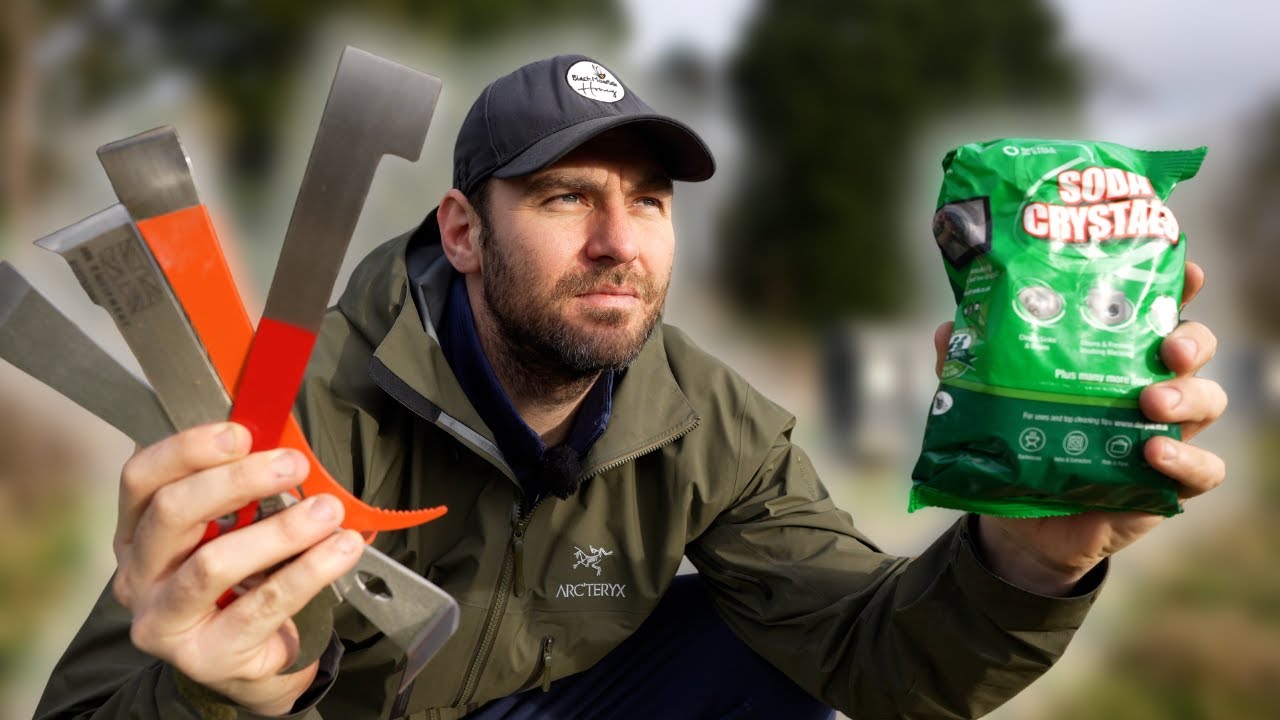
Laurence Edwards shows how to clean hive tools with a low-cost soda-crystal solution to stop diseases like European Foul Brood spreading between apiaries. Keep four tools per apiary in a bucket, rotating them so each tool soaks after every fourth inspection. Replace the solution every few weeks when it discolours.
Chapters
Today I'm going to show you how I mix up my soda solution to make sure that I'm not transferring diseases around whilst using my hive tools in the apiary. So this is a new system for me this year. I've always used soda crystals as a way of cleaning the hive tool. It's not disinfecting it, it's just cleaning it, trying to minimize that spread of EFB. But I'm bringing in a new system this year to try and mitigate the spread of disease as best as I possibly can. In this video, I'm going to show you exactly what I'm doing. So it starts off with a rectangular bucket. Much easier to do it in a rectangular bucket than it is a circular bucket. You can get these, these are old kind of Formic Pro or Max buckets, or you can just buy them as well, a couple of quid each. I've also got 4 separate hive tools, and as you can see, they're all a slightly different design. 4 different designs, get as many as you want, but it does make it a lot easier to have different design ones, as you'll see why later on in this video. And then the cleaning solution that I'm using, just standard soda crystals. I'm going to mix everything up together now and show you just how easy it is to try and keep your colonies as disease-free as you possibly can. Before we go into that, little changes to what I've done previously. So you know me, I used to have a retractable hive tool, one hive tool that I carried around with me all the time. I never lost it, but it probably wasn't the best in terms of disease spreading. I cleaned it as best as I could between each apiary, but looking back, it probably wasn't the best idea at all. So now what I'm doing, I've got a single bucket. In that bucket, I'm putting 4 hive tools, and then that bucket with those hive tools with the soda solution will only remain within that apiary. So for each apiary, I'm going to have 4 hive tools. That's the reason that I've got these 4 different hive tools here as well, because I want to be able to put one hive tool into the soda solution mix. All the other 3 are going to be sitting at the bottom of that mix, and in between each hive, I want to alternate through the system. So let's say that's number 1, that's number 2, that's number 3, and that's number 4. As I go through my hives, I'm going to go hive tool 1, hive tool 2, hive tool 3, hive tool 4, and then keep on going. Idea behind that is that each hive tool has as long as possible in between inspections to sit in my soda solution and to try and kind of clean it as best as it possibly can. If you just have one hive tool, then all you're going to do is like plonk it into the soda solution, give it a little swill around, and then put it straight back into the next hive. Probably not doing the best in terms of cleaning any remnants of wax or any honey off that hive tool. Whereas if you leave them in there, shaking them around a little bit, it's only every 4th hive that you're going to be using the same hive tool. And hopefully that's given me a little bit more kind of contact time with that soda solution just to try and clean the remnants off. It's not going to work, it's not like a bleach where it's going to completely sterilize the hive tools in between. You wouldn't want to be putting any bleach or anything like that into this solution if you're working with a food product, and it definitely wouldn't be safe. So don't recommend that. In terms of setting this up though, couldn't be simpler. All I'm going to do, take my hive tools, chuck them in the bucket, and take a packet of these soda crystals. My view is half is plenty to go in a bucket that size. Give it a little tap, open it up. Take your bucket, sprinkle in all that soda solution. If you've got a big block of it like this, just chuck it in, smash it up with the hive tools. You're then gonna pour some water in. You don't actually need that much water, you just want enough water in there to be able to submerge them. Put too much in and it weakens the solution. You're just gonna get your hand in like this, swill it around, break up all the bits. You can see those bits there, they just break up really easily. Give your hands a nice little wash, use gloves if you want. You can see it just kind of breaks up as soon as it gets wet, breaks up nicely. And you'll still get like bits like that at the bottom, but as soon as you start carrying that around, they're going to break up. And that's what you're looking for there, a nice milky white solution. Actually ice cold, my hands in here at the moment, but a nice milky white solution. Then you're just going to take your time going through, picking out a different hive tool at every single inspection. So there we go, simple as that. I'm gonna leave this in this apiary, probably get a few weeks out of it, as long as you don't get any bees in there. That will really put it off and start tainting the fluid. But there's no need to swill that out and change it kind of like every week. Get a good few weeks out of it. As soon as it starts going a bit of a weird color, you can change it out. All this is aiming to do is try and get your hive tools clean. You're not sterilizing it, otherwise you'd be doing it after every single colony. And what I've got there is 4 hive tools that will never leave this apiary. So if I ever do have a case of disease, I know that I've eliminated it by not transferring it through hive tools between apiaries. If you've got any beekeeping questions, hit the link below in the description. I'll answer it in one of my live streams.